
A Time Zone That Does Not Exist
The call center dislocates the worker
By night, Gurgaon glows.
Once little more than an agrarian settlement on Delhi’s fringe, Gurgaon—now officially Gurugram—was a place of tea stalls, tailors, and fields under Haryana’s sunny skies. Since the turn of the millennium, however, its skyline has erupted into a forest of glass towers and gated enclaves, gleaming monuments to global aspiration. Inside many of these towers, the lights never go off.
At midnight, Gurgaon’s international call centers hum with the energy of a place awake to someone else’s day. Young Indians, fresh out of college and speaking into headsets, answer billing queries from Seattle or reset passwords for clients in Sheffield. They do this in English that has been carefully neutralized: accent scrubbed, cultural references learned, regional inflections softened. They lunch at midnight, sleep through the sun, and live a life inverted. This is not night work in the traditional sense. It is labor performed in a temporal elsewhere.
This is the offshore.
But not the offshore of shipping containers or palm-fringed tax havens. This is a deeper dislocation: of time, of voice, of self. Gurgaon’s call centers expose the offshore not as geography, but as a condition. At its core lies a quiet, ongoing violence: the body forced into sync with foreign markets, the voice divorced from identity, the night reordered around someone else’s morning.

A ghostly sky hangs over the city as workers head to their night shifts. Photo by Slyronit (CC BY-SA 4.0).
In a country where most cities are repositories of deep history, Gurgaon is striking in its lack of one. Unlike Delhi, Varanasi, or Mumbai, it has no ancient temples, Mughal palaces, or colonial façades. It is less a city than a cluster of “functional nodes,” built not for walking or public life but for transaction. Its identity isn’t built on memory but on speculation, on what it might become.
Gurgaon’s rise was underwritten by deregulated special economic zones, private developers, and global capital seeking service infrastructures. Office towers were built in anticipation of contracts not yet signed, tenants not yet arrived. The city was financed into the future before it was socially consolidated in the present. Rents can rise with distant service agreements denominated in dollars and pounds, and a slowdown in American consumer demand can quietly thin the night shift in the Udyog Vihar industrial district. Value is projected elsewhere, realized here, and accounted for elsewhere again.
The agents who populate Gurgaon’s call centers rarely see this architecture of capital directly. They encounter it instead as targets, incentives, and performance dashboards that translate global expectations into nightly discipline. Sales that fail to count toward incentives, bonuses that fluctuate without explanation, evaluations conducted through opaque software systems: these are the everyday textures of financial abstraction. The offshore thrives on partial visibility: enough transparency to coordinate action, enough obscurity to diffuse responsibility.
At GoCom—a pseudonym for one call center—the cafeteria bustles at midnight. Steel trays clatter as agents queue for daal and rice. Downstairs in basement training rooms, new recruits rehearse accents, memorize laws, and study maps of states they will never see. Upstairs on the “floor”—the sacred space of live calls—they speak to customers they will never meet in cities they may never visit.
Most employees are migrants—from Kerala, Bihar, Bengal, Uttar Pradesh—drawn by the promise of English-language jobs and modern anonymity. They live in shared apartments, their social rhythms frayed by night shifts. One worker described himself as a “walking ghost,” visible to no one, moving through the city while it sleeps.
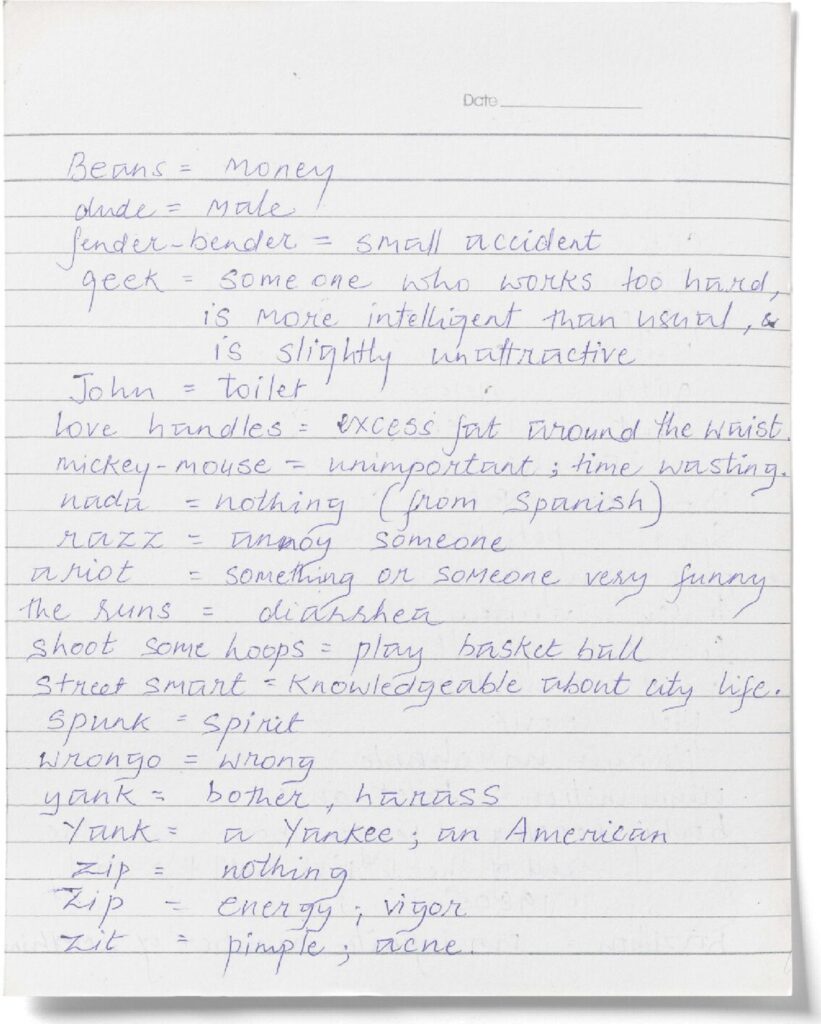
Training the voice, syllable by syllable. Photo by A. Aneesh.
While workflows move smoothly between continents, the human body does not. Delta sleep is interrupted. Digestion is inverted. Circadian rhythms are thrown into disarray. This is not just fatigue. It is bioshock, an internal offshore. The body itself becomes a contested site, caught between local biology and global demand.
Jet lag presumes eventual return; this condition does not. Eight hours remain eight hours, yet their placement fractures social life. Breakfast becomes dinner. Weddings are missed. Conversations with friends are postponed because one or the other is asleep. This conflict is not over the length of the workday but over its position in the cycle of light and dark.
Strikingly, there is no shared vocabulary for this strain. Fatigue is individualized; irritability privatized. One agent becomes a ghost, another postpones marriage, another recalculates incentives that never quite align with expectation. These are not dramatic protests but quiet recalibrations. The system functions precisely because the dissonance remains dispersed: economic gain here, social thinning there, biological disruption elsewhere, never converging into a single political claim. The offshore reorganizes not only labor but the grammar through which grievance can be spoken.
The offshore is also a reconfiguration of voice. In training rooms, young Indians learn to speak English in what is called a “neutral accent.” Neither British nor American, the accent does more than smooth pronunciation; it engineers a communicative zone stripped of locality and engineered to reduce friction. The voice becomes software: installed, debugged, upgraded.
Yet the erasure is never complete. The neutral accent still carries traces—of Hindi, Malayalam, Bhojpuri. However fluid the intonation, the voice on the other end senses something askew. The customer knows the agent is not from Kansas. And the agent knows that the customer knows. This double awareness—the performance of fluency under suspicion—is the emotional architecture of the offshore call.
It does not stop at accent. Agents adopt pseudonyms—Jessica, Mark, Ashley—names that fit seamlessly into American expectations. And agents simulate empathy: “I’m sorry to hear that, Mr. Anderson.” It is a script, not a sentiment. The agent knows it. The customer can only hope it is real.

An office building awake to someone else’s day. Photograph by Parna Gohil on Pexels.
But the call is structured by databases, scripts, and pacing software. Agents speak to profiles as much as to persons. Customer histories, compliance categories, and credit scores circulate more fluidly than bodies ever could. And there is authority embedded in this infrastructure: in metrics, algorithms, and contractual obligations stretching across jurisdictions. Accountability, when something goes wrong, follows the same diffuse path. The offshore is not lawless; it is plurally regulated.
What happens when your name, your voice, your sleep—even your mealtimes—are governed by a foreign jurisdiction?
Mukul moved from Kerala not only for work but to escape family pressure to marry. The anonymity of night gave him space. In return, it took structure, companionship, belonging. His girlfriend moved away. His job, though well-paying by local standards, offered little recognition. He was alone in a city built for someone else. Absent during the day, hidden at night behind pseudonyms and scripts. Present only through a headset, a voice without a body.
This story is not unique to Gurgaon. It is part of a broader condition: the global disarticulation of labor from geography. Once, “offshoring” meant relocating factories. Now it also means crossing hemispheres in time while remaining in place.
Gurgaon is the offshore’s ideal vessel: no historical anchors, only glass towers, fiber-optic cables, and air-conditioned control rooms. A city built for elsewhere. Labor becomes abstracted from place, body, self. The voice that answers your complaint floats in the circuitry of global capital, spoken by someone trained to disappear.
What might resistance look like?
Not necessarily strikes. This offshore is too diffuse. Perhaps smaller recalibrations: recognizing night work as a health issue and regulating it. Restoring some balance between economic labor and bodily time. Questioning the tyranny of neutrality.
This is not a call to halt globalization. It is a call to notice its incoherences, its demand for connection that fragments the human. The call center does not fail because it doesn’t work. It fails because it works too well, smoothing over cultural distance at the cost of those who live it.
“If Gurgaon’s skyline was financed through the promise of cheaper voice, what happens when voice no longer needs a local body?”
Already, however, the system is shifting. The voice from elsewhere will soon be synthetic, calibrated in data centers rather than in training rooms, as artificial intelligence stands ready to answer midnight calls. Machines are neither diurnal nor nocturnal. They do not tire. They do not resent. They simulate empathy with mathematical precision. AI requires no circadian adjustment, and no pseudonyms. The temporal dislocation remains, but the organism experiencing it disappears. AI does not simply replace the agent; it radicalizes the offshore condition.
If Gurgaon’s skyline was financed through the promise of cheaper voice, what happens when voice no longer needs a local body? The offshore has already aligned Indian nights with Western days. It may soon align data centers directly with consumers, bypassing the headset entirely.
The towers may continue to reflect the sun. But the labor that animated them may quietly recede. The offshore will not collapse; it will become more seamless. And in that transformation lies a final disquiet: a system perfected by removing human labor from its most fragile hinge—time.
And what, then, becomes of Gurgaon?
The city built as a relay node in global communication may still stand, but the voices may fall silent. The young men and women who once spoke from someone else’s day may return to their own. The offshore may become seamless. And in that perfection, perhaps, nonhuman.
Until then, Gurgaon glows. ◆