
How’s My Feedback?
When you deposit frozen fish in someone’s safe deposit box
Search for almost anything—books, hotels, teachers, haircuts, dates, doctors, prisons, dishwashers, Italian restaurants, real estate brokers, accountants, sex workers, dentists, board games, or illegal drugs—and there is a platform ready to rate and review it. These feedback systems are widely hailed as engines of transparency and solutions to a range of public problems. They are said to make hidden qualities visible, to hold providers to account, and to broaden participation.
In practice, things rarely work so smoothly.
Platforms such as TripAdvisor, RateMyProfessors, and ReviewCentre have long been plagued by contradictions that undermine their promises. Amazon placed user reviews at the heart of its business model not just because they helped customers, but also because they generated the vast amounts of unique content crucial for search engine rankings. Meanwhile, small businesses, from hotels to cafés, have complained about fake, retaliatory, and misleading reviews posted by disgruntled customers and competitors.
On these platforms, judgment is amplified, circulated, and archived—ironically, with little recourse when something goes wrong. Fake reviews are difficult, often impossible, to challenge. Most complaints are handled by automated systems. And reviews frequently create a lot more work for those affected, who must publicly respond and manage feedback, regardless of its accuracy or intent.
Studying these platforms in the early 2010s, our UK-based research team thought it had a wonderful idea: What if we built a website called How’s My Feedback? that allowed users to rate and review the rating and review websites? Could we build a platform that would submit these systems to the very logic they had imposed on others?
✳ ✳ ✳
Parody, scholars tell us, is a powerful debunking tool. At its simplest, parody places a secondary text alongside the original and repeats it with a twist.1 (The word derives from the Greek para [alongside of] and ode [song].) By mimicking something, with slight but telling variations, parody exposes the original’s defining features and undermines its authority. This dissonance is what makes a Saturday Night Live skit lampooning a US president so effective. Through exaggerated reenactment, we recognize the absurdity and flaws of the original. Or as literary scholar Linda Hutcheon puts it, parody is “repetition with ironic critical distance, marking difference rather than similarity.”2
Historically, this strategy of ironic distancing has been the province of artists, activists, and cultural theorists. In 1950s France, for instance, groups like the Letterist International and the Situationist International rerouted and hijacked cultural forms for subversive political pranks under the label détournement. Similar tactics surfaced in 1970s punk movements and, again, among 1980s culture jammers such as the Cacophony Society, the Billboard Liberation Front, and Adbusters.
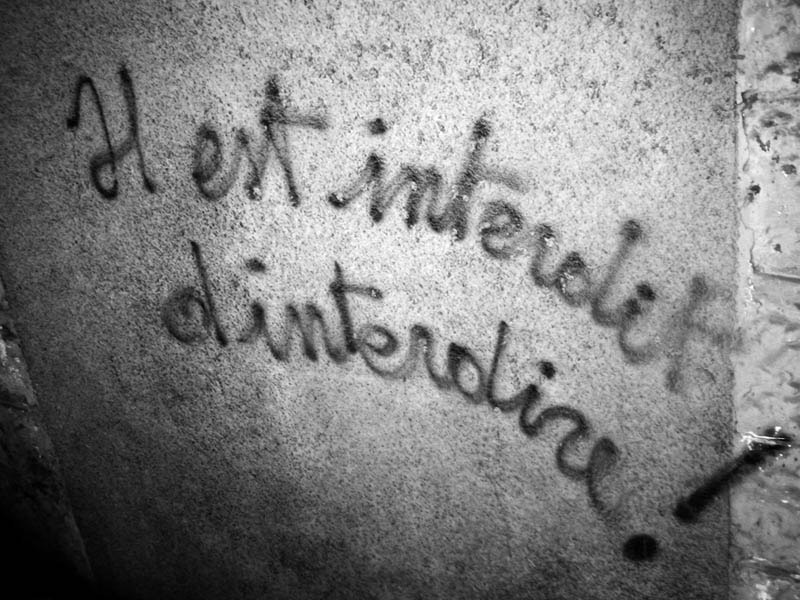
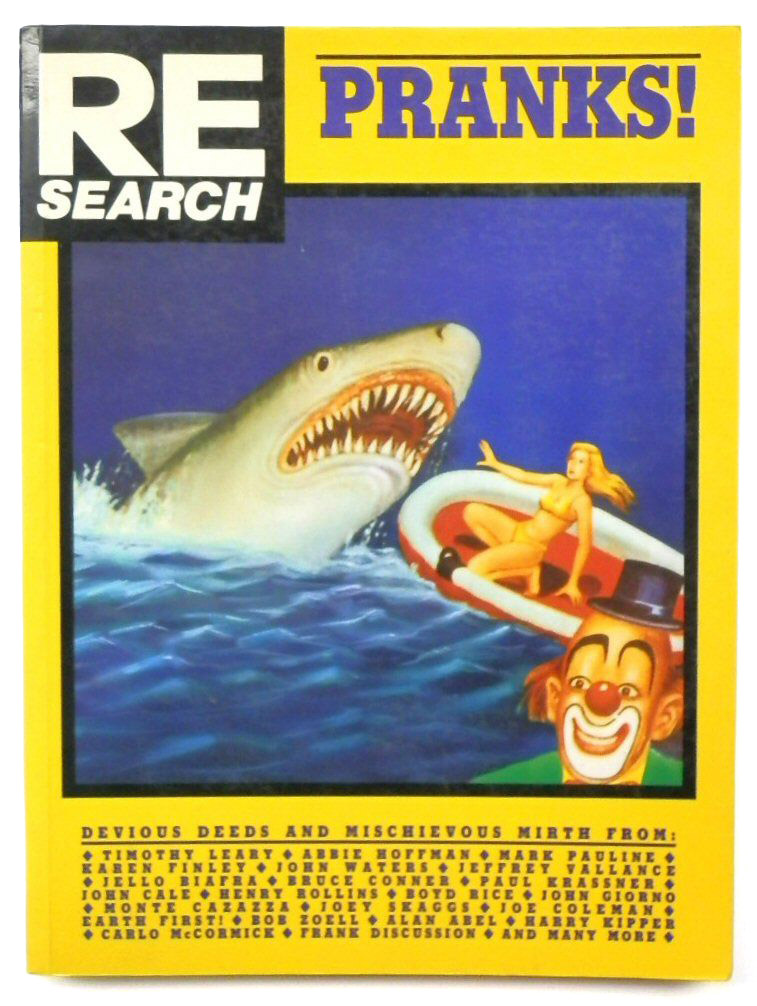

A common technique employed by groups like these was to manipulate a well-known image—subtly distorted corporate logos, or modified official symbols like the American flag. Other interventions had the quality of practical jokes, such as depositing frozen fish in a bank’s safe deposit box, knowing that the bank was legally prohibited from opening it. Another system undone by its own rules.3
✳ ✳ ✳
When it was time to build How’s My Feedback?, we sometimes wished we’d opted to leave fish in someone’s safe deposit box instead. The project proved to be a serious piece of work. We began by organizing two workshops in London, gathering a group of people who were professionally involved with online review platforms. The group included, among others, community and product managers from well-known review companies, a digital rights activist, one of the top ten amateur reviewers on Amazon.co.uk, academics specializing in technology and privacy, a search marketing consultant, and representatives of a consumer watchdog organization.
The discussions were revealing, though not quite in the way we had anticipated. Instead of being challenged by our colleagues from the industry, the process was surprisingly harmonious. Together with our co-designers, we talked about legal safeguards, audience segmentation, privacy protections, and database architecture. We filled flipcharts with Post-it notes and built wireframes on whiteboards. We found a set of templates we could adapt for our site design and reserved a domain name.
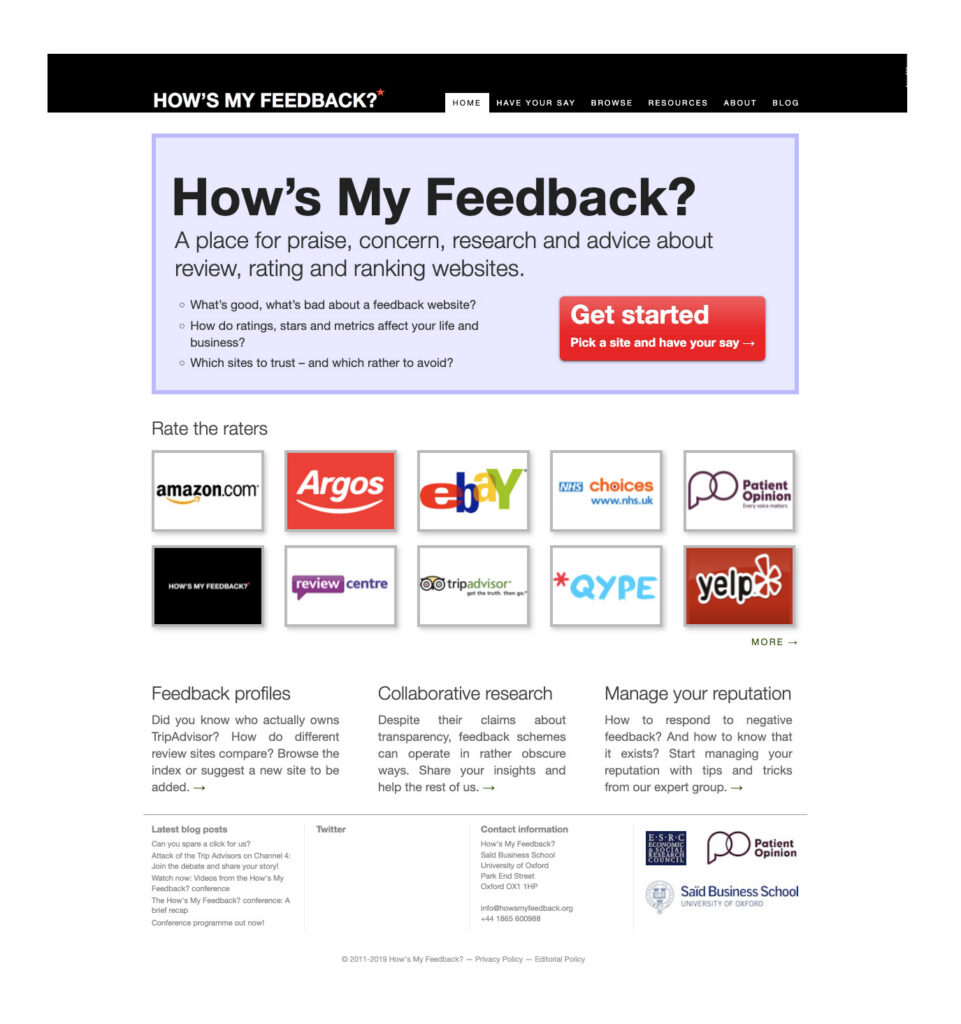
Eventually, we ended up with a website that was strikingly conventional: a review form with a text box, one to five stars for ratings, and a field for contact information; a directory of platforms and a way to browse the reviews; and—our modest innovation—a resource section where users could learn about consumer protection and the workings of the online rating and review industry.4 Branded as “a place for praise, concern, research and advice about review, rating and ranking websites,” the home page featured a black-and-white banner reading How’s My Feedback? marked by a prominent red asterisk that—we thought—would perfectly convey the project’s half-serious tone. Underneath a list of questions:
• What’s good, what’s bad about a feedback website?
• How do ratings, stars and metrics affect your life and business?
• Which sites to trust—and which rather to avoid?
Next, a big-buttoned call to action asked visitors to “Get Started: Pick a site and have your say,” followed by the clickable logos of all the platforms we had added to the roster, including Amazon, eBay, TripAdvisor, Yelp, and many more (“Rate the raters!”).
Only one thing was missing: the reviews.

✳ ✳ ✳
In the weeks that followed, the line between parody and platform turned out to be quite blurry. Maybe a bit too true to the original, our platform replicated many of the features we had set out to challenge.
For one, it turned out that people did not necessarily want to be empowered. Feedback platforms routinely struggle to persuade their users to contribute in the first place, which is why most online purchases result in emails asking us to review both the seller and the product; it’s why podcast hosts routinely plead with listeners to rate, subscribe, and “smash that like button”; and it’s why restaurants offer free dessert in exchange for an online review. Without such prompting, platforms are left with empty pages and lonely invitations to “be the first to rate this business.”
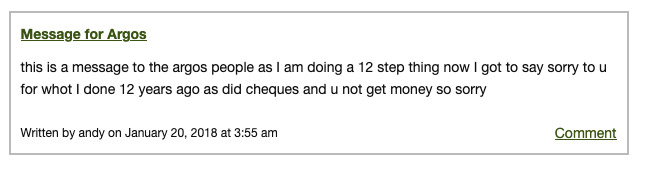
Even when How’s My Feedback? gained some traction, appearing occasionally in search results for terms like “concern with amazon review,” the submissions raised more questions than they answered. At times, the irony seemed completely lost on people. Reviews for the British retailer Argos, for example, showed a range of sentiments from casual complaints about ordering “3 sets of tea cups and saucers and the next day 2 sets were delivered (not 3)” to dutiful reports that someone had needed to “ring tech guys at argos and spoke to Simon,” who turned out to be “wonderful.” A user by the name of “andy” even took the opportunity to offer a heartfelt apology for a previously bounced check:
Other contributions posed more difficult questions. If one reviewer described a platform’s practices as “filthy” and another kindly offered his perspective that a certain review system “s*cks,” should those be seen as valuable contributions, or as unwanted exposure under England’s notoriously draconian defamation laws? At the opposite extreme, some praise was so effusive that we suspected it may have been written by one of our workshop participants—perhaps sincerely, perhaps in jest.
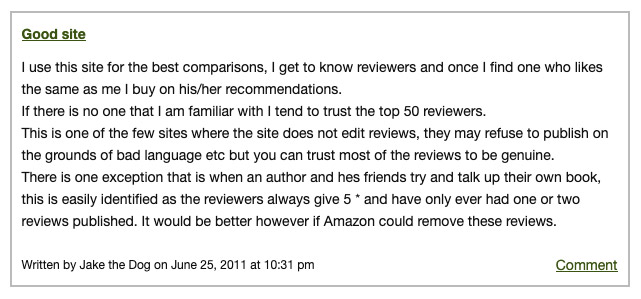
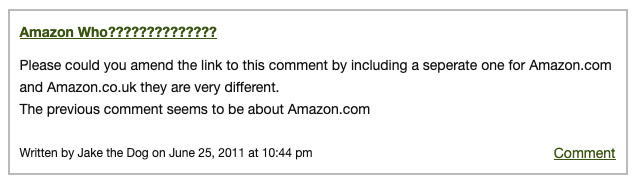
At times, the irony was lost on users of the website. SCREENSHOTS HOWSMYFEEDBACK.ORG, © 2011-2019 HOW’S MY FEEDBACK?
✳ ✳ ✳
So what, if anything, did our platform parody accomplish?
By conventional standards, How’s My Feedback? was a miserable failure. Submissions were sparse, the platforms we targeted largely ignored it, and public conversation about the corrosive dynamics of these systems remained sporadic. Over time, maintenance became burdensome: plug-ins expired, links broke, text went out of date.
And yet, it could be argued that the project had still hit a nerve.
If parody works by imitation ad absurdum, then our efforts to reveal the platform’s structure and significance had done exactly that. There was in fact a lot of structure, but only little meaning and significance. In becoming indistinguishable from the empty form it sought to challenge, How’s My Feedback? exposed—somewhat paradoxically—the emptiness of the original text.
This vanishing act taught us an important lesson. Good parodies show platforms as they really are: boring, dull, and formulaic, yet still immensely powerful. ✳
- Michael Mulkay, The Word and the World: Explorations in the Form of Sociological Analysis (Allen & Unwin, 1985), 238, https://doi.org/10.4324/9781032714028. ↩︎
- Linda Hutcheon, A Theory of Parody: The Teachings of Twentieth-Century Art Forms (1985; Routledge, 1991), xii. ↩︎
- V. Vale, ed., Pranks! (RE/Search, 2010), 60. ↩︎
- See the How’s My Feedback? website, https://howsmyfeedback.org. ↩︎