
Próspera’s Stack
Choose your own regulation
Próspera is not a location. Próspera is a platform that delivers governance-as-a-service in partnership with host governments that create a legal framework that allows public-private partnerships to emerge.
— Próspera CEO Erick Brimen, in a 2023 interview with Reason
magazine.1
In 2017, Venezuelan businessman Erick Brimen and Guatemalan tech entrepreneur Gabriel Delgado Ayau signed an investor agreement with the Honduran government to launch Próspera, Honduras’s first Zone for Employment and Economic Development (ZEDE). The Honduran congress had legalized ZEDEs just four years earlier. Such zones serve as jurisdictional enclaves offering incentives to attract foreign investors—low or no taxes and tariffs, and relaxed business and labor regulations. Controversially, ZEDEs are also semi-autonomous, with the authority to create their own laws and regulations, government institutions, tax systems, public services, schools, courts, and police.
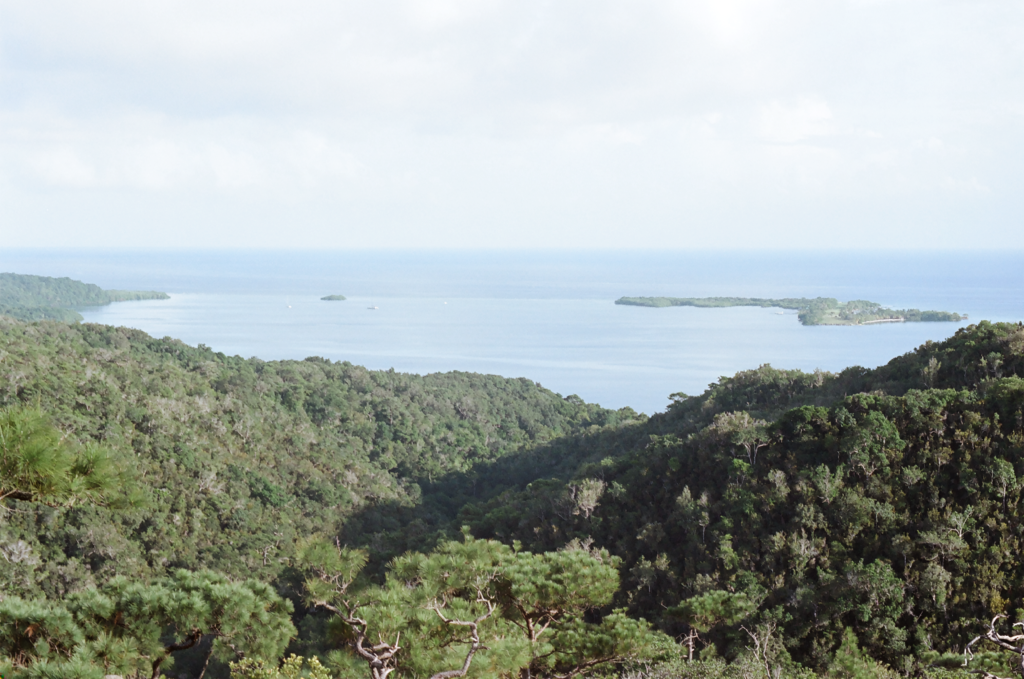
In founding the first ZEDE, Brimen and Delgago Ayau aimed to develop a regional hub for fintech and biotech in Central America and the Caribbean. In 2019, they purchased fifty-two acres of jungle on the Caribbean island of Roatán. One year later, they purchased the nearby Pristine Bay property, a four-hundred-acre golf resort community that had fallen into disrepair. To date, they have renovated sections of Pristine Bay and, on the jungle property a mile away, completed construction on Duna Tower (a fourteen-story condominium building), the Beta Building (which serves as a multi-purpose office), and Circular Factory (a robotic micro-factory that builds modular structures out of locally sourced timber). Próspera’s master plan also includes the construction of new residential and commercial districts, however, these projects are contingent upon investment.

Próspera’s government is designed as a hybrid system for both physical and e-residents. E-residency is a type of government-issued digital identity first piloted in Estonia in 2014. It is currently offered by a handful of countries and jurisdictions worldwide, and it allows foreign entrepreneurs to incorporate and manage companies online without establishing physical residency. For a subscription fee, the e-resident is provided access to a country’s e-governance services and business environment.
As of 2026, Próspera has 2,262 e-residents from 40 countries and 478 companies. These companies include fintech and biotech start-ups, remote staffing firms, medical clinics, a Bitcoin education center, and a scuba shop. Próspera also has approximately one hundred physical residents—from Honduras, the US, Europe, Australia, and other Latin American countries—who live full-time or part-time in Pristine Bay or Duna Tower.

Próspera exists within an ecosystem of offshore jurisdictions across Latin America and the Caribbean. Mexico and Honduras adopted policies geared toward export-oriented industrialization in the 1980 and 1990s, offering a host of incentives for North American companies to establish maquilas, duty-free factories where manufacturers can offshore the production of textiles, automotive parts, electronics, and other components. Meanwhile in the Caribbean, Bermuda, the British Virgin Islands, and the Cayman Islands have provided low-tax or no-tax environments since the 1960s for clients to offshore their banking and assets.
Neither a manufacturing hub nor an offshore financial center, Próspera is a new type of offshore jurisdiction. Designed to provide flexibility to companies in emergent industries, it is a regulatory haven for entrepreneurs searching for an alternative to the regulatory and tax environments in the US and Europe. Próspera even grants companies the privilege of choosing which regulations they want to be subject to, and the option to design and propose their own regulations. For instance, the biotech company Minicircle proposed the “Próspera Medical Innovation and Safety Regulation,” which was approved by the Próspera Council in 2023. 2Customized for Minicircle’s gene therapy clinic that operates out of Próspera, the regulation reduces liability for medical providers and elevates patient choice—that is, the right to assess risk for oneself.
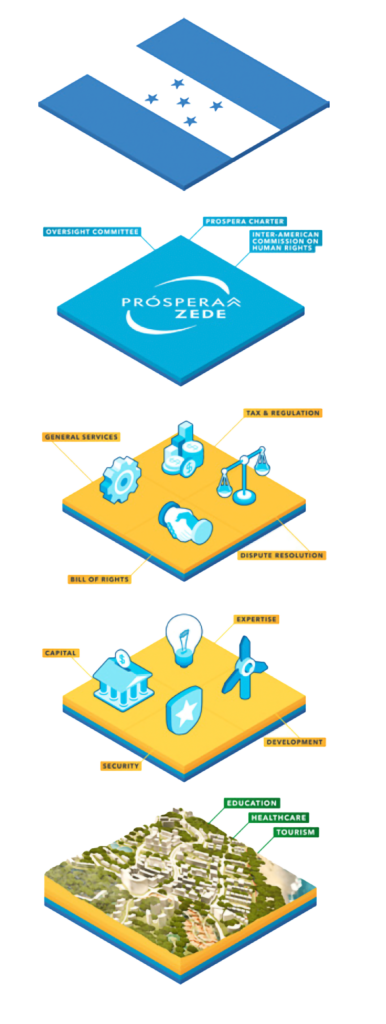
Próspera provides services to its e-residents and companies via an e-governance platform. In promotional materials like the image shown to the right, Próspera illustrates its governance as comprising five stacked layers. The foundation is the Honduran state; as the legal base layer to the e-governance platform, all the layers above it are subject to Honduran constitutional and criminal law. The second layer is the ZEDE, which sits atop the Honduran state as a legal subdivision; ZEDEs have the authority to create their own unique laws that the layers above it are subject to, but the layer below, meaning the rest of Honduras, is not. The third layer is the zone operator company, Próspera itself, which is the city developer and the provider of legal and governmental services within the ZEDE. The firms that the zone operator contracts to provide public services, such as security, schools, and infrastructure, are the fourth layer. The fifth and final layer is a LEGO-style city in the jungle—businesses and residents subject to Honduran, ZEDE, and Próspera law.
Law and governance are complex and unwieldy processes whose functions are difficult to distill into words, let alone images. In this attempt to visualize how Próspera is embedded within the Honduran state, which bodies of law it is subject to, and how government services are rendered, the company presents a seemingly clear-cut image. However, this graphic provides a number of additional insights into how Próspera frames itself and its platform to potential e-residents, companies, investors, and host nations.
First, the city is a rendering of law and governance as technology. Próspera has grafted onto governance the concept of “software stacks”—a tech industry term for the architecture of operating systems. Próspera’s e-governance platform is designed to automate compliance and streamline bureaucratic processes. The goal is to use technology to cut red tape and expedite the approval processes for commercial activities, such as starting a business or obtaining a construction permit. Law in Próspera is not an immutable sacred text issued by a sovereign state, but rather a malleable tool. Próspera’s proposal is: What if laws, regulations, and procedures could be constantly tweaked and updated based on user feedback, rather than slowly and painfully reformed through plodding democratic processes?

The second insight is that Próspera is a start-up government that follows the start-up ethos. From “governance-as-a-service” to “legal innovation” to “disruption of legacy systems,” many Silicon Valley proverbs and frameworks shape the design of its governance model. However, this is easier in theory than in practice. A start-up government faces unique challenges stemming from its dual status as both a public service provider and a for-profit venture. Start-ups must be nimble and responsive to the market. They are also financially unstable, they struggle to scale, and they are quick to fold. While entrepreneurs like to “move fast and break things,” governments tend to avoid this approach; their purpose is to hold everything together. The start-up mentality assumes a certain level of failure, and even normalizes it. However, when developing a politically experimental city on an island surrounded by a protected coral reef in one of the poorest countries in Latin America, the stakes are high. A project like Próspera may be legally circumscribed, but it presents unforetold risks that cannot be spatially or economically contained, spilling over to the rest of the island and country.
The third insight is that Próspera situates itself within Honduras geographically, while operating outside it legally. This arrangement allows Próspera to benefit from Honduras’s climate, culture, labor force, infrastructure, resources, and coastal access, while distancing itself from Honduras’s institutional problems and political crises. Yet despite its best efforts to escape the confines and dysfunctions of the state, Próspera is deeply mired in national and local politics, ethical controversies, land struggles, and environmental conflicts.
From the political right, Próspera faces opposition from the business community and the oligopolies that control the vast majority of Honduran manufacturing, telecommunications, energy, and banking. From the political left, Próspera must contend with the shadow of US corporate colonialism and interventionism, as well as the association of ZEDEs with a corrupt former president who was extradited to the US on drug trafficking charges in 2022. Critics from the left draw similarities between Próspera and the multinational fruit companies that established banana enclaves in Honduras at the beginning of the twentieth century. These companies soon became the most powerful forces in the country, controlling the majority of agriculturally productive land, and installing (or deinstalling) Honduran presidents.
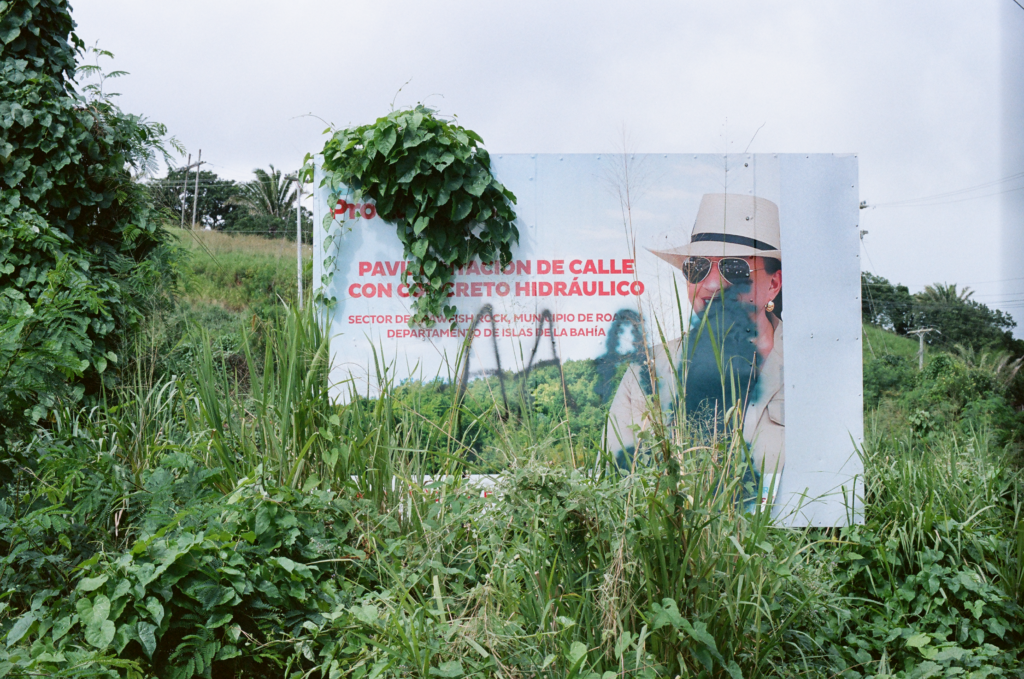
In 2022, a socialist president was elected who waged a campaign to dismantle the ZEDEs, which she argued violated Honduran sovereignty. In response, Próspera sued the Honduran state for violating international investment agreements, and it commenced a sweeping public relations campaign to promote and defend itself against its many political opponents and much negative press. Subsequently, ZEDEs entered a state of political limbo, which was further complicated by the international investment arbitration. Behind the façade of a golf resort, Próspera is now a political operation, with lobbying arms in Honduras and the US. Ultimately, the most costly and labor-intensive part of launching Próspera has been campaigning states, municipalities, local communities, and the media in an attempt to gain public support, acceptance, or at minimum tolerance for the project.
Overlaid atop Honduras, Próspera strives to be its own operative layer, self-governing and semi-autonomous. Its e-governance platform presents a political configuration of law, jurisdiction, and institutions that require no fixed place, people, or territory. Instead, they can be designed as virtual, mobile, adaptable, and scalable technologies. But while Próspera markets the e-governance platform as its primary product and innovation, its financial viability will hinge upon real estate development and the physical sale of land.

Próspera aims to develop a city for as many as a hundred thousand physical residents. But to become a city, Próspera must first build one, which requires land, water, sand, and soil—not to mention workers to build, staff, and maintain it. The project also requires local buy-in. Already, tensions have emerged over new construction, shared infrastructure, and common-pool resources. Próspera has sparred with the municipality over road maintenance, reliance on the municipal landfill, and the height of Duna Tower, which violates zoning regulations that Próspera does not have to follow. Próspera has also clashed with the neighboring village of Crawfish Rock over access to groundwater. Presently, the e-governance platform lacks a function for dispute resolution with local and government stakeholders, so, for now, Próspera must navigate these conflicts itself.
Próspera may lie dormant as a golf resort until the political winds again blow in its favor. If and when they do, Próspera will build swiftly—horizontally and vertically. It will also seek to forge new alliances with Honduran government officials and business elites to help Próspera weather instability in the future. Paradoxically, as a governance platform designed to float atop a nation-state base layer, the only way Próspera can insulate itself from political instability is to more deeply entrench itself in local and national politics. It turns out that all governments are socially embedded, even private ones. ◆
- Zach Weissmueller, “A Private Libertarian City in Honduras,” Reason, July 6, 2023, https://reason.com/video/2023/07/06/a-private-libertarian-city-in-honduras/. ↩︎
- “Próspera Medical Innovation and Safety Regulation,” Codification 3-2-219-0-0-0-1, “Regulatory Principles,” Section 4 (2023). ↩︎