
The Birth of the Offshore
Avoiding double taxation in 19th-century Southern Africa
Between 1902 and 1906, De Beers Consolidated Mines and the United Kingdom’s Commissioners of Inland Revenue were embroiled in a legal dispute over how to tax income from the De Beers diamond mining operations in Southern Africa. The case was initiated with a motion alleging that, for tax purposes, De Beers was a UK resident. The company’s practice up to that date had been to pay tax only on dividends distributed to shareholders in the UK; no income tax had ever been paid by Africa-based shareholders in the Cape Colony. The company had been registered in the colony in 1888, with its head offices there in the town of Kimberley, from which it managed its operations. While De Beers resold its diamonds in London through a syndicate established by Cecil Rhodes, it argued that, as a colonial company, “it did not exercise any trade with the United Kingdom.” 1So, was De Beers a UK resident for tax purposes?
In its judgment, the House of Lords ruled that “real control” of the company’s strategy was exercised from London. Henceforth, De Beers would be subject to tax in England on all of its worldwide income. Therefore, the court ruling ended the Cape Colony’s status as an effective tax haven.
The De Beers ruling applied to the entire British Empire, and it was soon exploited by Bermuda, the Bahamas, and later the Cayman Islands and the British Virgin Islands. The ruling gave legal force to a notion of corporate residence dislocated from the place of income-generating activity much earlier than commonly acknowledged.
“… the financial empire was the direct result of the colonial experience.”
To appreciate the international implications of the De Beers judgment for the development of modern tax havens and offshore financial centers, we must first situate it within the ambitions of late nineteenth-century imperial expansion in colonial Southern Africa. The De Beers case was not the first instance in which the question of international taxation of overseas trade went before the British Exchequer. At that time, income tax was still a recent introduction in British law, with the first nationwide act having been passed in 1853, but by 1876 there had already been at least two other disputes regarding where overseas companies should be taxed.
The English Income Tax Act had a provision that any person “residing in the United Kingdom must pay on his annual profits securing to him from whatever kind of property, whether situated in the United Kingdom or elsewhere.” Emphasis here on profits situated elsewhere. Calcutta Jute Mills and Cesana Sulphur Mines were both registered in England, but with their operations and income-generating activities located in India and Italy, respectively. The judgments in the cases brought against both of these companies solidified what could be regarded as the “source” principle in British law, affirming that “the great principle of the law of England in relation to taxation is that taxation shall only be imposed upon persons or things actually in this country.”2 What sets the De Beers ruling apart is that, in making the company subject to British taxation, it subverted this notion of source entirely.
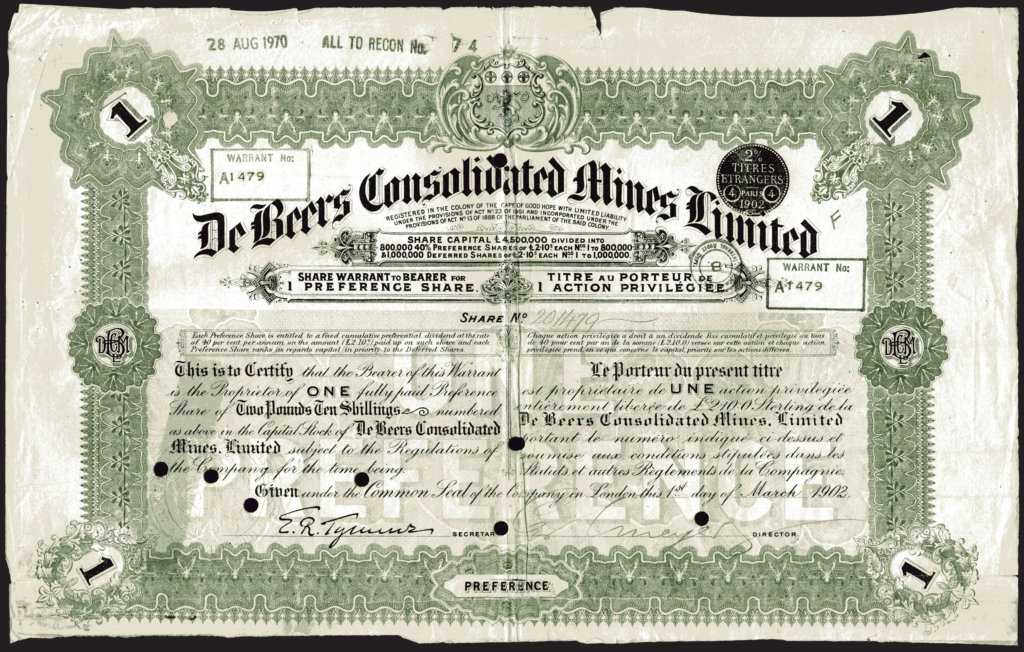
The De Beers decision was seminal because it unsettled the idea of corporate residence based on a company’s place of registration or incorporation, and, in doing so, it exposed De Beers to double taxation. Double taxation arises when two or more states have claims to impose tax on the income or capital of the same taxpayer. The result is a contest revolving around two conflicting concepts: residence versus source. This debate is premised on Hobbesian arguments that the state has an absolute right to tax people in its jurisdiction or territory, and that the taxpayer is an object of regulation “to be fought over where two sovereigns happen to collide.” 3Thus, the one state makes a claim to tax an individual or company on their worldwide income because the taxpayer is a resident of that state. The other state asserts its taxing rights by virtue of income or capital being generated within its borders, irrespective of where that taxpayer resides. Today, international treaties and conventions provide relief from double taxation, but before these concepts had achieved their contemporary legal clarity, there was uncertainty regarding how the proceeds of imperial overseas trade should be taxed.
The motion to tax De Beers in the UK on its South African Income was first heard by the Income Tax Commissioners’ special court in London in 1902, after the conclusion of the Anglo-Boer South African War. After finding in favor of the Commissioners of Inland Revenue, De Beers would lodge three appeals, each unsuccessful, in the King’s Bench Division of the High Court of Justice, in the Court of Appeal, and, finally, in the House of Lords Privy Council. In 1906, the House of Lords confirmed that De Beers must pay tax in the UK on its worldwide income. De Beers was ordered to pay £603,045 for the six preceding tax years.
Yet, a corporation, the court said, referring to case law precedent, is a legal person whose only residence is “the place of its incorporation.” 4The legal precedent, still true today, held that a company can only have one residence. Therefore, a foreign company could have “no legal existence in this country” with reference to Britain. Under these terms, De Beers was a legal person only in South Africa: its seat of control, as fixed by its articles of incorporation, was Kimberley, and the company’s business was conducted there.

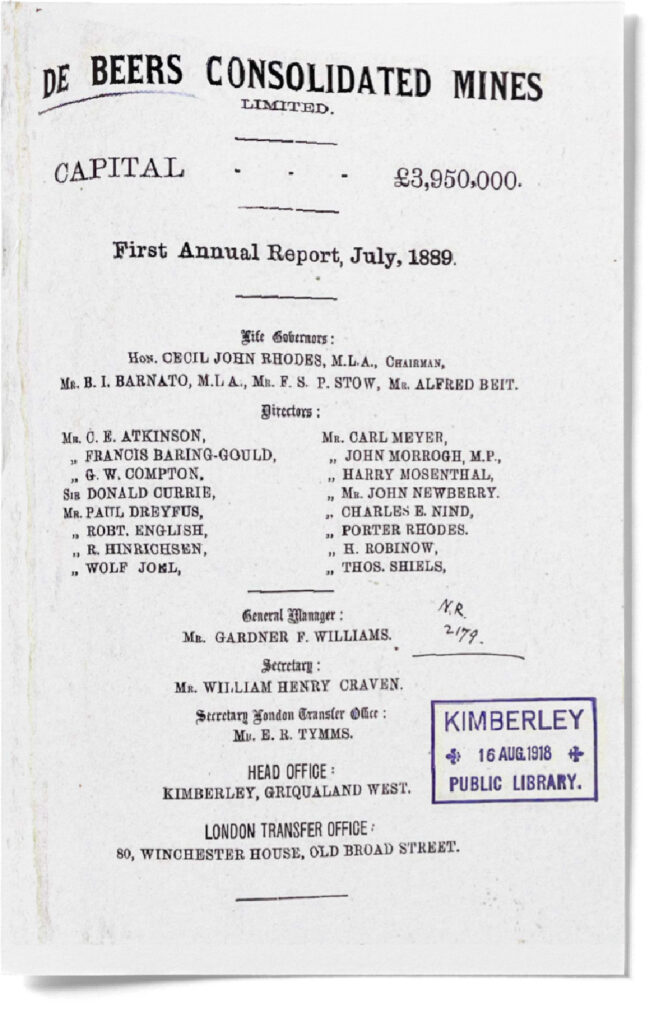
Indeed, as a life governor of De Beers and chair of its board of directors, Cecil Rhodes was based in South Africa. He would subsequently assume the role of head of the Cape Colony government, and would expand imperial control in Central and Southern Africa using the wealth from his mining ventures. Moreover, not only was the company’s business as a mining operation conducted in South Africa, but all general meetings of shareholders were held there, and all shareholders were required to have a registered address in South Africa if they wished to receive notice of these meetings.


How, then, did the House of Lords rule that De Beers would be subject to tax in the UK? The legal validity of the court’s rationale was upheld partly because a London bank, N.M. Rothschild and Sons, had financed De Beers’ acquisition of its rival diamond mining companies. The consolidation of De Beers was the result of a fight for control over the diamond fields in Kimberley dating back to the 1880s, and international backing from London to buy up competing claims had been instrumental in Rhodes’s decisive victory. As a result, as of 1899, Lord Nathan Mayer Rothschild’s stake in De Beers was twice that of Rhodes, and the Rothschilds were the majority shareholders in the consolidated company. Moreover, as part of their financing terms, the Rothschilds had the ability to appoint London-based directors. As such, the controlling interest of the company in the court’s eyes was in London. “It is clearly established,” the court ruling said, that “the majority of directors and life governors live in England.”5
Even more importantly, the court found that the directors’ meetings in London were the place where the “real control” was always exercised in “practically all the important business of the company except the mining operations.” 6This became known as the effective management principle. For De Beers, the negotiation of contracts with diamond syndicates, the determination of policy regarding the disposal of assets, dividend distribution, the “application of profits,” and questions of expenditure were all carried out from London. Consequently, according to the court, De Beers was a resident of the United Kingdom for income tax purposes.
This definition of corporate residence led to a plethora of companies using the case law precedent to find favorable jurisdictions for income tax. Special economic zones and offshore financial centers emerged to cater to this demand. At the same time, the decision to tax De Beers on its worldwide income was obviously useful to the British Exchequer, and at the zenith of British colonial expansion, London was the largest center of international finance in the world. The implications continue today: taking into account British satellite overseas territories, which make up the bulk of offshore financial centers globally, the United Kingdom remains the top center of international finance, accounting for 40 percent of global banking assets and liabilities.
The claim that Britain established a second financial empire in the wake of decolonization is no mere analogy, but rather, the financial empire was the direct result of the colonial experience. Therefore, this colonial history locates the modern formation of offshore finance not in twentieth-century regulatory zones of exception, but in Southern African diamond mining over a century ago. ◆
- De Beers Consolidated Mines Ltd. v. Howe, 2 K.B. 612, Court of Appeal, para. 16 (Court of Appeal, 1905). ↩︎
- Robert Couzin, Corporate Residence and International Taxation (IBFD Publications, 2002). ↩︎
- Allison Christians, “Human Rights at the Borders of Tax Sovereignty” (2017): 4, https://doi.org/10.2139/SSRN.2924925. ↩︎
- De Beers Consolidated Mines Ltd. v. Howe, A.C. 455, 456 (House of Lords: UK Privy Council, 1906). ↩︎
- De Beers Consolidated Mines Ltd. v. Howe, A.C. 455, 458 (1906). ↩︎
- De Beers Consolidated Mines Ltd. v. Howe, A.C. 455, 459 (1906). ↩︎