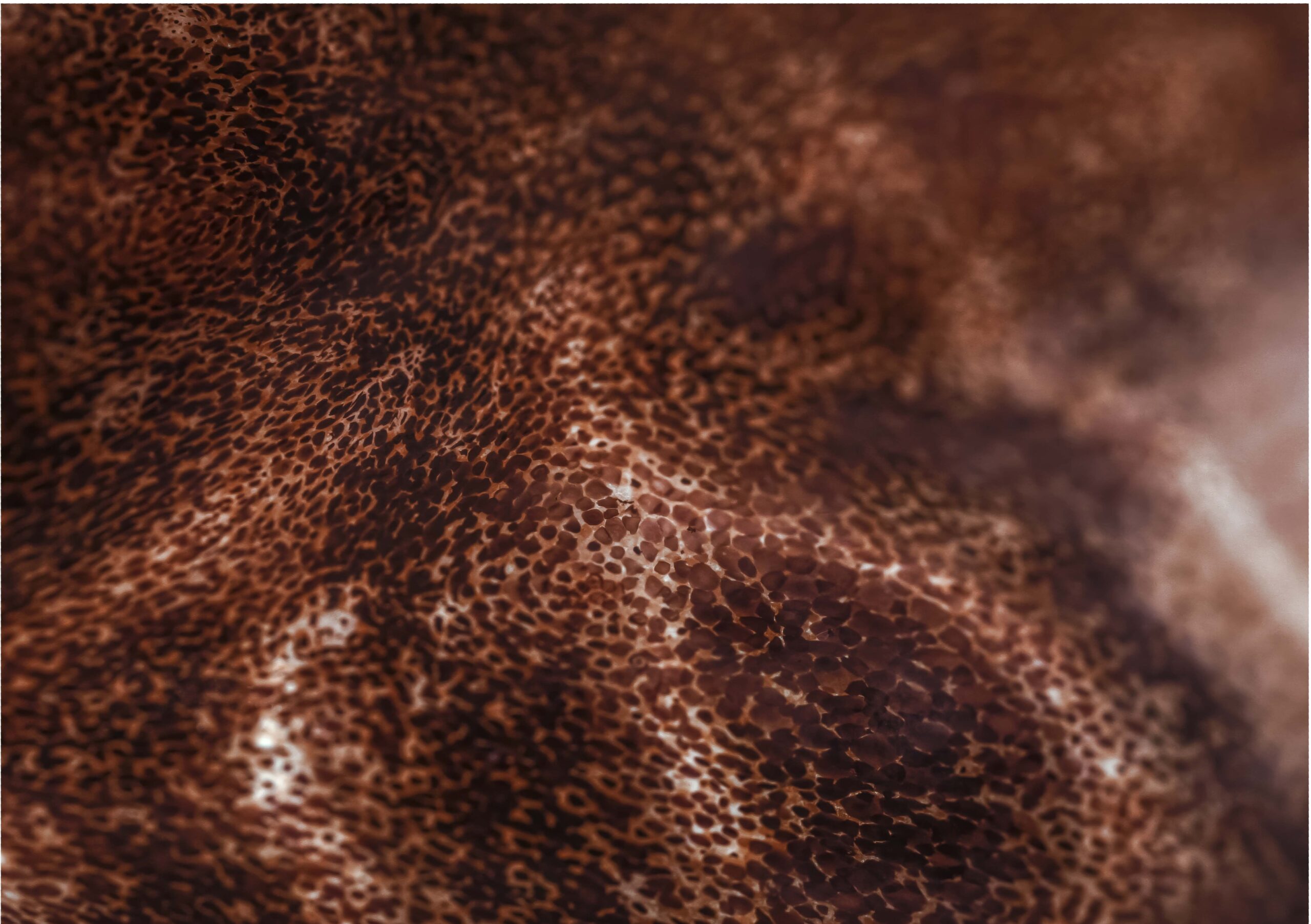
La Mer Devient Rouge لبحر تولّيّ حمراء
Submerged images trace submerged stories
In Mohammed Dib’s novel Qui se souvient de la mer (Who Remembers the Sea), set during the Algerian War without ever naming the conflict, colonial violence sinks into the sea, returning instead through altered atmospheres. Through the perspective of an unnamed narrator navigating an unnamed city, ordinary spaces become submerged worlds, and brutality surfaces not through transparency or testimony, but in fragments and dreamlike registers:
I was dazed by the brightness of the light that I still carried inside me; I couldn’t adjust to the sea depths of this room.1
The Gulf of Gabès in southern Tunisia, the focus of this work, likewise bears the legacies of imperial, postcolonial, and neocolonial violence. It used to be among the Mediterranean’s richest nurseries, where oasis met sea, sustaining extensive seagrass meadows and abundant life. Since the 1970s, the gulf has been profoundly transformed by the establishment of the state-owned Groupe Chimique Tunisien. In a vast industrial facility, phosphate rock mined inland is processed into fertilizer, feeding Europe’s industrial agriculture and releasing radioactive waste into the sea. Fisherfolk now describe waters that have turned red after decades of toxic discharge.
Research videos shared with me during my fieldwork document the remnants of the Gulf’s seagrass meadows. In one, a submerged camera descends through blue-green water before settling on graceful seagrasses swaying in the current. In another, the descent shifts from blue to yellow to red before fading into darkness: no seabed, no image. The camera did not fail; the sea had become completely dark.
From within these altered atmospheres, I present the following series of still images and soundtrack visualizations from a film in progress.
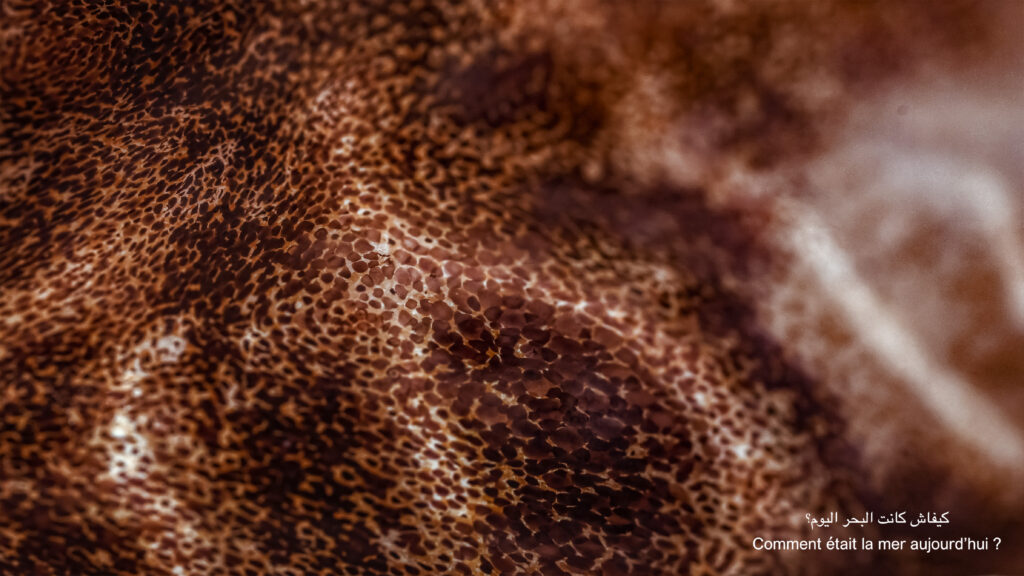
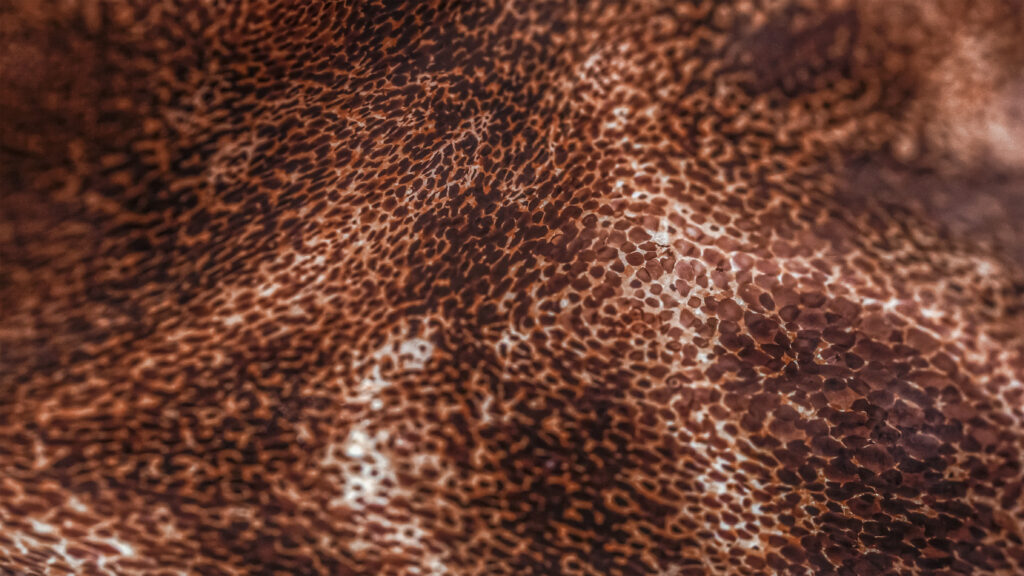
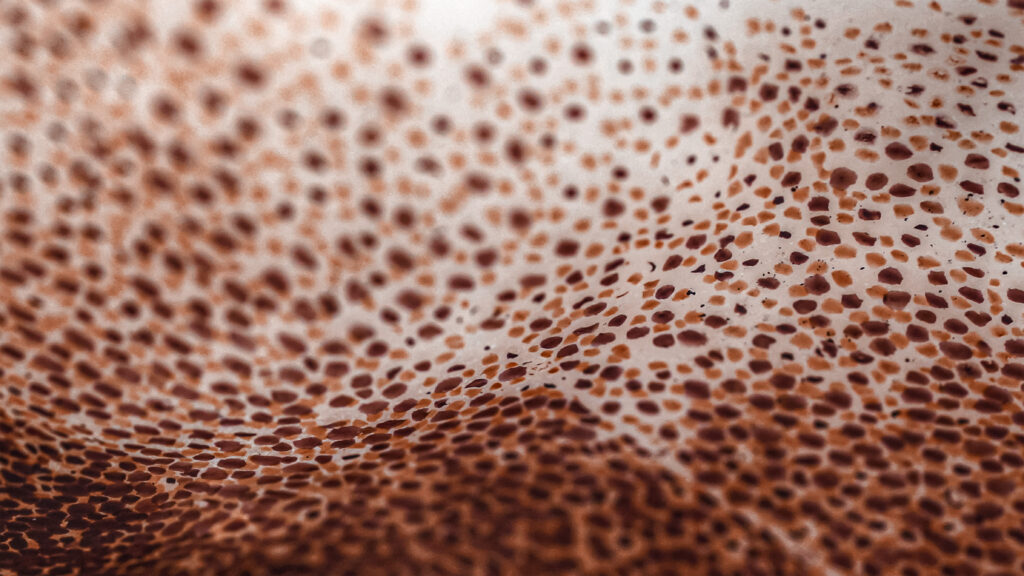
Here, the sea is encountered through obscuration. One of the subaqueous inhabitants of the gulf is the cuttlefish, or locally soubia (سوبيا)—a name that evokes sepia, the cephalopod’s dark ink, which it expels as a dense cloud to veil itself from the sight of its pursuers. Across the soubia’s epidermis, chromatophores contract and expand, pulsing through reds, golds, browns, and blacks in continuous acts of signaling. One may recall the “dream-enacting behaviors” observed by scientists in sleeping cuttlefish, when oneiric states ripple into visibility.2 Yet, what might these creatures dream in waters turned to nightmare?
These are waters darkened by many stories.3 The central Mediterranean is also shaped by European border policies. Fisherfolk from Gabès encounter abandoned boats and traces of the drowned; at times, they too attempt the crossing to Europe, as their livelihoods become increasingly untenable by what they call el-bahr mrīd (البحر مريض)—a sick sea.
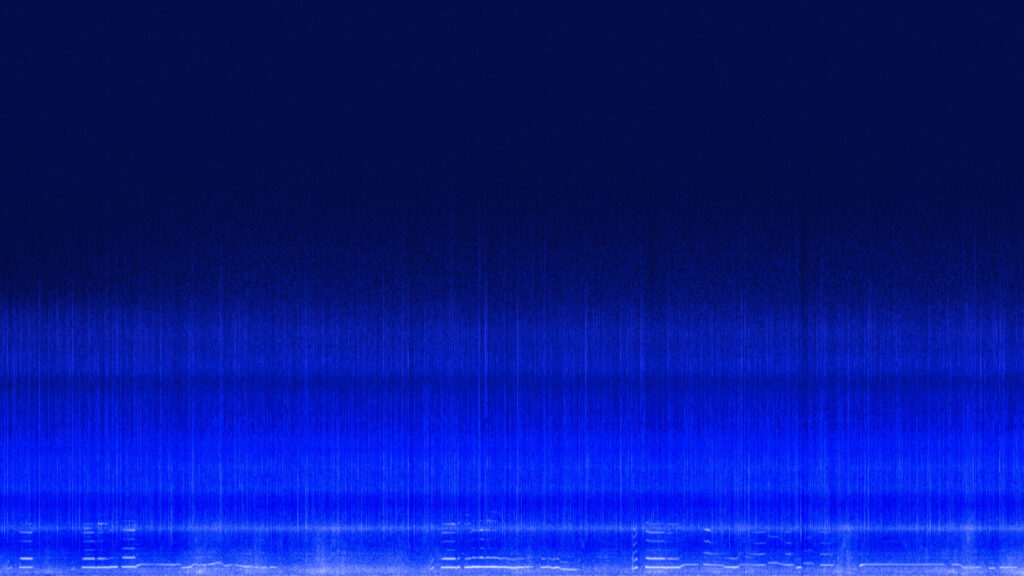
Alongside these images, blue spectrograms—visual renderings of the frequency spectrum in underwater sound recordings—translate the voice of artist Bint Mbareh into visual form. Her submerged elegy, captured by hydrophones plunged into the Mediterranean and altered by water, is threaded with the crackle of marine life. The voice appears as wavering lines, representing a lament borne by the sea.
In recent years, environmental protest in Gabès has faced increased criminalization, with anti-pollution organizers subject to arrest, detention, and prosecution. In a context of intensifying authoritarianism and expanding extractivism, how might we attend to what cannot safely or adequately be made visible?
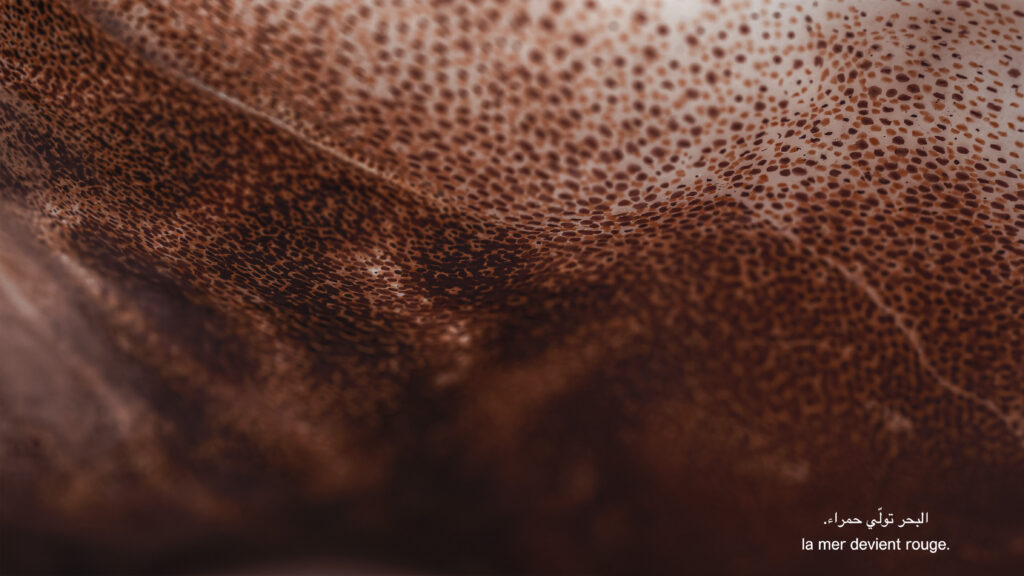
What follows offers neither evidence nor explanation. Instead, it assembles reverberations: submerged stories and mournings carried by a sea that remembers otherwise. ◆
- Mohammed Dib, Who Remembers the Sea, translated by Louis Tremaine (Three Continents Press, 1985), 17. ↩︎
- Filipa Ramos, “The Abyss They Call Home: On Sonia Levy’s We Marry You O Sea,” in Wet Matters, YAZ Publication Series, curated by Merve Yücel and edited by Zeynep Öz (Sharjah Art Foundation, 2024), and Joseph E. Malinowski, David Scheel, and Michael McCloskey, “Do Animals Dream?,” Consciousness and Cognition 95 (2021): 103214. ↩︎
- In the “funerary or necro-hydrologies” of visual cultures scholar Ifor Duncan, watery sites marked by dispossession and posthumous remains insist on the ethical limits of representation itself. Ifor Duncan, “Hydrology of the Powerless” (PhD diss., Goldsmiths, University of London, 2019). ↩︎