
An Ocean in Common
The deep sea is up for grabs
Is the open ocean a commons? As governments and private companies discuss plans to extract deep-sea resources deemed critical to renewable energy technology, the question has become ever more urgent. The legality of such projects is hotly contested, and much of the disagreement implicitly turns on a fundamental uncertainty about the meaning of an ocean commons.
“…contemporary discussions rarely interrogate what the ocean commons itself should mean, or who has the authority to define it.”
Since the late 1960s, deep-sea minerals have promised more than just economic value. Their location beyond any national jurisdiction inspired visions of an international authority capable of managing resources on behalf of humanity as a whole. The International Seabed Authority, established in 1994 under the United Nations Convention on the Law of the Sea (UNCLOS) to govern the seabed and its resources, has more recently become the focal point of these debates. Activists criticize it for failing to realize the redistributive ambitions of the common heritage principle, while industry increasingly regards it as an obstacle to resource extraction. The one point of agreement is that existing regimes of ocean governance are not fit for purpose.
To understand this impasse, we need to consider the ideas and definitions on which it is founded. Bringing the offshore into the fold of global governance entails debates not only about the nature of the ocean but also about semantics. The UNCLOS has never settled the definition of the ocean commons, and despite its strategic invocation by both industrialists and anti-extractive activists, the commons remains fundamentally ambiguous. Today, the ocean commons conceptually anchors and justifies divergent goals. Ocean resources are scripted into multiple conceptions of common property, each advancing competing claims about how to share the sea.

In 1967, Arvid Pardo, the ambassador to the United Nations of the newly postcolonial state of Malta, portrayed the deep-sea floor and its mineral resources as the “common heritage of mankind” at the UN General Assembly. For Pardo, common property demanded shared management. An approach to an ocean commons grounded in such an understanding would enable redistributive economic justice by helping societies derive material wealth from seabed minerals, but, even more importantly, by managing ocean science and technology, which, left unchecked, threatened to widen global inequality.
In 1971, Pardo submitted a draft treaty to the UN in favor of establishing a strong institution that could equitably manage the ocean. His proposal entailed the mandatory transfer of technology and technical knowledge from developed countries to developing ones. For many, this vision is still what we mean by “the commons.” However, Pardo’s plan never gained traction within the UNCLOS. While developed states, particularly the US, sought to maintain their capacity to innovate in ocean technologies independently, developing countries knew that without guaranteed equitable participation, the supposed commons would only perpetuate the political and economic status quo.
Pardo’s proposal anchored the idea of the commons within the redistributive potential of seabed mineral governance, but subsequent technological projects gave rise to markedly different understandings. Attention shifted beyond mineral extraction toward other oceanic resources, whose exploitation demanded new institutional and political imaginaries.
One example was ocean thermal energy conversion (OTEC), which harnesses energy by exploiting the temperature difference between warm surface waters and cold deep waters, particularly in tropical seas. By the early 1980s, multiple configurations of OTEC-based systems had demonstrated experimental production of energy, conditioned air, desalinated water, and aquacultural products, and had promised tropical coastal states a path toward development.
Where Pardo saw the ocean commons as a means for political communities to combat economic dependency and effect self-determination, naval engineer and maritime lawyer John Piña Craven advanced a conception of the Pacific as a web of material flows in need of optimization. His notion of the ocean commons was one of open access.1 Craven suggested that states organize not along political lines but along functional economic ones, treating the oceans as geographies of resource extraction, processing, transport, and consumption. His goal was restricted to the optimal management of resource rights and rents, with scant attention paid to global inequality.
Craven had reason to be optimistic. After near-shore and land-based demonstrations of OTEC’s capabilities, supporters of the technology envisioned that oceanic grazing ships would roam the high seas to produce and store energy, while inducing artificial nutrient upwelling to stimulate fisheries.
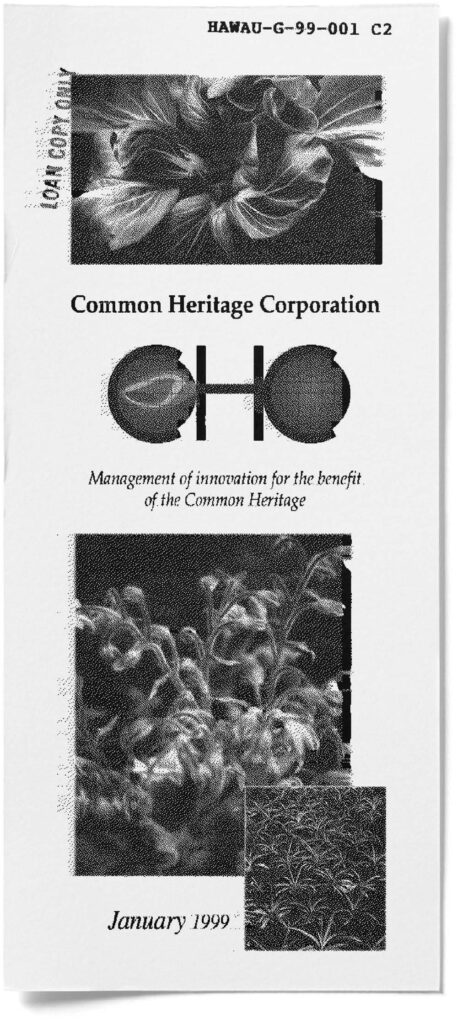
Craven’s business venture, the Common Heritage Corporation, thus aimed to operationalize the ocean commons—“managing innovation for the benefit of the common heritage”—by privately profiting from oceanic common property in the form of ocean thermal energy, first in Hawai‘i, followed by Saipan of the Northern Mariana Islands, and then across the Pacific. He aimed to make the corporation a billion-dollar venture by the 2010s, using deep-sea water to provide premium produce, cold air, desalinated water, and electrical power to paying island customers. Although he invoked Pardo’s shared heritage ideal, in practice, Craven reinterpreted the language of common heritage through an open-access logic in which common resources became assets to be optimized and commercialized.
In the end, like OTEC in general, Craven’s business never scaled up to the extent that he had hoped. The reasons were both technological and sociopolitical. For one, scaling OTEC beyond the size of a demonstration plant is extremely challenging. But more than that, Craven’s plans failed in their ambit. Capitalizing on ongoing American Pacific colonialism to plan projects in places such as Saipan, Guam, and Hawai‘i , the corporation primarily marketed expensive modular structures to investors in the military and tourism sectors. Chasing high-cost infrastructural development projects that often failed to materialize, Craven neglected all the while to consider the potential benefit of OTEC-derived products and services for those most in need of reliable and independent access to fresh food, clean water, and stable power—Pacific islanders themselves.

Today, both deep-sea mining and OTEC are experiencing renewed interest, as components of the blue economy and as technological responses to climate change. Yet unlike the debates of the 1970s and 1980s, contemporary discussions rarely interrogate what the ocean commons itself should mean, or who has the authority to define it. This absence of conceptual debate allows industry, policymakers, and international institutions alike to invoke seemingly self-evident notions of the ocean commons while advancing fundamentally different political projects. The resulting semantic slippage enables extractive industries to appropriate the language of common heritage in order to commercialize marine environments and resources.
Rather than asking whether the ocean is a commons, this history suggests that we should ask which commons is being invoked, by whom, and to what ends. The history of ocean governance is not one of a stable legal principle gradually implemented, but one of competing political imaginaries attached to the same vocabulary. Deep-sea mining, OTEC, and other offshore ventures do not simply operate within established governance frameworks. They continually generate new arrangements through which understandings of the commons become thinkable and actionable.
The contemporary revival of the blue economy, therefore, reactivates unresolved disputes over the political meaning of the ocean itself. Unless competing conceptions of the commons are made explicit, the language of common heritage risks becoming detached from its redistributive ambitions, reduced instead to a rhetorical justification for new forms of enclosure.
The future of the ocean commons depends not just on defining the commons more precisely, but on recognizing that every technological proposal advances a political vision of what should be held in common, who should benefit, and how collective futures ought to be organized. ◆
- Bonnie J. McCay, “The Culture of the Commoners: Historical Observations on Old and New World Fisheries,” in The Question of the Commons: The Culture and Ecology of Communal Resources, ed. Bonnie J. McCay and James M. Acheson (University of Arizona Press, 1987). ↩︎