
Ghosts of Digital Extraction
I was well into my late teens before I gathered up enough courage to visit the place my grandmother always referred to as “the haunted house.”1 For years, I waited in its gravel driveway under the Mississippi sun while my family toured inside. I was simply too afraid to go in. When I finally asked Granny why it was haunted, she explained that the nickname originated in her childhood during the ’30s and ’40s. She and her friends found the overgrown house, deep in the woods just outside of town. They called it “haunted” simply because it looked creepy. They dreamed up scary stories about it, threw rocks at its windows, and dared each other to touch the front door.
The house’s true history only came to light in the 1960s, after a local couple, Robert and Donna Snow, purchased and restored it. As I had suspected, beyond the rumors that the ghosts of the original owners’ family haunted the grounds, there was indeed something wrong with that house. It was haunted by the far more persistent specter of racial capitalism. As it turns out, the home was a former plantation.
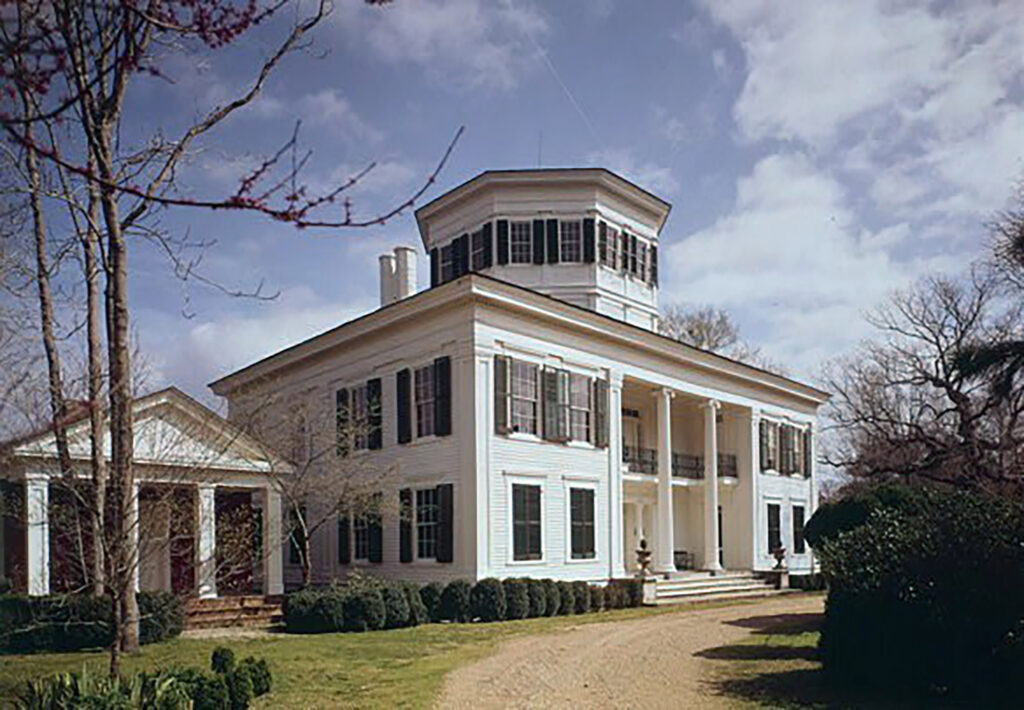
Waverley Mansion, exterior view with plantation office in foreground
Waverley Mansion was completed in 1852 to serve as the main house for the estate, which operated a saddle blanket and hat manufacturer, a lumber mill, and a leather tannery. Enslaved Africans and generations of their descendants built, maintained, and worked in the house and its grounds. It fell into disrepair in 1913 and was left abandoned until the Snow family arrived in the 1960s. Their renovation of the physical structure required a parallel renovation of its history. The house’s past was retrofitted to reflect the era’s resurgence of Lost Cause mythology, with its romanticization of enslavement, torture, and the tragedy and nobility of the Confederacy. This ideology repackages the Civil War as a noble fight for “states’ rights” while relegating slavery to a secondary problem.
This historical alchemy is standard for plantation tourism. Architecture stands for heritage. A violent erasure transforms the pain of the enslaved into a commodity—a packaged experience wherein the Black foundations of the structure, and the labor it took to run it, are merely context for the loving restoration of period decor. In the architectural tours offered today, Waverley Mansion’s original purpose is talked around, not about. Colonel George Hampton Young of Georgia lived here; his enslaved labor force lived on the grounds as well—visible yet invisible. They worked the fields, slipped through side doors with meals from the detached kitchen, and maintained the house. In death, as in life, their contributions are unacknowledged, an open secret haunting the grounds.
To omit slavery on a plantation tour is not an oversight; it is an intentional exclusion in order to sanitize an ugly history. This remixing is essential to capitalist mythology, which obscures its foundational dependence on the exploitation of racialized groups. Plantations were first and foremost sites of violent economic extraction. Focusing solely on the luxurious lives of the enslavers is callously aligned with capitalism’s modus operandi. This is why scholar Paul Gilroy called slavery “capitalism with its clothes off.”2 By this, he meant that the exploitation of enslaved Africans was clear and apparent, with no pretense. Slavery rationalized exploitation as a means to an end.
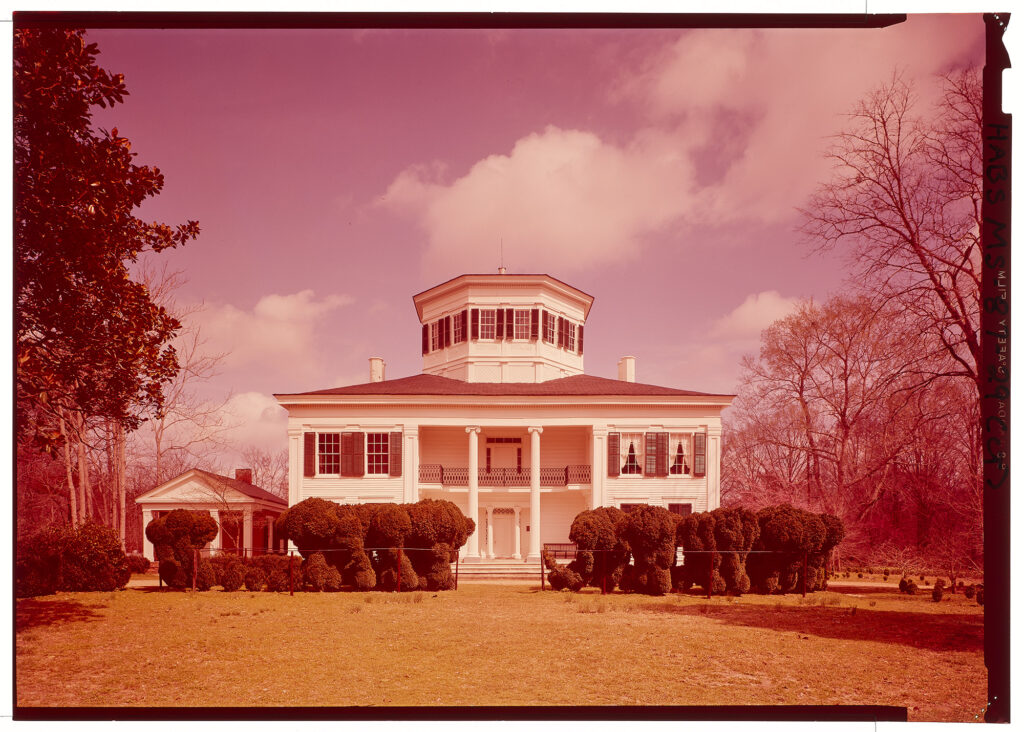
Archival photography of Waverley Mansion from US Historical Building Survey render the estate an architectural achievement and obscure other histories.
HISTORIC AMERICAN BUILDINGS SURVEY, JAMES BUTTERS, PHOTOGRAPHER. JUNE 11, 1936. LIBRARY OF CONGRESS.
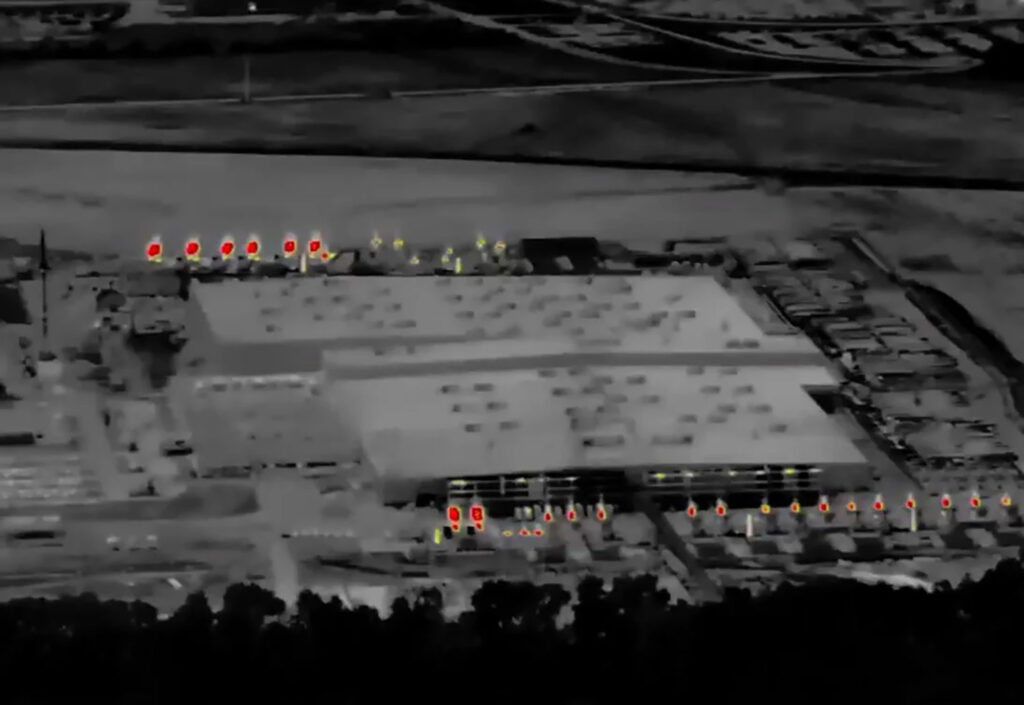
A thermal image of the xAI data center’s thirty-five methane gas turbines, significantly more than the fifteen turbines for which the company sought permits. STEVEN JONES. FLIGHT BY SOUTHWINGS FOR SOUTHERN ENVIRONMENTAL LAW CENTER.
Slavery was legally abolished, but it mutated into the sharecropping system, which was characterized by insurmountable debt, exploitative contracts, and labyrinthine loopholes. This laid the groundwork for a style of capitalist venture that persists today, making Cedric Robinson’s theory of “racial capitalism” indispensable.3 Capitalism requires racial hierarchies to justify the extraction of land, labor, and life. Racial capitalism is inextricable from the past and present of technological development. The plantation was a site of industrial innovation in farming techniques, machinery, and the brutal management of human capital. Blackness—a political identity forged through transatlantic enslavement—is not incidental but foundational to capitalism’s function, and to the history of technology in the United States.
Mainstream analyses of the contemporary tech industry tend to use euphemistic terms like “implicit bias” that sidestep the explicit naming of racism as the engine of extraction. This evasion prevents any real understanding of why “magical” technologies, with their promises of social progress, consistently fail or harm people in apparently unexpected ways. The plantation thrived on free, invisible labor that was mythologized as expendable. Modern wage labor in tech industries mimics these patterns: backbreaking work for paychecks that barely bridge workers to the next shift, with little appreciation or security.
The Waverley Mansion tour recasts horror as heritage by steadying its focus on antebellum grandeur. Contemporary myths of technological racial capitalism require similar maintenance. While data extraction targets everyone, Black communities are disproportionately impacted—the proverbial “canaries in the coal mine.”4 Harm against Black people is often disregarded until it affects white populations. Zuboff defines “surveillance capitalism” as extracting ephemeral information.5 But this “data” is intrinsically tied to human bodies and lives, only made to appear detached. Surveillance has always been about control, containment, and behavior modification, a fact evident in historical regimes like the plantation’s “lantern laws” that enforced Black hypervisibility.6
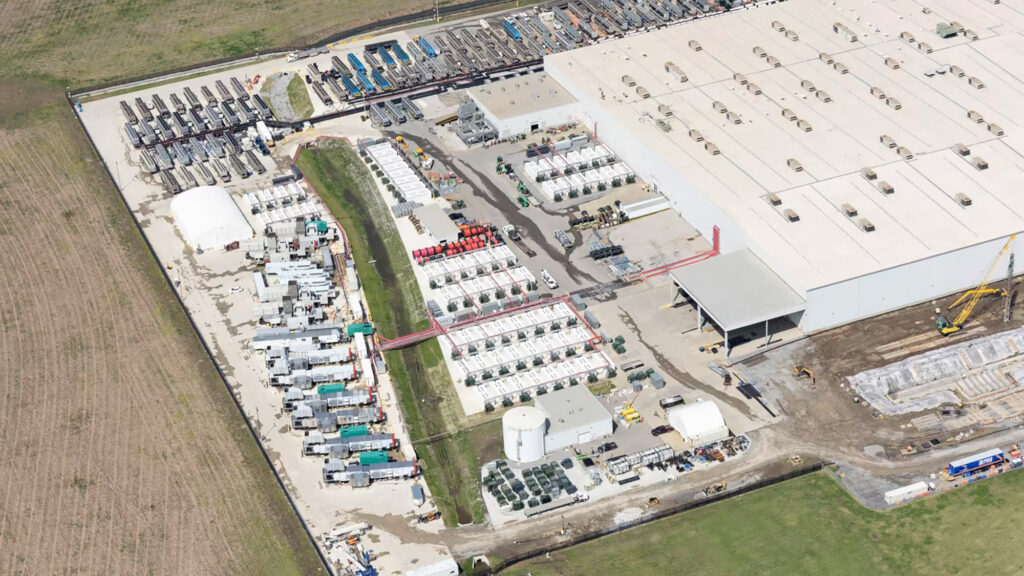
xAI’s data center in Memphis, Tennessee. STEVEN JONES. FLIGHT BY SOUTHWINGS FOR SOUTHERN ENVIRONMENTAL LAW CENTER.
Anti-Blackness is modernity’s ghost in the machine: a spectral force that renders Black people not visible as fully human, while simultaneously positioning them as indispensable sites of extraction. This contradiction is epitomized by the fight against Elon Musk’s Colossus supercomputer in Memphis. Colossus runs thirty-five unpermitted methane turbines that spew carcinogens, directly threatening the health of residents in the majority-Black local neighborhoods.7 Activists like KeShaun Pearson and his brother, State Representative Justin Pearson, argue that the promise of supercomputing doubles down on a long history of environmental racism. Grandiose promises of social economic transformation through advanced technologies have come and gone, leaving residents rightly skeptical of Musk’s vision of Shelby County as a tech-focused industrial hub. These residents already live in a sacrifice zone to the industrial effluents of previous techno-utopias. The ruins of industrial failure litter the landscape.
“Anti-Blackness haunts not only the environmental impact of digital extraction, but its entire logic.”
Anti-Blackness haunts not only the environmental impact of digital extraction, but its entire logic. Digital extraction depends on systematic erasure. The physical infrastructure, the manual labor to maintain it, and the lives exploited to fuel it are all rendered invisible by the rhetoric of frictionless progress. This sublimation of seized land, exhausted bodies, and poisoned communities mirrors the plantation mythos and its erasure of the enslaved. Readers of “The Gentle Singularity,” a short blog post by OpenAI’s Sam Altman seemingly meant to assuage existential fears of an agentic AI, would be forgiven for getting the impression that our greatest challenge with respect to AI will be what to do with the abundance of “cheap superintelligence” it will bring. There is no mention of Memphis’s turbines or the exploited bodies in lithium mines, no mention of gig workers with no recourse in labor disputes or those whose urgent medical claims are denied by an automated system. The question remains: For whom is the singularity gentle?
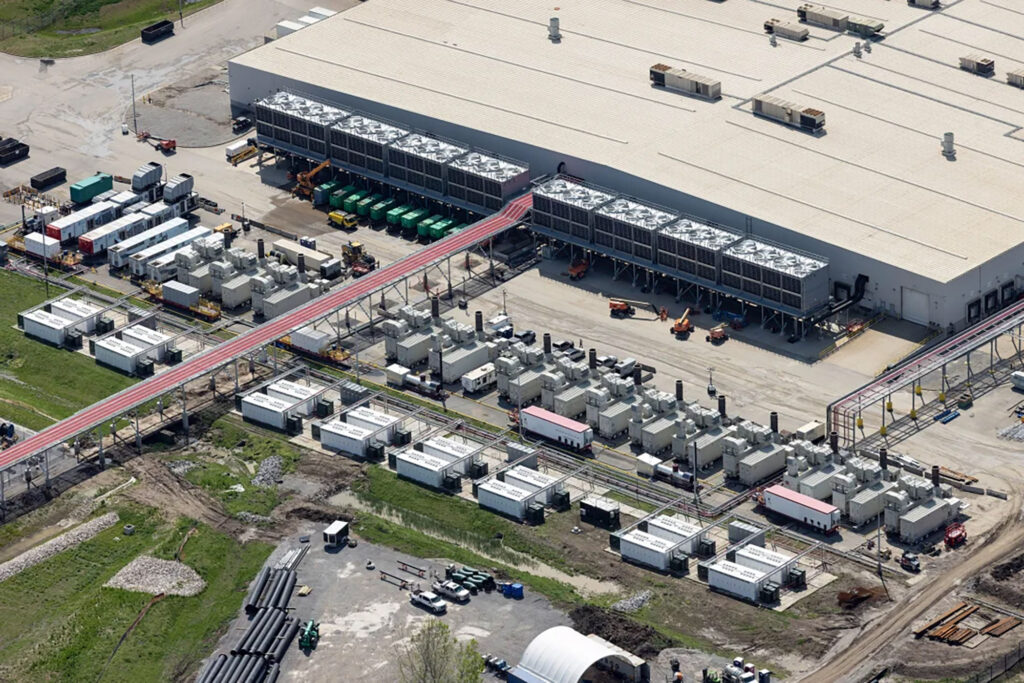
The physical substrates for data extraction continue to concentrate pollution in already overburdened communities. STEVEN JONES. FLIGHT BY SOUTHWINGS FOR SOUTHERN ENVIRONMENTAL LAW CENTER.
The Waverley plantation was built through extracted labor, and it was itself a machinery for rendering Black life and bodies culturally, ideologically, and technologically as a site of extraction. The recovery of its architecture and the simultaneous burial of its racial foundations cemented anti-Blackness into the technological imaginaries of what would come after. The early American plantation fused labor and extraction into a blueprint for modern technology. Anti-Blackness, the plantation, and its aftermaths generated the conditions through which racial difference became a prerequisite for multiple kinds of extraction—from the appropriation of embodied labor to the mining of abstracted data. The plantation is capitalism’s pre-digital extraction machine.
Today, American technological production remains rooted in extraction from racially marginalized communities. Black communities have long recognized the hubris in this process, from Gil Scott-Heron’s “Whitey on the Moon,”8 which critiqued 1960s space race extravagance amid Black poverty, to Huey P. Newton’s call for “people’s community control of modern technology.”9 This Black Technoskepticism reveals how “progress” narratives serve racial capitalism. It exposes the costs of technofetishism, and it challenges the presumed inevitability of harmful innovation. Informed by W.E.B. Du Bois’s “second sight” and “double consciousness,”10 the ability to see oneself through the dominant gaze provides critical ambivalence. Beyond techno-optimism, determinism, or pessimism, it asks: Progress for whom? At what cost?
If anti-Blackness is the ghost that enables digital harm to pass as unfettered technological advancement, who benefits from ignoring it? What ghosts haunt the halls and grounds of Waverley Mansion, polished into blinding whiteness? What haunts the machines that are powered by the poisoning of lands, waters, and bodies? Truly understanding surveillance capitalism requires confronting anti-Blackness. It’s about time the tech industry takes action to give up its ghosts—that is, to abandon futile attempts to fix technology without addressing its core failures. The solution isn’t exorcism—further erasure—but emancipation, and a future beyond extraction.
Daniella DiRienzo, “The Story of Mississippi’s Most Haunted House Will Give You Nightmares,” Only in Your State, October 26, 2016, accessed July 1, 2025, https://www.onlyinyourstate.com/experiences/mississippi/most-haunted-house-in-ms-is-terrifying. ↩︎- Gilroy, Paul. The Black Atlantic: Modernity and Double Consciousness, (Harvard University Press, 1993). ↩︎
- Cedric J. Robinson, Black Marxism: The Making of the Black Radical Tradition (Zed Books, 1983). ↩︎
- Brandi Collins-Dexter, “Canaries in the Coal Mine: COVID-19 Misinformation and Black Communities,” Shorenstein Center on Media, Politics and Public Policy, June 24, 2020, accessed September 19, 2025, https://shorensteincenter.org/canaries-in-the-coal-mine/. ↩︎
- Shoshana Zuboff, The Age of Surveillance Capitalism: The Fight for a Human Future at the New Frontier of Power (PublicAffairs, 2019). ↩︎
- Simone Browne, Dark Matters: On the Surveillance of Blackness (Duke University Press, 2015), https://doi.org/10.1215/9780822375302. ↩︎
- See Bracey Harris, “NAACP Announces Plans to Sue Musk’s xAI Over Pollution Concerns,” NBC News, June 17, 2025, accessed September 19, 2025, https://www.nbcnews.com/news/us-news/naacp-musk-xai-supercomputer-colossus-memphis-tennessee-rcna213490; and Amy Goodman, “‘Musk Is Scamming the City of Memphis’: Meet Two Brothers Fighting Colossus, Musk’s xAI Data Center,” Democracy Now!, April 25, 2025, accessed September 19, 2025, https://www.democracynow.org/2025/4/25/elon_musk_xai_memphis_tennessee. ↩︎
- Gil Scott-Heron, Small Talk at 125th and Lenox, vinyl LP, Flying Dutchman Records, 1970. ↩︎
- See Huey P. Newton, “Intercommunalism: February 1971,” in To Die for the People: The Writings of Huey P. Newton (Random House, 1973), 39–58; and Joshua Bloom and Waldo E. Martin, Black Against Empire: The History and Politics of the Black Panther Party (University of California Press, 2016). ↩︎
- W.E.B. Du Bois, The Souls of Black Folk (Oxford University Press, 1903/2008). ↩︎