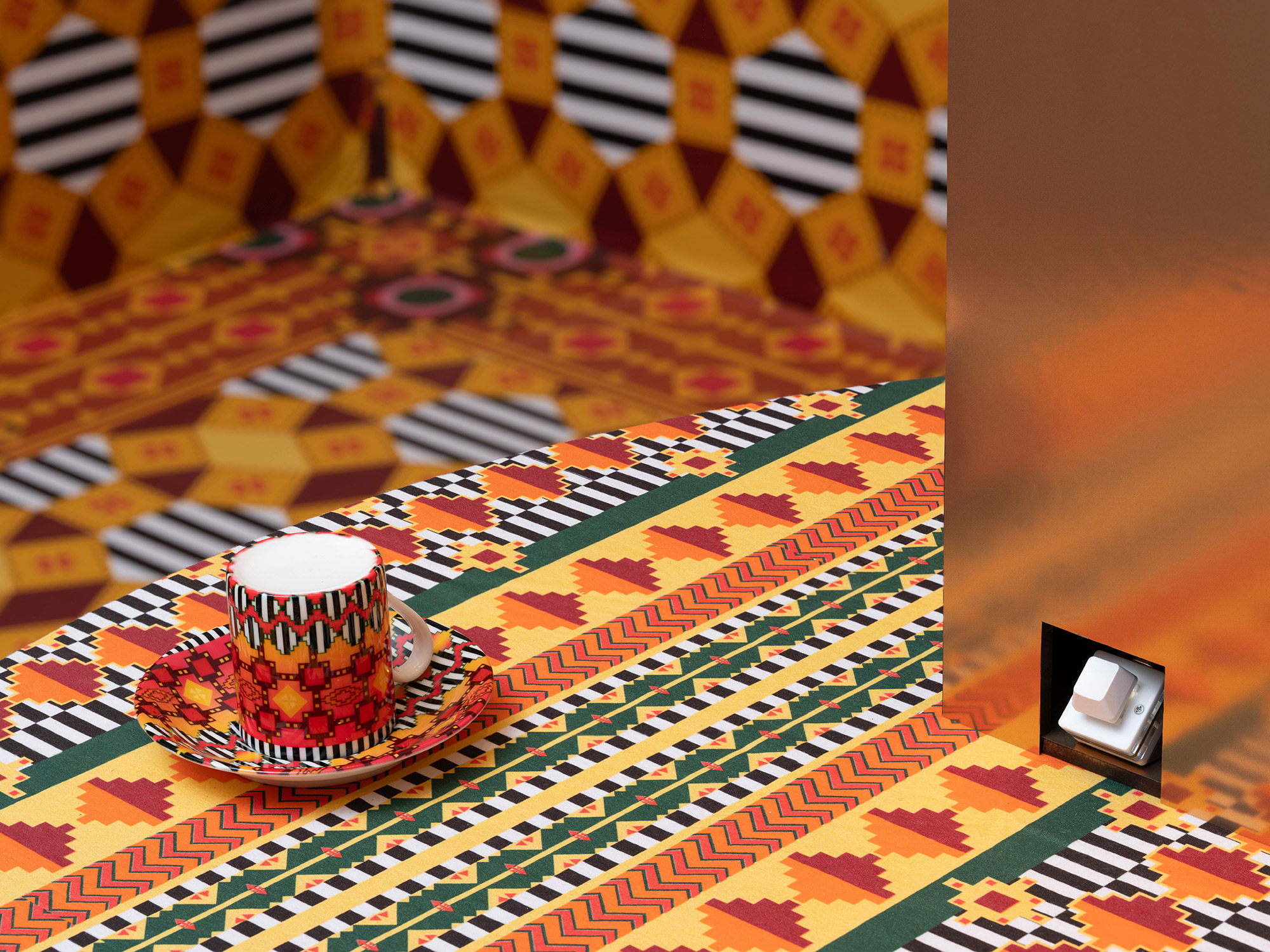
Algorithmic Counter-Divination
Before prediction became the purview of algorithmic logics, a host of divinatory practices turned to nonhuman agents to inscribe the future.
Among these, tasseography has been practiced throughout West Asia since the sixteenth century to fulfill a function now associated with predictive analytics. In this method of divination, visual patterns are identified in coffee grounds left at the bottom of a cup, and they are then interpreted to glean information about the past, present, and future. Historically, tasseography was a matrilineally transmitted practice, taught by femme elders to their femme descendants across Armenia, Palestine, Lebanon, and beyond. The Armenian term for tasseography, bazhak nayel, translates to “looking at the cup,” a phrase that foregrounds the process of observation that undergirds any attempt to decode a cup’s symbols.
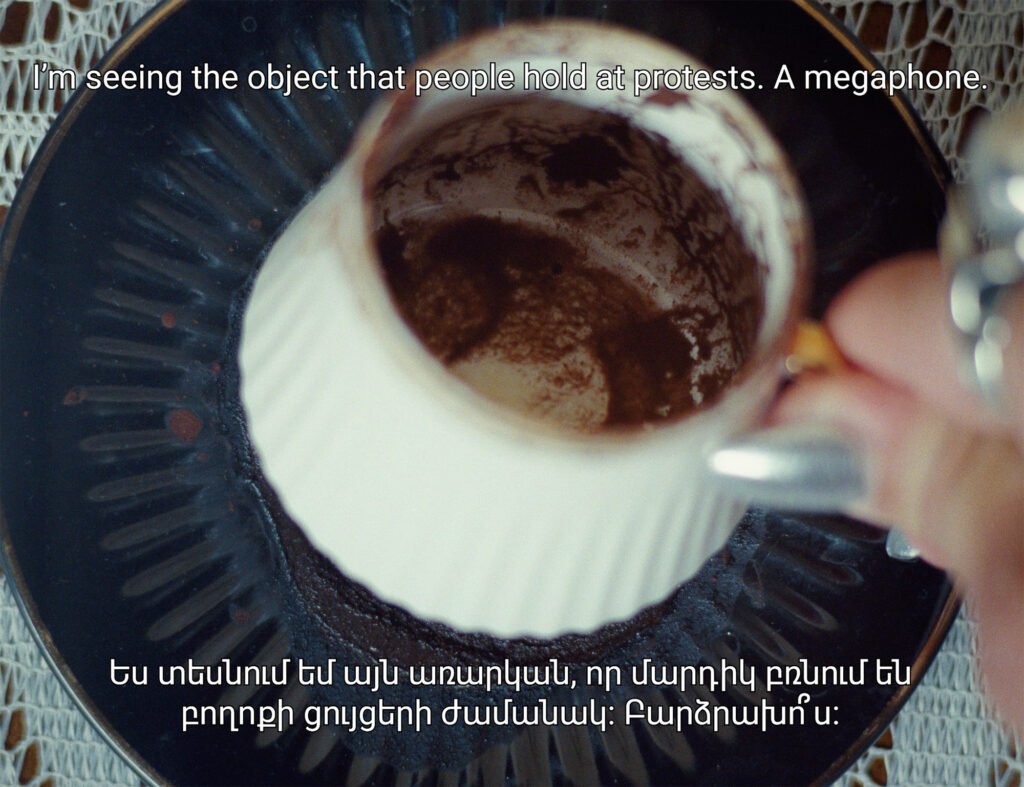
Film still, Բաժակ Նայող (One Who Looks at the Cup), Mashinka Firunts Hakopian, dir. Atlas Acopian, score by Lara Sarkissian, 2024.
The querent is the person receiving a reading, who queries the unseen entities whose communiqués appear in the grounds. As a querent drinks their coffee, they hold a question in their mind for the voices that converge in the cup to answer. The querent acts as a prompt engineer, the cup as a technology of ancestral intelligence, and the coffee reader as an interface for generative outputs. Each taps into knowledge systems that are irreducible to computation.
Tasseography’s methods are transmitted far afield from data analytics research centers or sites of institutional pedagogy. Seated around the kitchen table, you learn from your mother, grandmother, or aunt how to decipher the cup’s nonhuman utterances. After leaving Yerevan in 1991, I learned to read the cup in a kitchen in Glendale, California. There, I observed the furrowing of my aunt’s brow as she studied the images imprinted in the cup’s grounds. Her searching gaze would give way to expressions of beaming fascination, as indeterminate patterns coalesced into symbols from which she wrested meaning. Each symbol identified was a catalyst for conversation with the querent. In those encounters, predictions weren’t instantaneously conjured or fixed in advance. Rather, they were collectively articulated and unbounded, prying open pluriversal outcomes in a process of reciprocal exchange.
Unsurprisingly, tasseography has been subject to the kind of epistemological anxiety that accrues to practices identified with witches, who circulate the prohibited collective knowledge and memory of their communities. From this perspective, knowledge has the capacity to destabilize the rationalist regimes that underpin a once-mechanized—and now automated—worldview. Intervening as it does into prevailing imaginaries of what remains possible, divination poses a particularly hazardous threat in this regard.

Film still, Բաժակ Նայող (One Who Looks at the Cup), Mashinka Firunts Hakopian, dir. Atlas Acopian, score by Lara Sarkissian, 2024.
As Carina Karapetian Giorgi has observed, coffee reading in the Armenian context has long been “frowned upon as a feminized, superstitious, and nonscientific ritual.”1 Giorgi understands coffee reading as a practice of queer temporality-making that defies normative ideas of evidence-based knowledge and “creates new forms of subversive knowledge” in their place. Attesting to the anxiety this scenario provokes, coffee reading was forbidden in Soviet Armenia. From the present vantage, tasseography elicits less an air of apprehension than a wholesale dismissal of the practice as an outmoded curiosity. Its once-destabilizing capacity to conjure worlds is negated by its incompatibility with Western technoscience.
It’s believed that tasseography became particularly widespread among Armenian diasporic communities after the 1915 Armenian Genocide. When practitioners attune themselves to the communications in the cup, they also invoke the ancestral histories of that practice. And, through that invocation, they work to counter the erasures of dispossession and displacement. To divine the future in this context is a refusal to relinquish its writing to agents of colonial violence. Divination comes to operate as a tactic of collective survival, affirming futurity in the face of a catastrophic present.
Witnessing the eschatology of technofascism today, we’re told that it’s too late for any future that isn’t written by algorithmic authors. We reside in an algo-occultist moment in which divinatory functions have been ceded to predictive models trained to retrieve necropolitical outcomes. Scholars of algorithmic divination write that, “like cowry shells, scapular bones, or spiders trapped under a pot, algorithms are marshaled to detect and relay invisible patterns; to bring to light a truth which is out there, but which cannot ordinarily be seen.”2 What algorithms claim to conjure is an arrangement of the world that can neither be foretold through human sensoria, nor challenged by them.
Despite the dubiousness of that claim, an arcane magic is imputed to algorithmic prediction—to models that now determine outcomes in the realm of warfare, policing, housing, judicial risk assessment, and beyond. Crucially, imaginaries that tether AI to magic serve as a way to elide the realities of algorithmic violence.3 That elision enables two internally contradictory maneuvers. First, it cloaks algorithmic harm under a veneer of neutrality and aspirational superintelligence. Second, it displaces accountability for harm onto unknowable, phantasmatic entities.
What is the source from which this arcane magic emanates? Outlining the “conjuration of algorithms,” Gina Neff and Peter Nagy propose that predictive models have less to do with ancestral practices of more-than-human knowledge-making, and more to do with the flimsy deceptions of Western stage magic and its spectacles. They suggest that corporate entities in the tech industry adapt the principles of stage magic to “conceal the design of technologies … and produce dazzling effects.”4

Film still, Բաժակ Նայող (One Who Looks at the Cup), Mashinka Firunts Hakopian, dir. Atlas Acopian, score by Lara Sarkissian, 2024.
Who orchestrates the stage-setting for these divinatory theatricals, and who scripts their predictive outputs? Despite the objections of those who suggest that it’s possible to commune with data, data points do not speak for themselves. Instead, the role once ascribed to ritual experts who interpreted the pronouncements of oracles is now performed by technocratic actors. These are not diviners rooted in a community and summoning communiqués toward collective survival, but charlatans reading aloud the results of a Ouija session—one whose statements they author with a magnetically manipulated planchette.
Surveying the contours of the future they foretell is instructive. What appears there is worldmaking through the aperture of “speculative whiteness,” described by Jordan Carroll as the ethnonationalist conviction that whiteness is “consubstantial with speculative futurity,” and that its potential can only be fully realized against the backdrop of a hyper-technologized terrain.5 In this imaginary, non-Western people and their practices are casualties of sundry cataclysms, relegated to a far-flung past.
Technocratic actors in the Global North now constitute what Sarah Roberts and Mél Hogan call an elite class of “future fetishists,”6 whose coterie predict mass annihilation for all but a select few. They augur a world that empire has made unlivable for most, save for the technocratic diviners who have accelerated those very conditions of unlivability. This is the logic that enables OpenAI to release a large language model that hastens ecological collapse through resource extraction, while at the same time its cofounder prognosticates about the urgency of bunker architecture to fortify against the apocalyptic effects of the company’s own technical systems.7
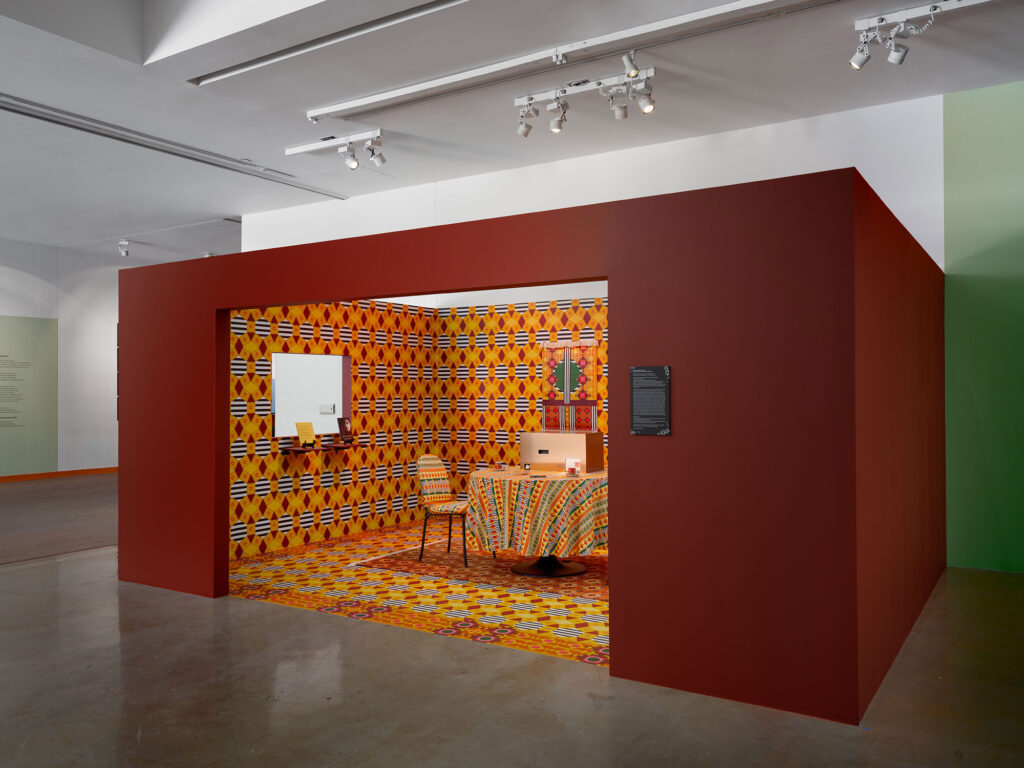
Բաժակ Նայող (One Who Looks at the Cup), Mashinka Firunts Hakopian, Dahlia Elsayed, Andrew Demirjian, and Danny Snelson. In “All Watched Over By Machines of Loving Grace.” REDCAT, 2024. Photo Yubo Dong.
What might it look like to turn the annihilatory logic of algorithmic divination against itself? This question animates Բաժակ Նայող (One Who Looks at the Cup), a multidisciplinary experiment in community dataset creation that I initiated in the summer of 2023. Բաժակ Նայող trains a multimodal model to perform tasseography and to output bilingual predictions in Armenian and English. In 2024, the project was mounted in Los Angeles at the Music Center and at REDCAT. The former was a collaboration with Atlas Acopian and Lara Sarkissian (among many others), the latter with Dahlia Elsayed, Andrew Demirjian, and Danny Snelson. The installation staged coffee readings in the setting of a purpose-built Armenian diasporan kitchen located in an indeterminate time-space—a re-rendering of the domestic spaces where tasseography customarily takes place.
The project began with data collection. I conducted coffee readings with Southwest Asian and North African (SWANA) diasporan artists, scholars, and activists. This process unfolded over sprawling evenings of community dinners, coffee readings, and hours of protracted conversation. The outcome was a collectively authored corpus that indexes how these particular dataset contributors imagine the contours of other worlds, at the same moment that we find ourselves continually unworlded.
Alongside the readings, oral history interviews asked dataset contributors to outline the features they ascribe to liberatory futures. Both readings and interviews were recorded, transcribed, and translated in their entirety into Armenian by Margo Gevorgyan and Hayk Makhmuryan. The project’s training corpus also incorporates writing by the Armenian feminist poet Shushanik Kurghinian, whose work in the early twentieth century bears defiant witness to revolutionary upheavals and the Great Catastrophe.
The querent acts as a prompt engineer, the cup as a technology of ancestral intelligence, and the coffee reader as an interface for generative outputs. Each taps into knowledge systems that are irreducible to computation.
In the project’s final staging, the querent receives a cup with moistened coffee grounds, and is asked, as in analog tasseography, to smudge the bottom of the cup with their thumb to reveal the messages it contains. They then place the cup inside a device to activate the reading. Finally, they receive a prediction printout in Armenian and English, with content drawn from the community-generated datasets. Recognizing Armenian as a low-resource language in the current machine learning landscape, the device’s bilingual printouts gesture toward models of digital language justice that counter the logics of algolinguicism.



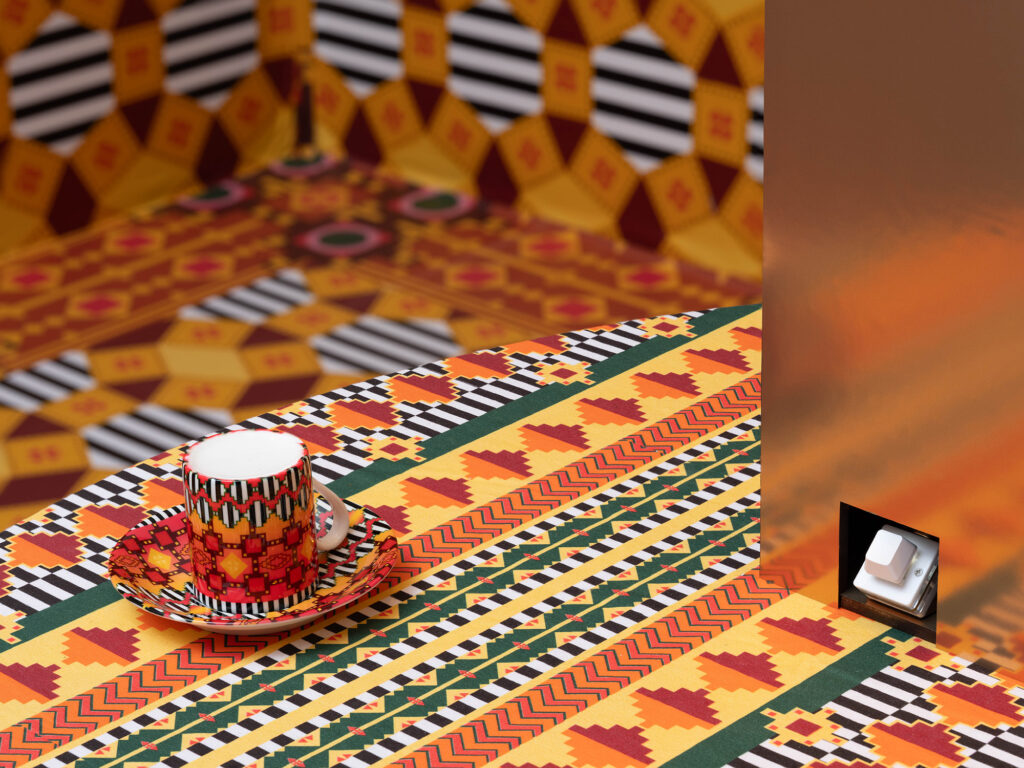
Բաժակ Նայող (One Who Looks at the Cup), Mashinka Firunts Hakopian, Dahlia Elsayed, Andrew Demirjian, and Danny Snelson. In “All Watched Over By Machines of Loving Grace.” REDCAT, 2024. Photo Yubo Dong.
Eschewing live generation, the model’s predictive outputs are scripted in advance. The “conjuration of algorithms” is here replaced by outcomes plainly conjured by human agents. The model’s only function is to identify visual patterns in a querent’s cup in order to retrieve corresponding texts. This arrangement declines to cede authorship to an algo-occultist circle of “stochastic parrots” and the diviners who summon them.8 Instead, a form of algorithmic counter-divination unfolds. Here, prediction is placed in the service of countering the narratives of techno-eschatology. The voices that converge in the cup foresee outcomes like the following:
Somewhere, a child is pulling at the
fraying threads of empire
and discovering
they are possible to unravel.
Ինչ−որ տեղ մի երեխա ձգում է
կայսրության քրքրված թելերը
ու հայտնաբերում,
որ դրանք հնարավոր է քանդել:
- Carina Karapetian Giorgi, “Intuitive Knowledge: The Queer Phenomenology of Armenian Matrilineal Rituals of Tasseography,” Armenian Review 56, no. 1–2 (Spring–Summer 2018). ↩︎
- Rebecca Carlson, Heikki Wilenius, and Jonathan Corliss, “On Algorithmic Divination,” Platypus, October 31, 2023, https://blog.castac.org/2023/10/on-algorithmic-divination. ↩︎
- On algorithmic violence, see MimiO. nu.o.ha, “Notes on lgorithmic Violence,” February 7, 2018, https://github.com/MimiOnuoha/On-Algorithmic-Violence. ↩︎
- Peter Nagy and Gina Neff, “Conjuring Algorithms: Understanding the Tech Industry as Stage Magicians,” New Media & Society 26, no. 9 (2024): 4939, https://doi.org/10.1177/14614448241251789. ↩︎
- Jordan S. Carroll, Speculative Whiteness: Science Fiction and the Alt-Right (University of Minnesota Press, 2024). ↩︎
- Sarah T. Roberts and Mél Hogan, “Left Behind: Futurist Fetishists, Prepping and the Abandonment of Earth,” b2o: boundary 2 online, 2019, https://www.boundary2.org/2019/08/sarah-t-roberts-and-mel-hogan-left-behind-futurist-fetishists-prepping-and-the-abandonment-of-earth. ↩︎
- See “Statement on AI Risk,” Center for AI Safety, May 30, 2023, https://safe.ai/work/statement-on-ai-risk; and Karen Hao, “‘We’re Definitely Going to Build a Bunker Before We Release AGI,’” Atlantic, May 15, 2025, https://www.theatlantic.com/technology/archive/2025/05/karen-hao-empire-of-ai-excerpt/682798. ↩︎
- Emily Bender, Timnit Gebru, Angelina McMillan-Major, and Shmargaret Shmitchell, “On the Dangers of Stochastic Parrots: Can Language Models Be Too Big?,” Proceedings of the ACM Conference on Fairness, Accountability, and Transparency (2021): 610–623, https://doi.org/10.1145/3442188.3445922. ↩︎