
Gaming in Infinity
Easy money, global connection, a viable escape
Claudia sat at her boyfriend’s computer in Matanzas, the desk crowded with handwritten notes she had copied from various Axie Infinity guides: lists of card names, damage values, and team compositions, each translated into Spanish. She had never actually played the game. Yet she was taking a “scholarship exam” over Telegram, hoping to secure a borrowed team of cute Pokémon-resembling creatures—so-called Axies—so she could battle and trade these blockchain-based assets and start earning. An anonymous recruiter asked a series of technical questions: how to build a Plant tank, which cards counter a Beast combo, what to do if an opponent hoards energy. Claudia flipped through her notes, whispering the answers as if preparing for a school test.
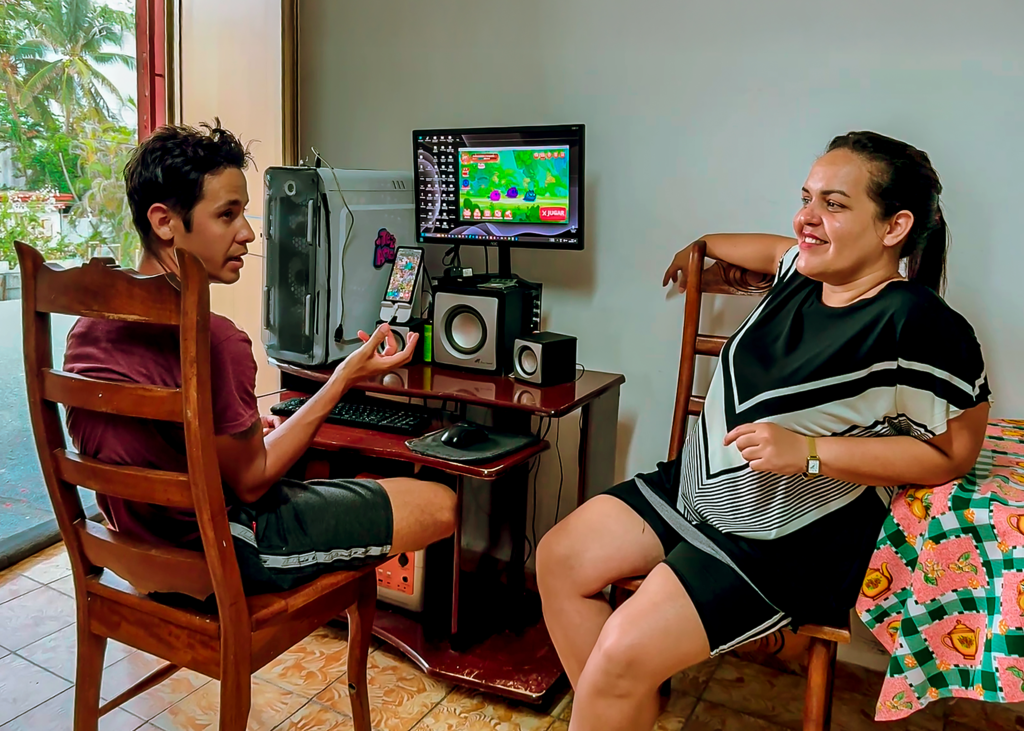
She had already failed two previous exams. This time she tried to show discipline, attention, and reliability—qualities recruiters wanted to see in applicants they might entrust with expensive digital assets. If she succeeded, she would be granted access to a team she could not possibly afford otherwise; if she failed, she would join the long waiting list of Cubans seeking entry into the emergent play-to-earn economy.
In the early 2020s, Axie Infinity—a blockchain game developed by the Vietnamese company Sky Mavis but quickly backed by American venture capital—had become an unexpected economic lifeline for players across the Global South. During the height of the COVID-19 pandemic, it attracted millions of players, from the Philippines to Venezuela. Victories yielded cryptocurrency rewards that could be converted into real money. At its peak, a successful player in Cuba could earn more in a month than many state jobs paid in a year. For a moment, it seemed as though Axie Infinity had achieved what blockchain evangelists had long promised: a democratized, decentralized economy in which anyone with a smartphone and an internet connection could generate income.
“Instead of surveillance, extraction, and moralistic discipline, the cooperative emphasized reciprocity, shared risk, and collective imagination. It used digital assets not for rent-seeking but for building relationships.”
The Scholarship Trap
To understand the cryptic world of Axie Infinity and the experiences of players like Claudia, we began studying the play-to-earn economy in Cuba as part of a broader ethnographic research project on cryptocurrency use in informal economies. At first, we approached Axie Infinity simply as observers. But the longer we followed the game’s Discord scholarship exams and Telegram exchange groups, the more entangled we became in the speculative world we were trying to document.
We learned that the first hurdle our interlocutors encountered was that participation required capital—something many players did not have. The game required at least three Axie characters to participate, each represented as an NFT (non-fungible token) on the blockchain. When prices peaked in mid-2021, the cheapest team of Axies cost around 1,000 US dollars. Therefore, a “scholarship” system emerged—and its origins reveal much about how Axie Infinity became an offshore economy of digital labor, speculative value, and infrastructural improvisation.

The scholarship model did not originate in Cuba. It began in the Philippines, where Axie Infinity experienced explosive early growth. Many Filipino players adopted the game during pandemic lockdowns, when widespread unemployment had left few alternatives. Early investors, often located in wealthier regions, lent their Axies to players who could not afford to buy them, in exchange for a share—often the majority—of the player’s earnings. What began as a workaround quickly evolved into a global system: guilds formed, applications proliferated, and standardized assessment practices emerged.
At first glance, the term “scholarship” evoked mentorship, education, and opportunity. In practice, it disguised exploitative relationships between distant investors and desperate players: a rent-seeking economy in which asset owners extracted value from players who had little choice but to accept unfavorable terms. Entry exams, like the one Claudia took, were introduced as a form of labor discipline—a way to vet potential workers at scale. And once accepted, scholars played under surveillance for hours daily, with owners tracking their performance and setting quotas. Earnings were split according to opaque agreements; failures were swiftly replaced by new recruits. The scholarship system turned Axie Infinity into an offshore labor market built on distributed assets and transnational asymmetries of wealth, regulation, and opportunity.
Playing Through Blackouts
In Cuba, these dynamics took on particular intensity. The country’s economic crisis—aggravated by sanctions, declining tourism, and an ill-timed currency reform—had pushed many young people to look for income online. Axie Infinity circulated through local networks as a rumor of possibility: easy money, global connection, a viable escape. But the offshore nature of the game—its circulation across jurisdictions, infrastructures, and regulatory voids—quickly became apparent.

Cuban players thus faced constraints that few others did. US sanctions meant they could not use major centralized cryptocurrency exchanges like Binance or Coinbase to cash out their earnings. Instead, they relied on informal peer-to-peer markets on Telegram and WhatsApp, where local brokers mediated swaps between in-game tokens and dollar-pegged stablecoins like USDT. These exchanges functioned through fragile systems of trust, reputation, and improvised escrow services.
The stakes were real: because no bank or platform stood behind these swaps, whoever transferred funds first had little recourse if the other party simply disappeared—and stories of exactly that circulated constantly. To contain the risk, some groups would route both parties’ money through a trusted administrator, who would release funds only once the trade had cleared. Others required traders to submit an ID photo, home address, and phone number, so that anyone caught defrauding a counterpart could have their details broadcast to the whole group.

And, once accepted into a scholarship arrangement, Cuban players entered a routine described by our interlocutors as monotonous, repetitive, and physically tiring. The emotional tenor of this labor was shaped by scarcity—of time, connectivity, stable electricity, and trust. During power outages, players raced to finish their daily quotas before their borrowed teams were revoked. Family members lent their phones so that two accounts could run concurrently, making the labor literally collective.
The instability of the game’s economy intensified this precarity. Token values fluctuated wildly; some weeks’ earnings were equivalent to several Cuban salaries, while other weeks they barely covered data costs.
The Axie Gamer Cooperative
Our research into Cuba’s crypto ecosystem took an unusual turn when we decided to intervene in the informal economy we were studying. Inspired by the solidarity we observed among Cuban players—who shared strategy guides, warned each other about scams, and studied together for scholarship exams—we developed the Axie Gamer Cooperative, an experimental attempt to imagine an alternative to the extractive scholarship model.
Using research funds, we purchased a competitive Axie team and offered it to a skilled Cuban player under a cooperative agreement. Rather than a majority share for the owner, as was usually the case, the player received 60 percent of earnings and co-ownership of the team. The remaining 40 percent went into a shared fund with which we purchased a second team for another Cuban player. In this way, each successful player contributed to the onboarding of the next, creating a small cycle of redistribution and growth.
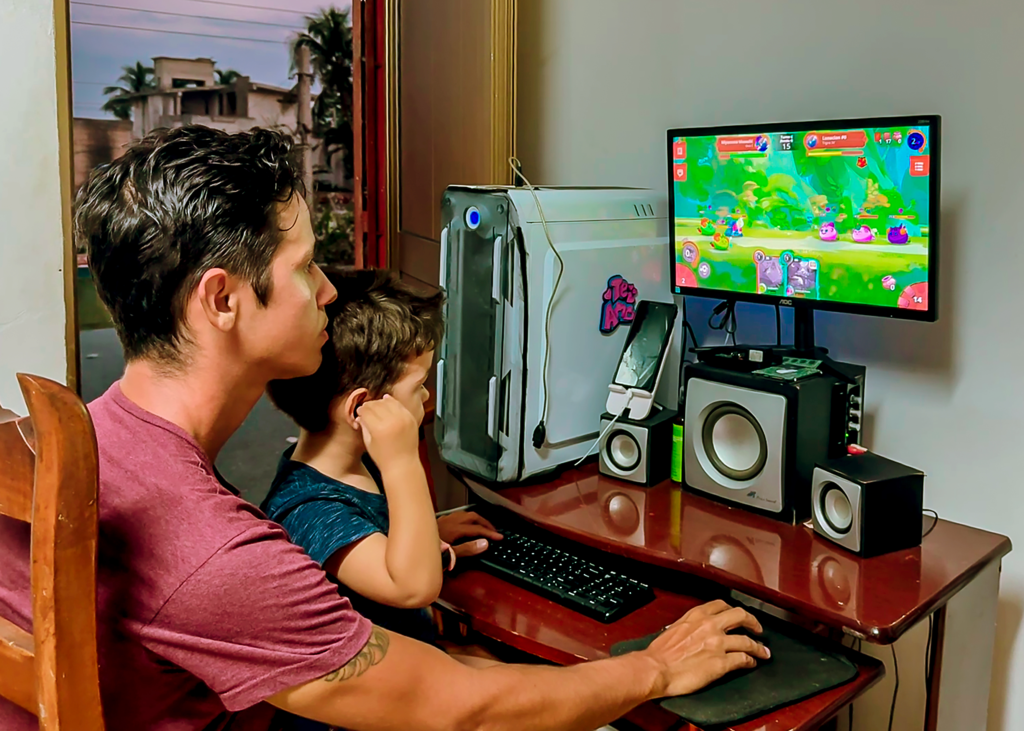
Communication with the players revolved around strategy, market timing, and the logistics of token conversion. The cooperative made decisions collectively: when to swap Axie’s in-game cryptocurrency SLP for the stablecoin USDT, when to reinvest in breeding or upgrading, and how to navigate the island’s fluctuating informal exchange rates. These discussions became a small forum for shared economic reasoning, grounded in the very conditions—scarcity, sanctions, volatility—that had shaped the local crypto ecosystem.
The cooperative did not radically transform the economy of Axie Infinity. But it did reveal that alternative relations could be built within its offshore infrastructures. Instead of surveillance, extraction, and moralistic discipline, the cooperative emphasized reciprocity, shared risk, and collective imagination. It used digital assets not for rent-seeking but for building relationships.
After the Crash
Axie Infinity’s economy collapsed in March 2022 after the North Korean hacker team Lazarus drained over 600 million US dollars from the blockchain underpinning the game. The value of in-game currency plummeted, and most investors abandoned the game.

Yet our cooperative persisted for longer than most foreign-investor-run gaming guilds. Even when profits dwindled, the sense of shared ownership and experimentation remained. The Telegram group we had set up became a space for discussing other platforms, other opportunities, other ways of making do. The collapse, in this sense, revealed what the cooperative had been all along: not primarily an income stream, but a laboratory for rethinking relations within a digital offshore system.
The story of the Axie Gamer Cooperative is, in many ways, a story about the limits of technological utopianism. Axie Infinity promised decentralization and empowerment, but delivered hierarchy and dependence. The cooperative didn’t reverse those dynamics, yet it carved out a space of experimentation and care within them. It demonstrated that even within extractive infrastructures, small acts of redistribution can have value.
In the end, our experiment offered a modest proposition. If offshores are places where value and accountability are displaced, they can also become sites where new forms of solidarity are rehearsed. On an island long cut off from global markets, we briefly turned a speculative game of borrowed assets into a commons. The earnings were small, the network fragile, but nobody played alone. ◆