Can We Offshore Justice?
The Limn interview with filmmaker Alex Rivera.
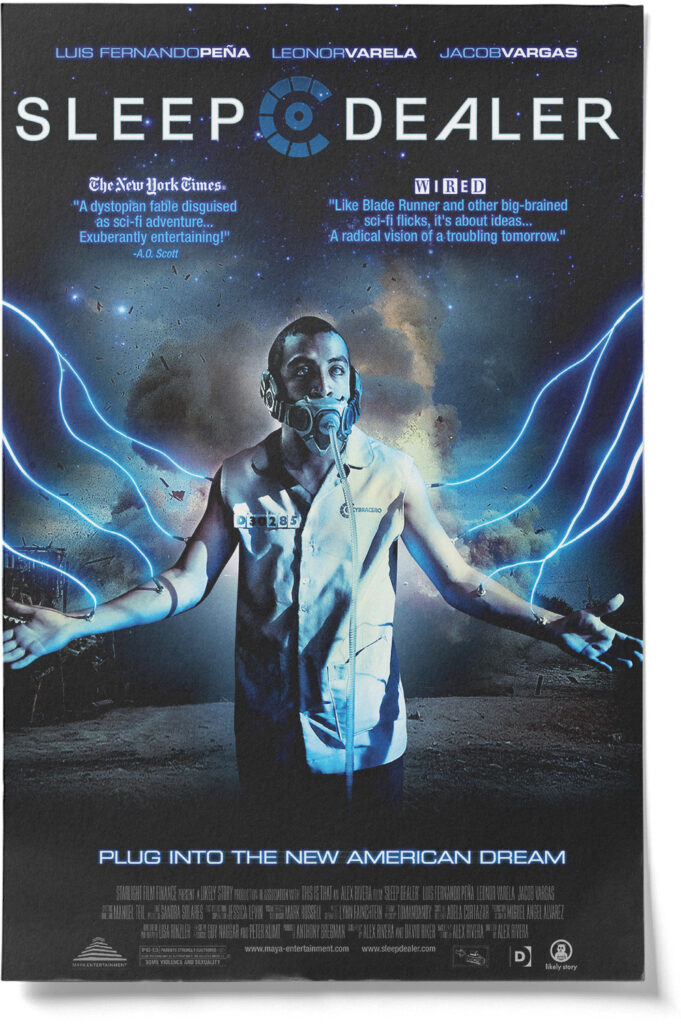
Alex Rivera’s 2008 cyberpunk thriller Sleep Dealer explores the dystopian fantasy of migrant labor without migrants. In the film, immigration between Mexico and the United States is illegal, so the US depends on laborers across the border who puppeteer robots by plugging into machines.
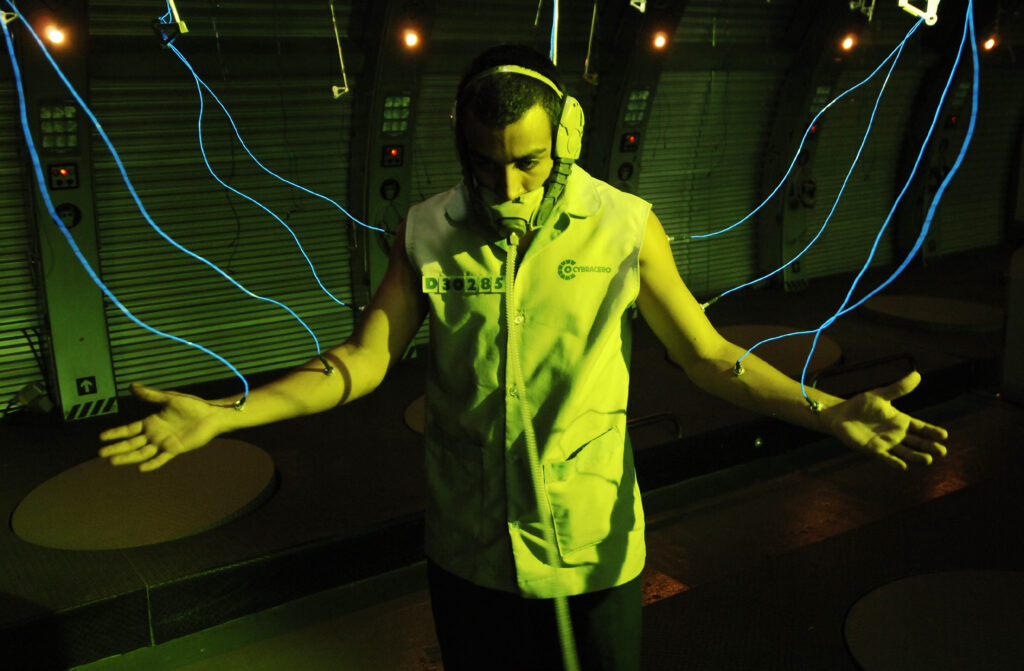
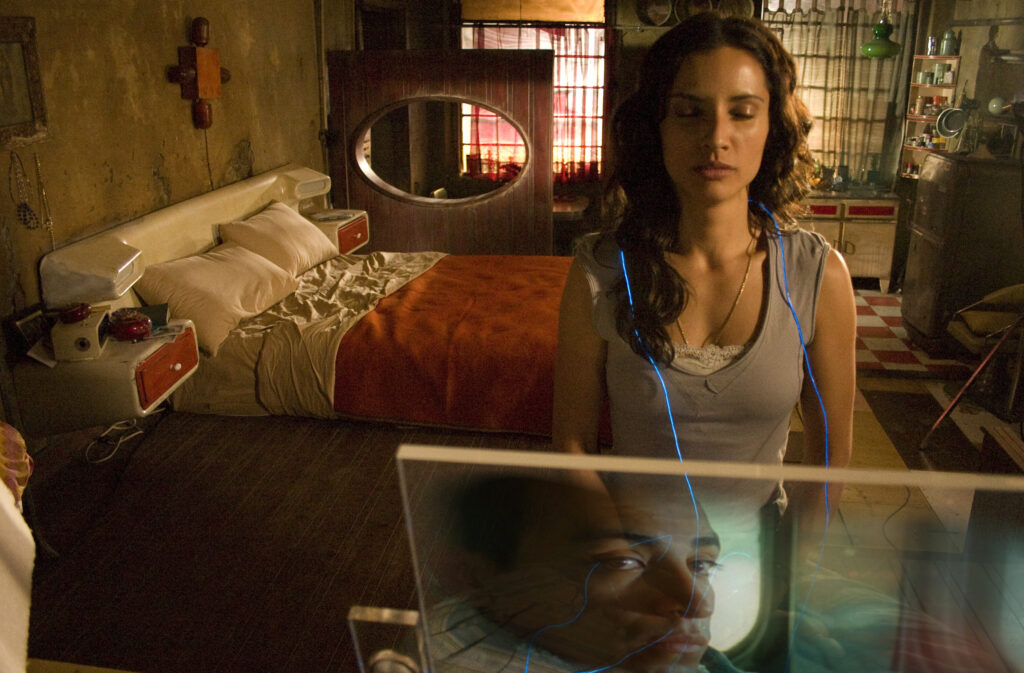
The film’s protagonist Memo is driven to a remote-control work camp in Tijuana after his father is killed in a US military drone strike—which Memo unintentionally witnesses on a grisly reality TV show. In Tijuana, Memo finds a back-alley biohacker to install sockets in his body, and he plugs glowing blue cables from remote-control machines into his arms for exhausting, dangerous, and mentally taxing work. In addition to exploring the violence of offshore labor, the film’s gimlet eye also examines drone warfare and the dangers of bringing reality TV strategies to military action.
Rivera is still making films about migration, globalization, and technology, including The Infiltrators (2019), a formally inventive docu-thriller that he made together with filmmaker Cristina Ibarra. The eponymous infiltrators of the film are activists who intentionally get themselves detained at the in-country offshore of a migrant detention center in Broward County, Florida. From the inside, they organize a hunger strike, bringing new attention and legal pressure to unjust immigration processes.
Limn sat down with Rivera to talk about labor, offshore dystopias and utopias, and AI, which appears in this conversation as the technology par excellence for offshoring labor.1
Jamie Jones These days, are you still thinking about work without workers? If you were making Sleep Dealer today, what would be different?
Alex Rivera First off, Sleep Dealer was never intended to predict the future; it’s not a crystal ball. It’s meant to look at now, through a language that is mythical and poetic and visual: like the blue cables going into the body. These blue cables were the language of film and fantasy; when the film was being made, wi-fi existed, wireless connections, Bluetooth, all of this. So the film works in a language of fantasy and metaphor to reflect on current political and social questions.
That being said, the fundamental guts of it are that capitalism is an amoral system that seeks to package and capture labor, and it will produce any form that allows it to achieve that. And for capital to accrue in the most dynamic ways, technology in that system plays an accelerant role, and technologies are developed in order to accelerate that capture and extraction. The film is a reflection of all that, and it postulates a future where workers will use their human energy in the Global South, and that will be captured in these networks and transmitted to the North, where the labor will be expressed through robots. The circuit that [the film] imagines, I think, has been very predictive of actual material changes in our world.
The part that I missed was the training of AI systems—the role living labor can serve when it is digitally encoded to train algorithms that can then, at one point, start to reproduce that labor. That was something I didn’t see, and it’s starting to happen right now.
Multiple companies have workers in the Global South who are puppeteering humanoid robots in the Global North, just like in Sleep Dealer. However, that remote control is now formed as a step toward training robots to eventually become autonomous. Their labor is, in a sense, being crystallized into a form where it can, at an inflection point, eventually be baked into an algorithm. The decisions that the worker makes—about how to fold a sheet, how to pick a ripe orange, or how to vacuum a couch—are being recorded and are intended to come alive in a future robot form.
The vision of labor being recorded, repetitively, so it reveals its underlying pattern, and can power truly autonomous laboring robots is the North Star for these capitalist enterprises. We’re in a kind of interregnum right now, where all these robot companies are doing the Sleep Dealer thing. It’s like, you get your couch vacuumed, your floor mopped, and your dishes washed. But the real purpose is to absorb that labor and crystallize it so that the machine then replaces its driver. And that’s something I did not foresee that would have been a great third act for the film.
Jamie What are you thinking about the North-South, colonial, and postcolonial politics of AI and labor right now?
Alex I think we really would benefit from stopping society entirely for about a year to have a good think about all of this. Because I don’t think this is a historic juncture that benefits from quick, gut reactions.
Obviously the specter of AI and autonomous robots poses myriad disturbing questions. There are frightening possibilities on the horizon. But I’ve been around and thinking about immigrant workers, and have had immigrant workers in my immediate family for my whole life. And I can’t say that yesterday’s world of labor is good. I never want to be in the position of arguing for the status quo, because the status quo is many forms of systematic violence. And so the prospect of a machine being able to do work that is toxic, painful, repetitive, or demeaning has to be—in our hearts and our minds—a good thing to some degree.
But there’s a lack of social imagination and political vocabulary to describe how that phenomenon can actually produce social benefit rather than more people sleeping under bridges. Our focus has to be on developing imagination, vocabulary, and a set of demands, so that the possibilities of repetitive labor being crystallized in a machine’s mind can somehow be a step in our liberation, justice, and equality. I don’t want to ever be a person who’s like, no to new technology, yes to our families picking lettuce out in the fields.
The question of robots, labor, and borders is fundamentally a political question, not a technological one.
Jamie Is there anything else that you’re reading or seeing or hearing that you think is worth engaging as we think about this issue of the offshore? Could offshoring be connected to other, better technofutures?
Alex I have the Seasteading book [by Joe Quirk and Patri Friedman] on my shelf here. When I read about these projects—these techno-libertarian moonshots—they’re reaching for far-out possibilities. Things like autonomous nations, either on land or at sea, or fully new political jurisdictions. One of the darkest of these mind experiments was from Erik Prince—founder of Blackwater—advocating for the land under the CECOT prison in El Salvador to be given to the United States to make it essentially a protectorate. Then the US would lease the prison back to El Salvador to run it in a service relationship, allowing the United States to remand whoever they wanted to that Salvadoran prison because it would technically be on US land.
Whether it’s thinking about building standalone neo-nations out in international waters, meaning seasteads, or moving the land under a prison from one country to another to enable rightless detention, all this stuff is disturbing and wild.
Yet I’m also a bit jealous of the audacity. I do feel, in a sense, inspired by all of that thinking to try to imagine: What kind of a map do the communities that care about justice want to see? What new political forms could we imagine? Can we offshore justice? Can we offshore equality? What’s our transnational imagination of a just future? Instead of pushing for a higher minimum wage, or tightening emissions—what new political forms can we demand? The neo-fascist imagination of the moment is boundless; what would a boundless imagination of justice look like?
I don’t have the answers, but I do want to engage with comrades and think about science fiction that can put some of that into the world. Science fiction has largely played the role of a warning sign or a critical form. How can it be a form that can tell fantastic, funny, wild, entertaining stories that also have utopian mappings or utopian dreamings? ◆
- This interview comprises edited excerpts from our conversation on November 10, 2025. ↩︎