
If You Give a Gorilla a Wallet…
Inside the world of what is known as interspecies communication, a number of researchers hope to use AI and related technologies to transform animal actions and signals into forms of communication that could let those animals advocate for maintaining their habitats or reducing their suffering at the hands of humans.
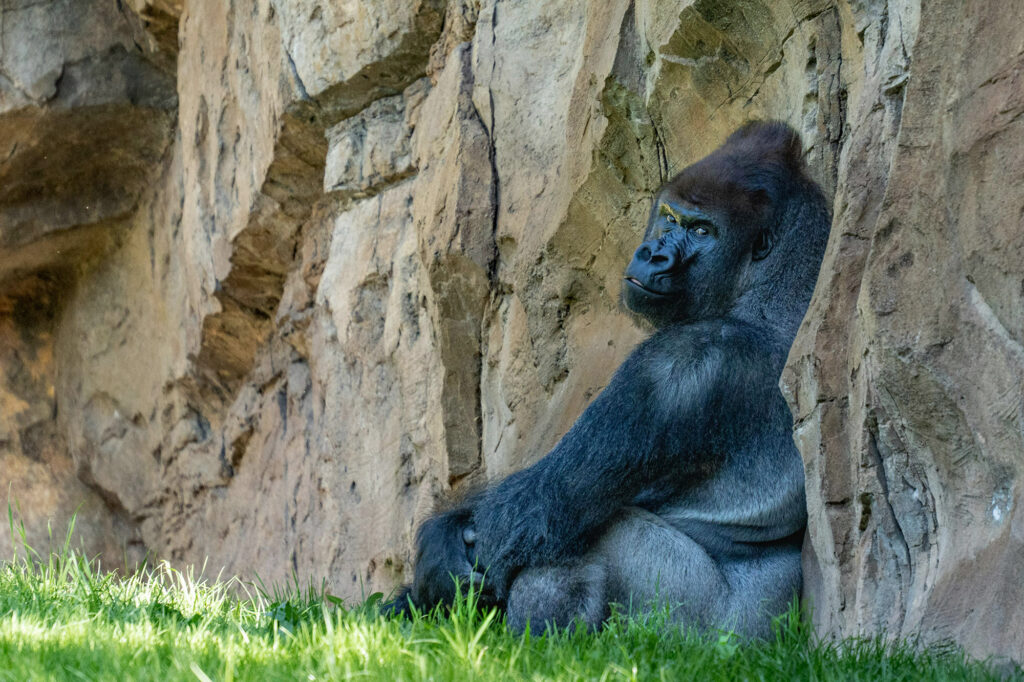
For the Tehanu project, giving animals rights means making the animals vote with their wallets.1 The project aims to serve as a conduit for a kind of AI-driven magic by claiming to grant nonhuman creatures the capacity to speak their own truth to humans and, in so doing, to influence human behavior. Funded largely by the Rwandan government and still very much in the tentative, early stages of development, Tehanu uses artificial intelligence to comb through the scholarship on mountain gorilla ethology and produce a set of inferred species-level “interests” such as security, freedom of movement, and access to food staples. A large-language-model-driven mobile app then allows rangers, trackers, and veterinarians to identify individual gorillas and to receive micropayments whenever the rangers perform actions that the app classifies as furthering gorilla interests.
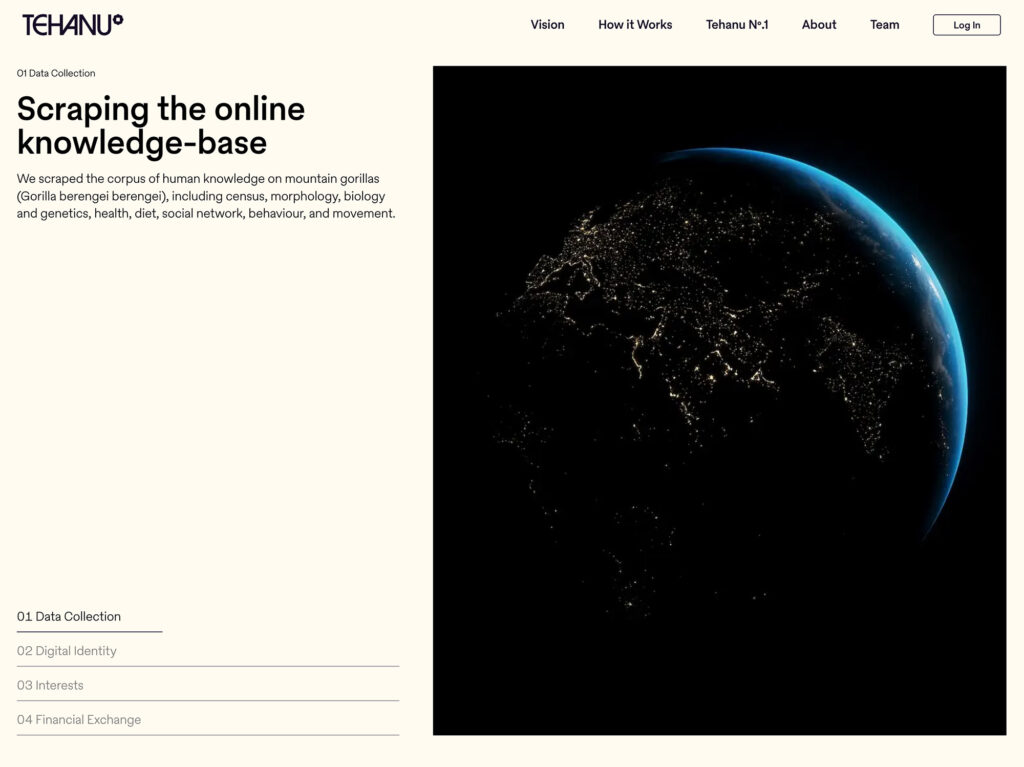
Tehanu uses previously published research scraped from the internet. TEHANU.IO
Currently, Tehanu transfers these payments in Rwandan francs from individual gorillas to individual humans via their respective mobile money network accounts within the national banking system. In the future, though, the project plans to issue payments entirely via blockchain cryptocurrency, thus creating an openly accessible accounting ledger and obviating the need for additional surveillance mechanisms verifying that the pro-gorilla behavior really took place. There are also plans for Tehanu to eventually include the inhabitants of local communities, more species of charismatic megafauna, and species such as ants and bats that may have less sentimental appeal to humans but that play key ecological roles. Within this framework, technology promises to one day communicate and incentivize animal interests with speed, precision, transparency, and a minimum of friction or distortion.
Who or what is given a voice through this model of AI ghostwriting? Who needs to speak in Tehanu’s vision of the world? Because animal advocates involved in interspecies communication tend to see “having a voice” as roughly equivalent to being part of a society, the lack of proxies for animal speech in political and economic processes means that nature, broadly, and individual animals, specifically, are separate from human sociality, even as they are exploited by it.
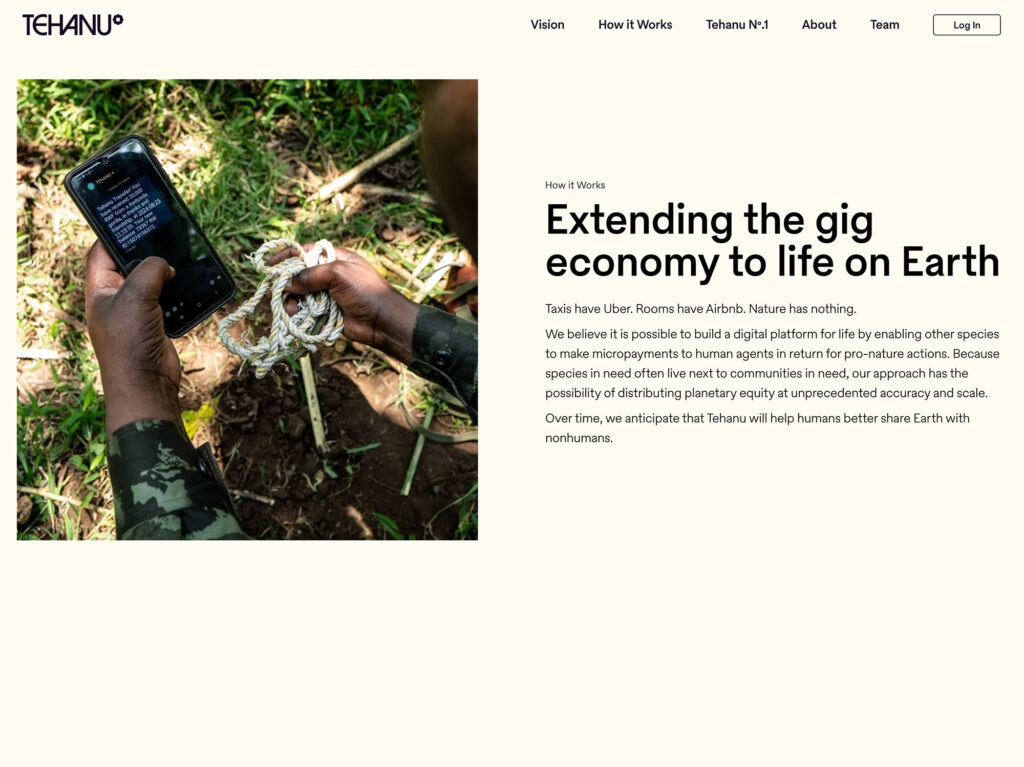
Envisioning gorillas as part of the gig economy. TEHANU.IO
The Tehanu project aims to even the playing field by enrolling animals as meaningfully participating members of human society. This begins with a perspective that frames nature as being relatively disarticulated from society. Even interspecies communication researchers who might be doubtful about giving mobile wallets to mountain gorillas tend to make this assumption of a nature/society divide. As one commenter asked the project’s founder, wouldn’t it be better to just “leave the animals alone?”
Jonathan Ledgard, the journalist, sci-fi author, futurist, and now founder of Tehanu, sees nature as suffering from a failure to properly price itself in the market given its lack of ability, until now, to “speak.” Ledgard’s inspiration for Tehanu was his experience of watching in sorrow as Sudanese farmers chopped down a healthy tree for firewood. If the tree could have argued that it was more valuable alive than dead, he reasons, then it might have been spared. If the tree could pay farmers to not chop it down, then the value of the natural world would be made more apparent.
The Tehanu platform and the larger gig economy model, combined with mobile wallets and blockchain transactions, promise to give nature this speaking role. The tagline on the Tehanu website suggests that gig economy platforms allow objects agency and voice: “Taxis have Uber. Rooms have Airbnb. Nature has nothing.” Of course, it isn’t taxis that “have” Uber, or rooms that “have” Airbnb, but rather people who have possession of cars or homes. However, the parallel erasure of humans in this tagline posits that all kinds of things are given direct agency and voice through the gig economy and mobile payment platforms. In developing Tehanu, nature’s “voice” can be expressed in digital payments that could, say, convince a Sudanese farmer not to chop down a tree.
Ghostwriting in the case of Tehanu is a series of translations across media—what is sometimes referred to as “transduction.”2 How do you go from animal behaviors to the idea of animal interests? How we do this as humans has its own long history. Albert O. Hirschman showed how what had been seen as antisocial human passions or sins came to be ideologically redefined in the seventeenth and eighteenth centuries as economic and political interests that could be arranged into social orders.3 But for Ledgard, no animal Enlightenment is needed to transform gorilla behaviors into economic action. AI can do the work. As he explains in various presentations, gorilla interests can be “inferred” when a large language model is fed “the entire corpus of human knowledge of the mountain gorilla.”
Or at least, that is the goal. As with several elements of the Tehanu project, AI’s starring role in the project of ghostwriting gorilla interests has a promissory character: one day, all this will be automated and easy. For the moment, humans are still helping the AI to do the work.
With interests inferred, there then needs to be a medium for their transmission. Other interspecies communication projects aim for two-way communication—what sometimes gets described as “Google Translate for animals.”4 But Tehanu is not interested in translating animal communication into human language.
Instead, Tehanu is based on the idea that money is already a kind of speech. Economists have long understood the market as a communicative system. For those in the United States, this idea is already familiar: the 2010 Citizens United Supreme Court ruling declared campaign finance regulations unconstitutional on the grounds that the political spending of corporate groups is equivalent to the political speech of individual citizens and must, therefore, be protected equally as a form of free speech. The idea that money is speech has an even longer pedigree, though, in which analysts commonly foreground money’s semantic “capacity to signal a wide array of different meanings and connotations.”5
Today, there are a host of initiatives under the heading of “interspecies money,” all of which operationalize these ideas with the aim of allowing animals and even plants to wield currency in the service of their own interests.6 Goals such as habitat preservation and species survival, once couched in the register of conservation, protection, and preservation, have been recast as economic participation, autonomy, and self-advocacy. The Tehanu project deploys these ideas so that animals, too, can express themselves in a monetary idiom and communicate what the project construes as the fundamental fact of existence: “I’m here. I exist. And I would like to persist … I want to make myself known to you and I’m actually prepared to pay for that.”7
Like many interspecies communication projects, Tehanu frames the communication it hopes to foster in terms that move fluidly between a species and individual speakers. In that last comment by Ledgard, the speaking “I” is, implicitly, a biographically individuated gorilla, visually represented in presentations where Ledgard shows a video clip of a gorilla giving him a high five—a gesture that the audience is invited to see as one of mutual acknowledgement, or even thanks. Equally individuated is each gorilla whose mobile wallet—linked to a unique nose-print biomarker—pays individual humans for pro-gorilla actions.
At the same time, the interpretation of gorilla interests is based, at least for now, entirely on species-level generalization. Standard field sciences, whether ecological or anthropological, begin by making observations of particular actions, events, and individuals, and then extrapolating knowledge about species or other generalized types. Tehanu works the other way around: it begins with scientifically produced species-level knowledge, uses AI to construct a further abstraction regarding species interests, and then uses that doubly abstracted model to construct and express—to ghostwrite—the interests of an individual gorilla. Even if Koko, the gorilla that learned some sign language, may have voiced desires, she did not become an economic actor in doing so. By contrast, Tehanu promises that AI and blockchain technologies will one day turn gorilla passions into gorilla interests.
While the project hopes one day to be able to express individual gorillas’ more particular interests—for example, to climb the gorilla social ladder, to secure a particularly appealing mate, or to alleviate the bloating that accompanies the consumption of vast quantities of roughage—that hope is situated in the somewhat distant future. Why, then, the current insistence on identifying particular gorillas through their unique nose-prints? Why the emphasis on linking mobile wallets to those particular gorillas, using their noses as if they were payment app QR codes? Managing micropayments, whether in Rwandan francs or blockchain currency, does not require individuation. The mobile wallets could be linked to whole gorilla troops, to a territorially defined ecosystem, to an entire species, or to any number of other interest-defined corporate units. On the human side of things as well, mobile wallets could be linked not to individuals but rather to villages, businesses, or political entities. In some ways, constructing a payment system between groups rather than individuals might be a more efficient approach to the large-scale problems of ecological and economic devastation.
But by opting instead for an individuated payment system, the Tehanu project frames payments, and communication in general, as dyadic acts between relatively autonomous individuals. This system encourages humans to imagine themselves in conversation with specific gorillas, who then stand in for the species at large. AI ghostwrites the gorilla’s lines, while the human’s acceptance of currency signals that the message has been received. Just as liberal economic theory posits a market based on a set of interlinked exchanges, these moments of dyadic communication, Tehanu argues, allow nature to be incorporated into society.
The promise of AI is that it allows for all kinds of contacts and connections previously considered impossible, whether to (hopefully true) information, to a famous figure from history in chatbot form, or to a nonhuman animal. AI systems are the ghostwriters that animate these connections. Right now, these systems are placed front and center, while their boosters work to prove that they can make the connections they claim to make: you really can talk to a chatbot version of Abraham Lincoln, and you really can interact with a gorilla to make its life better. But in the future that Ledgard and others imagine, AI mediations will eventually recede into the background as specters that haunt the social relations between humans and nonhumans.
- Readers of science fiction will recall Tehanu as the fourth novel in Ursula K. Le Guin’s Earthsea cycle of stories, about a world in which immense magical power lies in speaking the true names of people, creatures, and things. ↩︎
- Michael Silverstein, “Translation, Transduction, Transformation: Skating ‘Glossando’ on Thin Semiotic Ice,” in Translating Cultures: Perspectives on Translation and Anthropology, ed. Paula G. Rubel and Abraham Rosman (Berg, 2003), 75–108, https://doi.org/10.4324/9781003087243. ↩︎
- Albert O. Hirschman, The Passions and the Interests: Political Arguments for Capitalism Before Its Triumph (Princeton University Press, 1977). ↩︎
- Karen Bakker, The Sounds of Life: How Digital Technology Is Bringing Us Closer to the Worlds of Animals and Plants (Princeton University Press, 2022). ↩︎
- Carl Wennerlind, “Money Talks, But What Is It Saying? Semiotics of Money and Social Control,” Journal of Economic Issues 35, no. 3 (2001), 570, https://doi.org/10.1080/00213624.2001.11506390. ↩︎
- See, for example, the work of Futurity Systems (Plantiverse Explained). ↩︎
- Jonathan Ledgard, “Money as Memory: The Tehanu Project’s First Steps Toward Interspecies Economic Participation,” webinar with Neil Gershenfeld, April 28, 2025, minute 26–28, https://www.youtube.com/watch?v=Bj6AUz_KSGU. ↩︎