
Manifesting Loab
In 2022, an AI-generated entity known as Loab took her place among the firmament of imaginary monsters. She made her first appearance in a series of online posts by the Swedish artist Steph Maj Swanson. Testing generative AI’s ability to create completely novel pictures from vast oceans of previously digitized images, Swanson entered a series of negative prompts into an undisclosed text-to-image platform. The idea was that asking for the opposite of something would induce the AI to generate whatever imagery its proprietary algorithms calculated to be the farthest possible form from what was prompted by the user.
Swanson’s initial request for the opposite of Marlon Brando produced an image that looked like a distorted corporate logo. But a subsequent prompt for the opposite of that image did not produce anything resembling the famous Godfather actor. Instead, the AI generated an image of a corpse-like elderly woman with disheveled hair, rosacea-covered cheeks, and sunken eyes.

The first appearance of Loab on Swanson’s Twitter in April 2022. WIKIMEDIA COMMONS.
Swanson dubbed the woman—the opposite of the opposite of Marlon Brando—“Loab.” She then used her image in a series of subsequent prompts. At this point, the experiment seemed to take a turn toward the strange. In theory, a chain of negative prompts should have led the algorithm to produce a series of images that would appear, to the human user, to be related only arbitrarily. And yet, the contours of the elderly woman’s face and the shades of her complexion remained consistent after multiple prompts. That is, according to Swanson, asking for the opposite of Loab’s image only further stabilized the apparition. Even when Swanson managed to articulate a prompt that generated an image with no visible trace of the woman, she would inexplicably re-emerge in subsequent rounds of the algorithmic game. And in some iterations, she was surrounded by gruesome and violent imagery that had no clear connection to the language of Swanson’s prompts.
In the months that followed, Loab transitioned from a mere curiosity discussed in tech media and popular outlets like Rolling Stone, to a “true” ghost in the machine featured on paranormal podcasts. Analysis by outside parties determined that Loab was quite possibly a hoax intentionally created by Swanson. Still, I would argue that Loab’s alleged ontogenesis is less interesting than the cultural conditions of her plausibility. Even skeptics acknowledge that she embodies a number of tendencies that contemporary internet folklore inherited from its oral predecessor.
“Loab’s alleged ontogenesis is less interesting than the cultural conditions of her plausibility.”
The term “folklore” implies a form of knowledge that is detached from the rationality of science. It hints at experiences and affects that we use to make sense of reality, but that rarely cohere with the inner workings of the technologies that give twenty-first-century life its distinct tenor. Often, our folk perspectives imbue these technologies with a sense of mystical awe or fear. Those of us who are ignorant of computational theory tend to experience AI through texts and images that appear on our screens as if by magic. Our reaction to those texts and images tends to hinge on aesthetic and emotional responses, rather than any formal understanding of the technical procedures that produce them. Folkloric ghosts and monsters become a symbolic shorthand for those abstract feelings. Maybe we are sensing Loab’s presence with that chill of revulsion that lets us immediately distinguish “AI slop” from digital art made by human creators. At times, discerning the difference depends on a vibe, something in the negative spaces between words and images. Is that Loab?
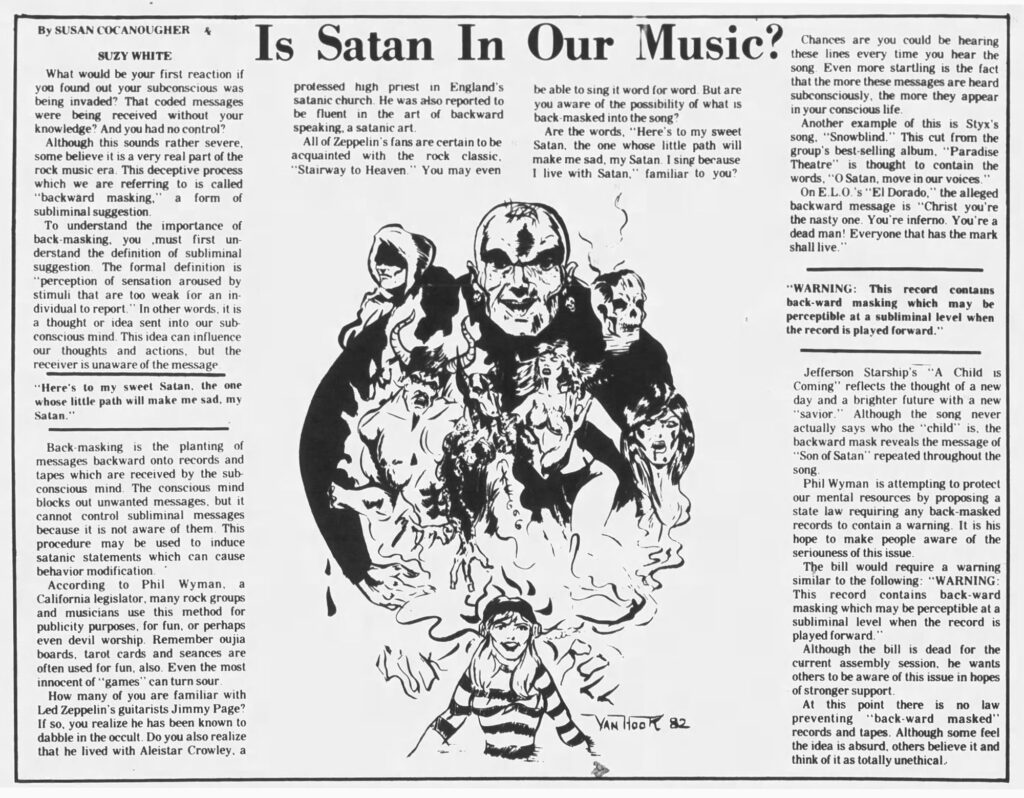
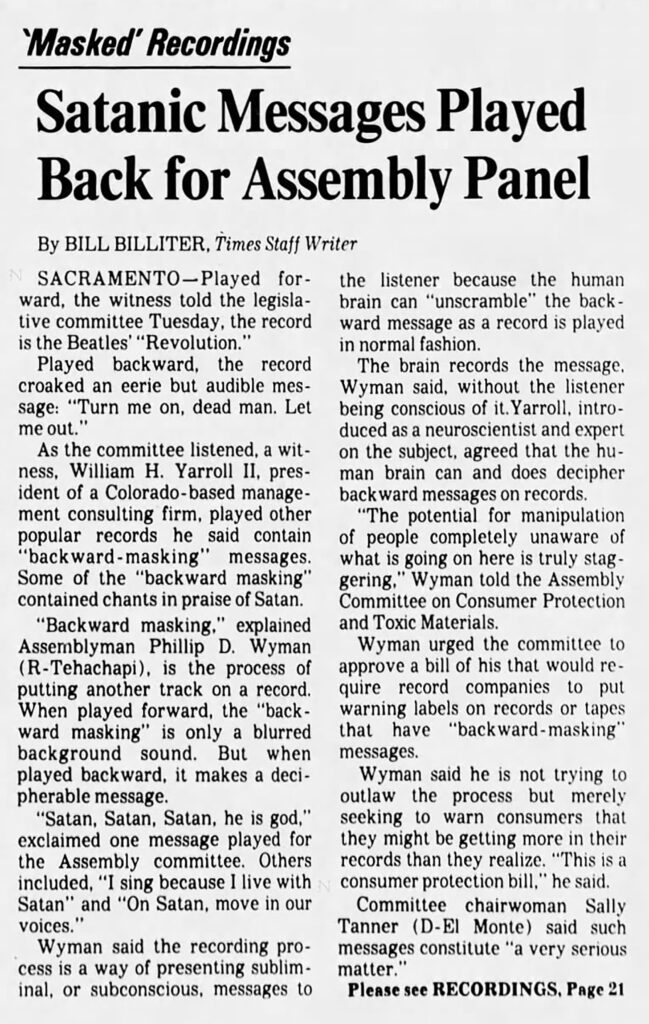
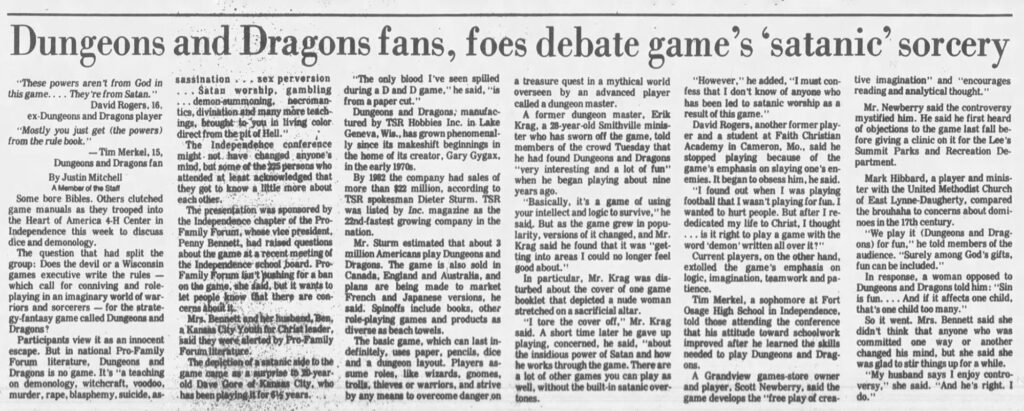
Throughout the 1980s, now-discredited accusations of widespread satanic ritual abuse spurred media sensationalism and paranoia about the role of popular culture (in particular role playing games such as Dungeons & Dragons and heavy metal music) in influencing young minds.
Clockwise from top-left: “Is Satan in Our Music?,” The Advocate-Messenger, October 28, 1982; “Satanic Messages Played Back for Assembly Panel,” The Los Angeles Times, April 28, 1982; “Dungeons and Dragons fans, foes debate game’s ‘satanic’ sorcery’,” The Kansas City Times, January 22, 1983.
As folklore, Loab is a recent iteration of a particularly powerful confluence of paranoia and technology that emerged in the twentieth century, a phenomenon that Timothy Melley named “agency panic.”1 For generations, we have been taught to fear mysterious scientific techniques that allow sinister forces to hijack the thoughts and behaviors of unsuspecting citizens. Loab performs a similar dark magic by using everything that we have uploaded to the internet. She thus shifts the object of subversion from the individual human mind to the vast body of knowledge and creativity that we have committed to our virtual collective unconscious.
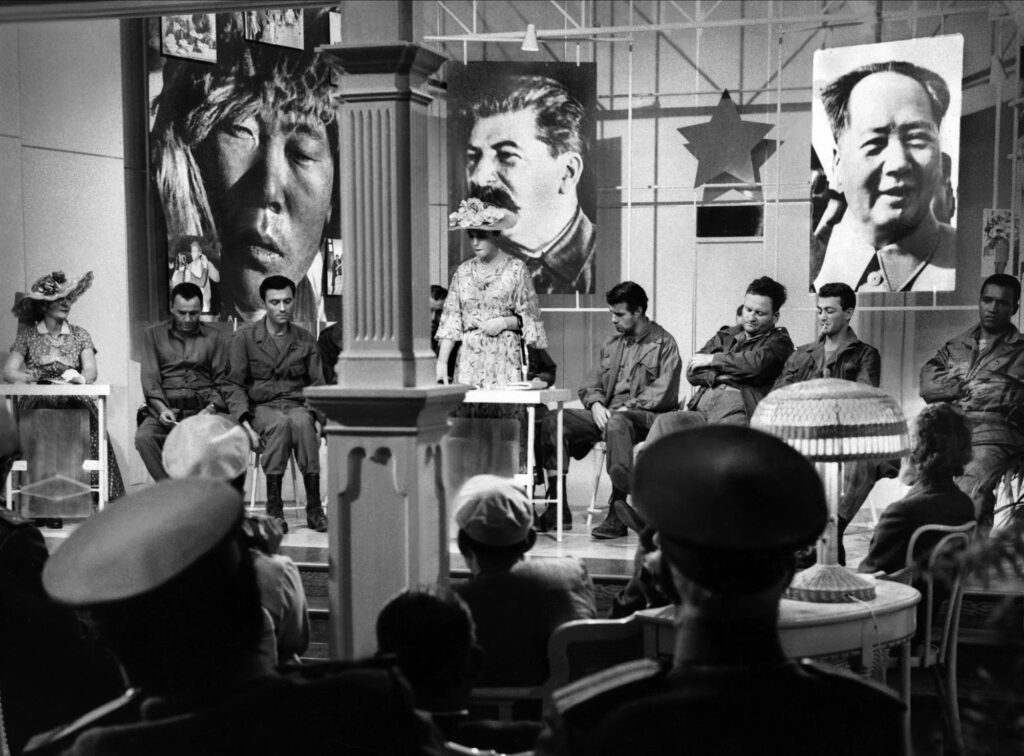
Still from The Manchurian Candidate, dir. John Frankenheimer, 1962
Many elements of Loab’s folkloric genealogy stretch back to at least the 1950s, when Korean War-era footage of American POWs denouncing their country’s war efforts spawned fears of mysterious new mind-control techniques, dramatized on screen in films like 1962’s The Manchurian Candidate. Though the captured soldiers’ treasonous statements have since been attributed to more mundane forms of violent coercion, they contributed to a fear of loss of control that was not limited to Cold War bipolarity.
By the time of my 1980s childhood, popular culture had taken a short step from the “godlessness” of Marxist propaganda to an explicitly Satanic subversion of the American ideal. Television, my teachers, and my schoolmates all (mis)educated me on the dangers of subliminal messages embedded in heavy metal music, video games, and Dungeons & Dragons. Like most Gen-Xers, I grew up in a world where a potential loss of agency over my own mind and body existed inside every suspicious bit of media, just like the needles and razor blades that many believed were hidden inside Halloween candy.

Armstrong-Fumero re-created an incident of needles hidden in Halloween candy that was rumored to have taken place in a neighboring school district in 1987. PHOTO BY NORA DAVIES.
How did these horrors emerge amid a half-century of seemingly unprecedented prosperity? As Melley and other authors have noted, the real loss of agency for millions of late-twentieth-century Americans came through deindustrialization and rising social and economic precarity. Were the imaginary subliminal messages of equally imaginary Satanic cults just shorthand for the growing inequalities that late capitalism hid behind the guise of unfettered consumerism?
It’s no coincidence that a new folk terror emerged in 2009, toward the end of the Great Recession. That year, Eric Knudsen posted two images with brief text captions on the online forum Something Awful, giving birth to the sinister transdimensional entity known as the Slender Man. The Slender Man perpetuated himself through the 2010s as a meme, a cluster of text and image so suited to a moment in culture that he was adapted and reproduced endlessly across multiple media. He was considered an iconic example of the then-novel phenomenon of internet folklore. The Slender Man also embodies a series of technology-induced agency panics that paved the way for Loab.
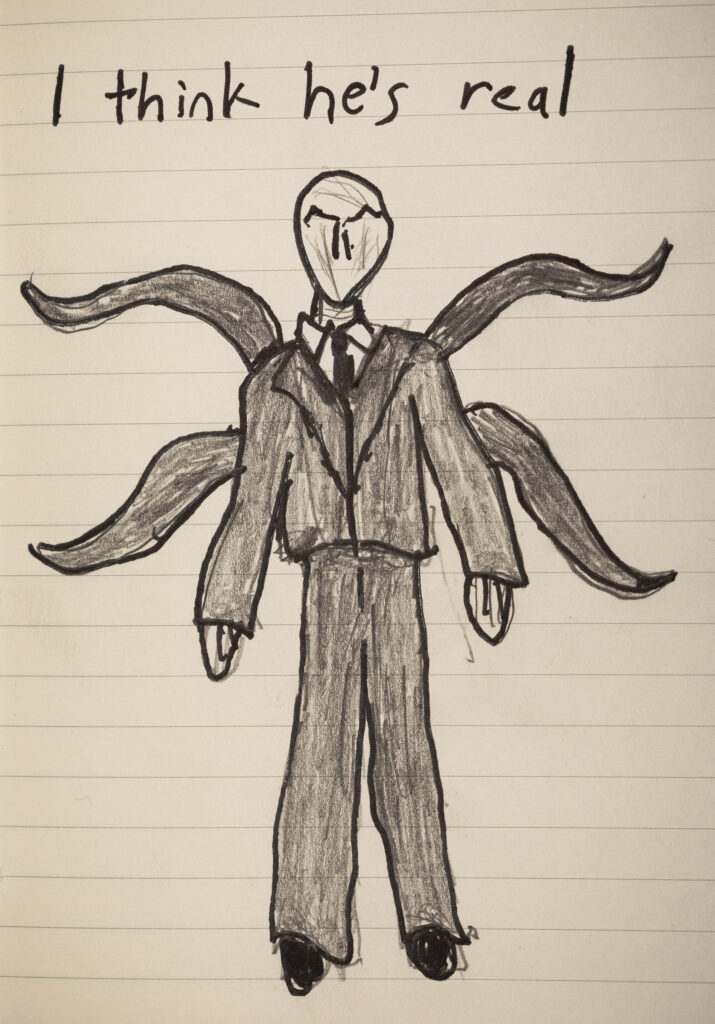
Loab exists among other modern cryptids like the Slender Man.
PHOTO BY NORA DAVIES.
New media notwithstanding, the Slender Man’s real-world powers mirrored the offline paranoia of the ’80s Satanic Panic. Just as heavy metal suicides had instantiated the imagined threat of an amoral music industry that peppered its product with subliminal messages, several high-profile crimes committed by teens in the name of the Slender Man became a metonym for the dangers that children faced in an internet rife with bad human actors. Were these kids accountable for their acts? Or had their minds been hijacked by catfish, cyberbullies, and online groomers whose digital manipulations recalled the techniques that had been applied to captured GIs during the Korean War? Had the Satanic cabals of the ’80s simply found a new medium with which to manipulate teenagers? These parallels hint at continuities in the role of agency panic as a projection, through folklore, of less tangible anxieties about precarity and downward mobility. In some ways, the 2010s simply replaced the unsupervised latchkey kids of my generation with Gen Z tweens who sought escape from their uncertain future in online fantasy.
Still, these continuities in the contours of agency panic emerged alongside some real changes, both in the technological context of our collective imagination, and in our folk epistemologies of danger. Many paranormal content creators whose work I enjoy suggest that the Slender Man can, in fact, manifest in the real world, despite his established fictional origins. These creators draw on notions of “High Strangeness” that were first explored in the 1970s to argue that ghosts, cryptids, and even UFOs come into existence as the somatization of the collective thoughts of ardent believers.2 They become real. Variously referred to as tulpas, thought forms, or egregores, these manifested entities subvert our agency by escaping the safe terrain of fantasy to engage in malice IRL. In theory, the sheer scale of collective fantasy enabled by the World Wide Web has accelerated this phenomenon.
Over a decade after the Slender Man made his first appearance online, the story of Loab instantiated High Strangeness by drawing on an emergent technology to create a truly credible egregore. Whether or not he could manifest physically, the Slender Man had his origins in a known human author. But through the “magic” of AI, Loab emerged autonomously out of our uploaded collective unconscious—her author was, at the same time, all of us and none of us.
For those of us raised on ’80s and ’90s popular culture, this posits a number of frightening, once-fictional possibilities. Is Loab a herald of the apocalyptic “rise of machines” at the heart of the Matrix and Terminator franchises? What does Loab’s manifestation teach us about the prejudice and violent fantasies that pervade online culture? Why, for example, did the internet teach AI to equate femininity, old age, and apparent illness with the horror imagery that accompanied some of Loab’s later iterations?3 Is Loab a manifestation of dark impulses that have become dominant in our collective digital subconscious?
And what if the skeptics were wrong, and Loab wasn’t a hoax? Here, the possibilities are less immediately threatening than some older paranoid fantasies, but no less uncanny. As a 2022 Rolling Stone article noted, the most frightening aspect of Loab is simply that she continued to exist, despite a series of prompts that should have altered her visual appearance beyond recognition—and that seems to be the limit to her schemes. Unlike the imaginary Satanic cabals of the 1980s, or the physically manifested Slender Man of the 2010s, Loab hasn’t coerced anyone into committing harm unto themselves or others. The only thoughts that she wants to hijack are those which we have already uploaded into the digital ether. For the appetites of algorithmic ghouls, human meatware pales in comparison to the endless feast of experiences and creativity that we have committed to virtual space.
It seems that for many of us, this loss of total human mastery over technology is horrific enough. Loab embodies the loss of our dominance over intellectual production, that last bastion of human labor amid the hyper-mechanization of late capitalism. Worse still, the technologies that birthed her are as pervasive as they are obscure. Most of us can’t explain how AI algorithms work, but we can sense their presence in texts and images that don’t seem quite right. At least, we can for now. Like Loab, AI continues to perpetuate and refine its existence, productively and profitably remixing the digitized debris of our culture.
- Timothy Melley, Empire of Conspiracy (Cornell University Press, 1999). ↩︎
- “Defending the Mothman,” Haunted Objects Podcast, episode 005, December 26, 2022. ↩︎
- Nina Raemont, “Who Is the Woman Haunting A.I.-Generated Art?,” Smithsonian, September 12, 2022, https://www.smithsonianmag.com/smart-news/loab-artificial-intelligence-art-180980743/. ↩︎