
The Hungry Sovereign
We have heard about the emperor’s clothes, but what about the sovereign’s appetite?
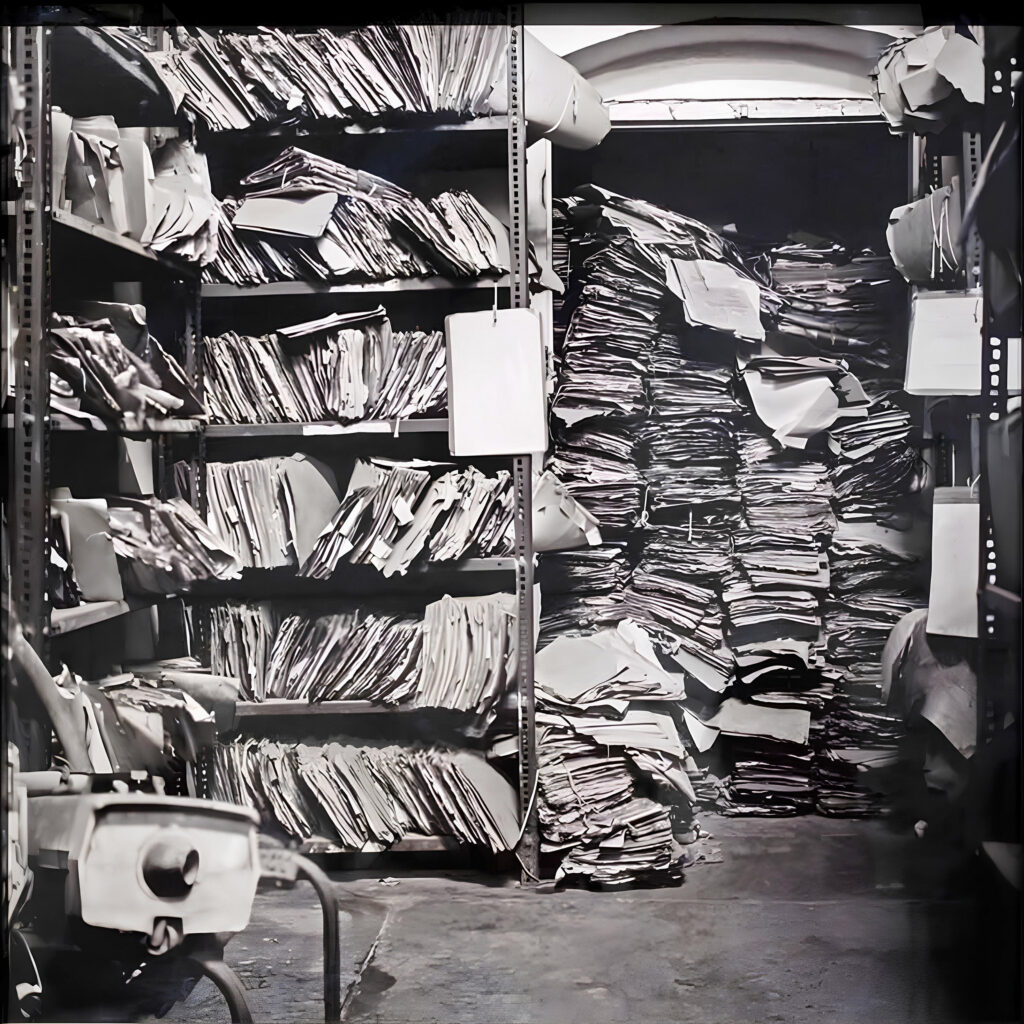
The paper trails and traps of India’s bureaucracy are legendary. The Indian state is not so much an iron cage as a vast, papyraceous web of documents—certifying a recipient of welfare, a legible citizen, or a legitimate voter, tracing the many stages of official decision-making and every layer of approval, logging every transaction, and registering the rightful owner of every parcel of land.1
In the late 1980s, early forays of the state into new computing and telecommunication technologies saw the conversion of physical files into their digital counterparts. Thus, “e-governance” in India was born, wherein existing bureaucratic techniques, forms, and practices were reconfigured as siloed virtual services. Land records were the first to be digitized, followed by bank transactions, utility bill payments, vehicle registrations, passports, driving licenses, and tax returns. The techno-optimism of e-governance was accompanied by a heady mix of discourses on efficiency and transparency that stoked the neoliberal fire blazing at the turn of the century.
Since then, an uncontained appetite for data has transformed India’s bureaucratic state, first into a digital state, and then more recently into what I call a “platform state”—and with that change has come an insatiable drive to devour long-standing settlements between the state, citizenry, and capital, and ultimately the body politic.2
The presumed affordances of speed and incorruptibility awakened the state’s appetite to digitize ever more points of contact between itself and its citizens. Buoyed by the prevailing techno-optimism as well as a nascent techno-nationalism, in 2009 the state rolled out a biometrics-based identification system called Aadhaar. Initially restricted to welfare recipients, its ostensibly non-duplicable biometric data was seen as a technological fix for the corruption and leakages that had long plagued India’s public distribution system. By 2014, however, Aadhaar had become a de facto requirement for all citizens and residents. Far exceeding its original size, purpose, and remit, it had morphed into the largest identification infrastructure the world had ever seen.3
Aadhaar flattened the multiaxial diversity of the Indian citizenry (language, region, culture, and so on) into universally capturable biometrics (name, gender, address, date of birth, iris scan, fingerprints, facial scan), and generated a database of unique twelve-digit numbers. The successful encompassment of over one billion people into Aadhaar was not an end point however, but a crucial milestone that only intensified the state’s drive to use biometric identification in new spheres. In a radical first, in 2014 the Indian state allowed the use of Aadhaar, in the form of a new hybrid technology, eKYC (Electronic Know Your Customer), for accessing not just government services and welfare, but also private services.
A remote, real-time digital identification process, eKYC began the transmutation of Aadhaar from a state identification platform into an authentication technology for commercial transactions—a pivotal change that upended the prevailing settlements between the state and citizens of India as the state identification framework began to be used in the service of private profit.
This potential for interoperability across domains acted as a catalyst for the creation of the governance behemoth India Stack, the backbone architecture of India’s new Digital Public Infrastructure. The Stack is imagined as a total governance ecosystem aimed not just at digitizing, but at digitalizing the state-citizen relationship. Digital governance under India Stack is composed of discrete yet compatible platforms: Aadhaar (the identification layer), Unified Payments Interface (the digital payments layer), DigiLocker (the digital dossier for state documents), and Sahmati (the consent layer). Each layer uses Aadhaar as its base and is interoperable with other layers in the Stack. This architecture enables seamless cross-platform integration and communication: a lender can access an applicant’s banking history, retrieve their relevant documentation, secure consent for access to their data, and verify their identity—all in one swoop. And new layers and ancillary technologies continue to develop apace. Notably, while e-governance technologies like Aadhaar may have been developed with the help of private enterprise, they are wholly owned by the state. On the other hand, each layer within India Stack, apart from Aadhaar, is owned by private capital.

Aadhaar whetted the state’s appetite for data as a new comestible, and this appetite came accompanied by a rhetoric of data sovereignty. India Stack is positioned as the edifice for generating sovereign data—based in the citizenry, but controlled by the state, and used for far more than mere statecraft. Aadhaar reduces every citizen to a set of data points, enabled by the state and open for exploitation by private providers and state alike. This data circulates through banks, fintech firms, lenders, and insurers, generating profit while gaining access to ever more granular aspects of everyday life, and deepening the state’s capacity for surveillance and control. The proliferation of data allows both state agencies and private actors to act upon populations in real time—restricting access, erasing rights, approving credit, flagging risk, suspending benefits, or triggering investigation. Administrative and political erasure—through database exclusion, deletion, or procedural invisibility—is becoming a reality, as illustrated by recent controversies around the Special Intensive Revisions of electoral rolls, and citizenship adjudication under the National Register of Citizens and the Citizenship Amendment Act of 2019.
As hunting grounds expand to feed the data-hungry sovereign, more governmental technologies are being developed—all based in Aadhaar—to swallow hitherto unmetabolized aspects of citizens’ lives. These include cashless transactions under the Unified Payments Interface, the aggregation and storage of every citizen’s documentation in DigiLocker, and so-called open banking (or more precisely, open lending) coordinated through Sahmati. And ever more new ancillary technologies rise in the shadow of the Stack, including facial-recognition-based digital passports for humans (DigiYatra) and biometric identity cards for cattle (Pashu Aadhaar).
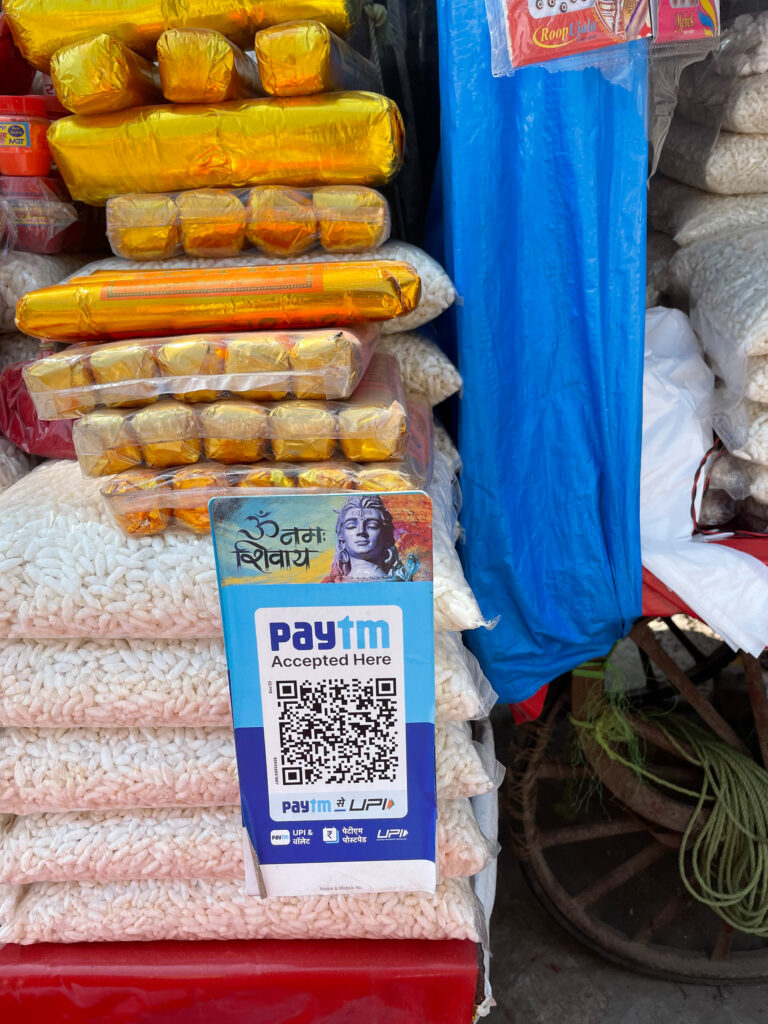
Appetite morphed the bureaucratic paper state into a digital state, paving the way for the platform state. The digital state converted existing objects and practices—land records, bill payments—into electronic form. The platform state, by contrast, creates new objects and relations in its own image. It does not just register persons and things; it renders citizens as digital assets, and day-to-day existence as a series of infinitely recombinant digital dossiers. The unbounded appetite for data and datafication has altered the nature of the state itself, into a meta-platform par excellence; the platform state abandons its paternalist persona, and instead exposes its citizenry to capital’s unchecked appetite. The state now exists primarily as force, while sovereignty and profit become ever more blurred.
The Indian state has long transacted across the public-private boundary, from colonial governance through e-governance. What distinguishes the platform state is that commercial capacity is no longer auxiliary to state capacity—it is constitutive of it. Governance now depends structurally on private infrastructures and venture-backed innovation. The state seeks total encompassment not only by digitizing what exists, but by generating new digital subjects, practices, and dependencies—while digitally erasing others. The platform state’s aspiration to complete sovereignty is unattainable, yet its pursuit intensifies the appetite. This sovereignty wishes not only to consume what is already there; it produces more to consume, opening its mouth wider and wider.
“Might sovereignty be devouring?” asked Derrida.4 For him, sovereignty rested on the distinction between humanity and animality, and on the sovereign’s capacity to limit its appetite—to avoid collapsing into the figure of the beast or the cannibal.5 In Indic theology, a voracious appetite or an all-consuming impulse triggers cosmic destruction. At the end of an age (kalpa), the world is destroyed in a great flood (pralaya) that swallows everything on earth. Vishnu, the god of creation, rests on the coils of the Great Serpent, or Shesh Nag, the sole survivor of the pralaya, who also holds the earth aloft. Shesh means “remains” or “remainder,” and it is Shesh Nag who provides the first substance of life, a part of its own body, with which Vishnu creates the world anew.6
The myth illuminates a structural limit. Even the most devouring sovereignty cannot eliminate the remainder. In the platform state, holding multiple Aadhaar cards or continuing to transact in cash may appear as system failures. Yet they also serve as brakes on devourment, keeping sovereignty always in a state of incompletion. ✳
- For instance, Akhil Gupta, Red Tape: Bureaucracy, Structural Violence, and Poverty in India (Duke University Press, 2012), https://doi.org/10.1215/9780822394709; Tarangini Sriraman, In Pursuit of Proof: A History of Identification Documents in India (Oxford University Press, 2018), https://doi.org/10.1093/oso/9780199463510.001.0001. ↩︎
- Kriti Kapila, “The Platform State: India After Aadhaar” (forthcoming). ↩︎
- Kriti Kapila, Nullius: The Anthropology of Ownership, Sovereignty, and the Law in India (HAU Books, 2022); Ranjit Singh, “Give Me a Database and I Will Raise the Nation-State,” South Asia: Journal of South Asian Studies 42, no. 3 (2019): 501–518, https://doi.org/10.1080/00856401.2019.1602810. ↩︎
- Jacques Derrida, “Eating Well, or the Calculation of the Subject,” in Points: Interviews 1974–1994 (Stanford University Press, 1995), 7. ↩︎
- Jacques Derrida, The Beast and the Sovereign, Volume I, trans. Geoffrey Bennington (University of Chicago Press, 2009). ↩︎
- Charles Malamoud, Cooking the World: Ritual and Thought in Ancient India, trans. David White (Oxford University Press, 1998). ↩︎