Suspended Endings
Decommissioning an oil platform can be as hard as building one
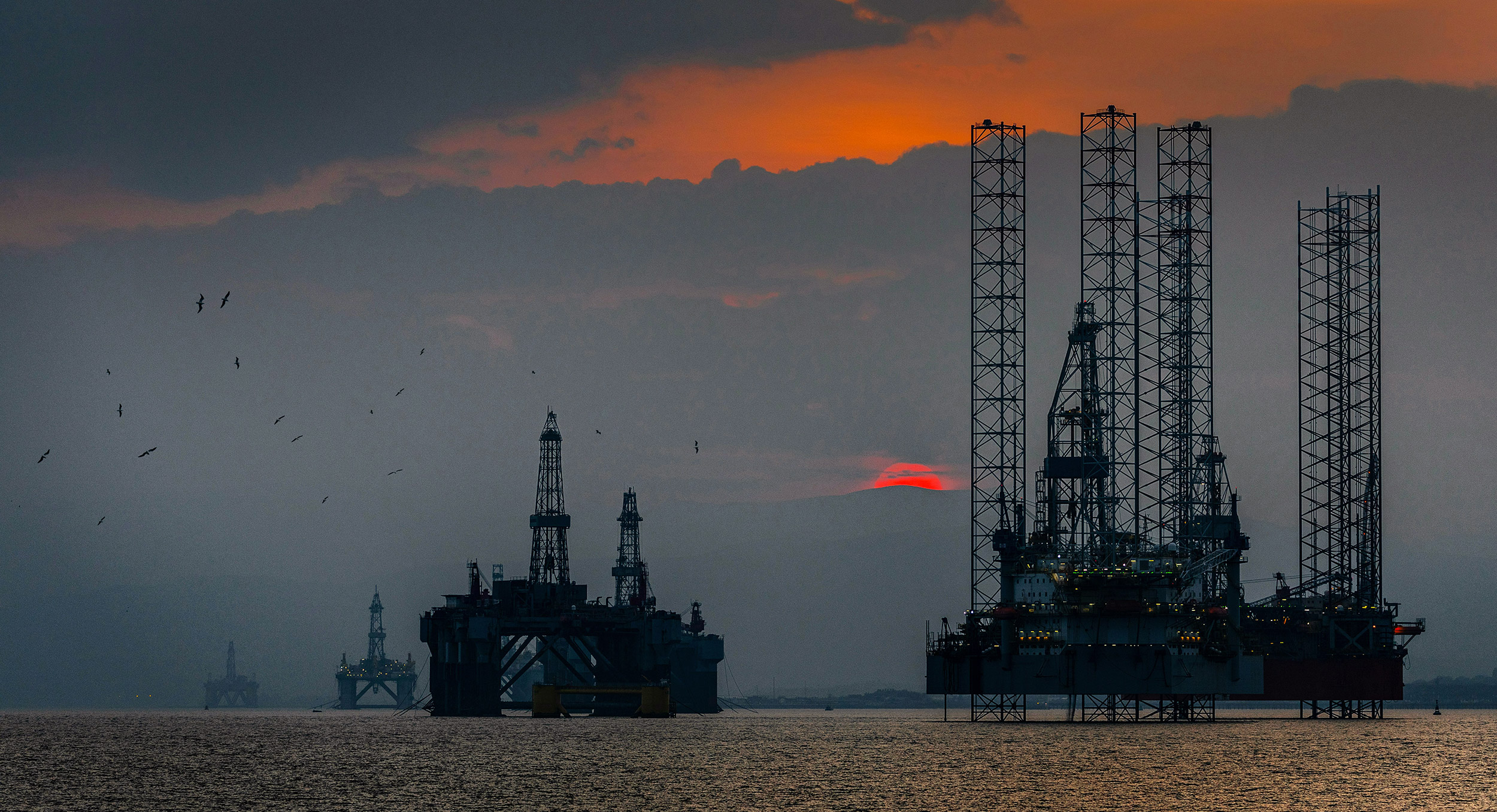
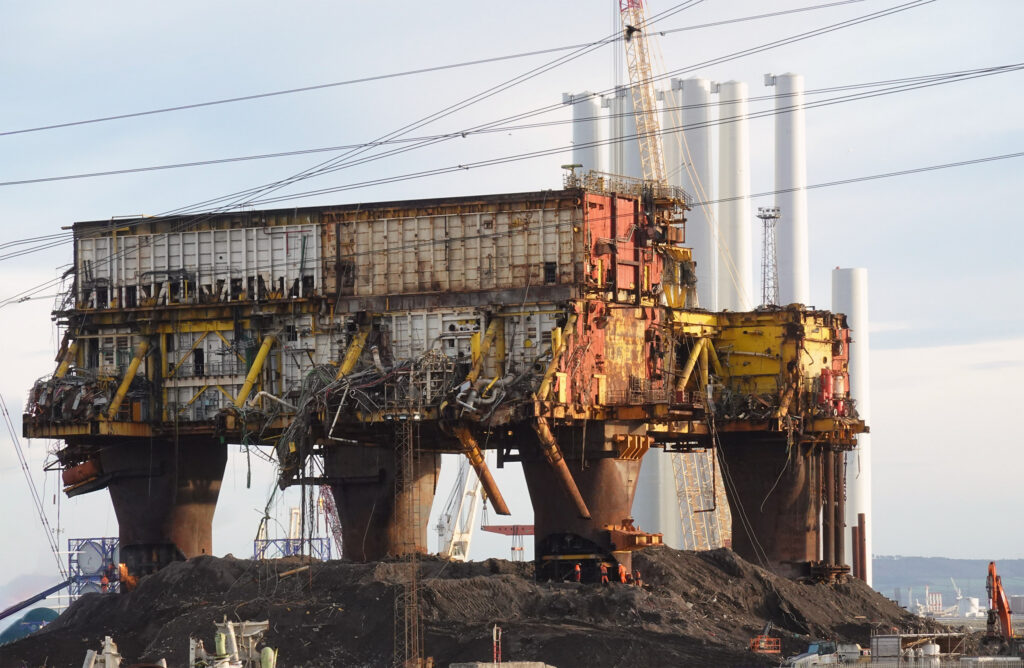
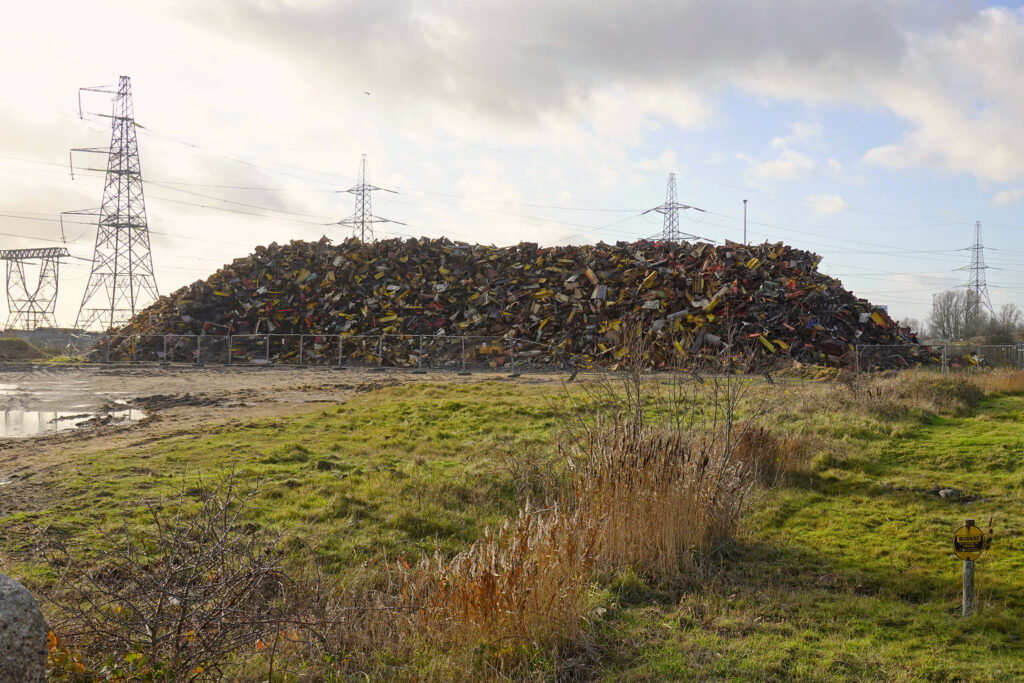
The death of an offshore oil and gas platform may mark the end of several decades of fossil fuel production, but the consequences of extractivism endure. Extending into geological timescales, these platforms’ afterlives outlast the corporate entities that once wrought value from them. Obscure in their productive life, nestled in the ambiguous and inaccessible “offshore,” the reterritorialization of these monolithic platforms embodies an immense scale of labor, capital, and waste. Offshore, platforms devolve through decommissioning, plugging, and abandonment procedures. Once on shore, the platforms slowly shrink as they are painstakingly deconstructed into growing piles of rubble.
Hydrocarbon extraction first began in the North Sea in 1967. Extractive output peaked in 1985 at 2.63 million barrels of oil per day. By now, the region has been “drilled to death,” as a longtime industry interlocutor described it to me. The oil and gas industry has transformed the oceanic subsurface of the United Kingdom’s continental shelf into an infrastructurally dense industrial zone, leaving behind 12,000 nonproducing legacy wells, over 1,500 platforms, 45,000 kilometers of pipelines, and nearly 900 inactive wells that have yet to be decommissioned.1 The cost of decommissioning these installations is estimated at £44 billion.2
The 1998 Oslo Paris Convention (OSPAR) Decision 98/3 first mandated the decommissioning of disused offshore oil and gas installations. As a signatory party of the convention, the UK government adopted the 1998 Petroleum Act; this consolidated a discordant regulatory landscape by reforming model contract clauses and, crucially, establishing a national-level legal mandate for the permanent plugging and removal of disused offshore oil and gas infrastructure. However, before these policies were implemented, many North Sea platforms had been built without consideration for how they would eventually be dismantled.
Despite the inevitability of ruination made clear by the boom-and-bust cycles of capitalism and the obviously finite nature of subsurface fossil fuel reserves, before Decision 98/3, industry pioneers built extractive infrastructure based on an ideal of infinitely productive potential. Decommissioning these installations has presented immense challenges. Older structures can contain obsolete technology or other site-specific features, which require significant capital and time to dismantle. Additionally, their scale and weight results in enormous quantities of waste; conceived under the conceptual banner of a limitless carbon modernity, these structures were built for permanence. The record for the heaviest structure ever moved is held by the Gullfaks C platform, which commenced commercial extraction in the Norwegian North Sea in 1986. Weighing between 1.4 and 1.5 million metric tons, the platform has yet to be decommissioned.3
Similar challenges plagued the Brent oil and gas field, which began extraction in 1976. Each of Brent’s four platforms was roughly equivalent to the Eiffel Tower in height. Brent Charlie, the last, largest, and heaviest of the four platforms, was brought onshore for decommissioning in 2024. Its topside was, to use Shell’s language, “brought home” by the Pioneering Spirit, the largest construction vessel in existence. Even this enormous vessel needed to be widened to accommodate the platform’s size.
Decommissioning offshore oil and gas infrastructure in the North Sea, one of the harshest marine environments on Earth, demands nearly as much technological innovation and capital as it took to enable extraction at the bottom of the ocean in the first place.
Prior to the late 1990s, decommissioning was not a priority for the industry. The idea that oil would run out was conceptually reduced to merely a “blip in the production curve,” as one of my interlocutors noted. It wasn’t until after the ratification of the 1998 Petroleum Act that the industry realized they were “on the hook” for decommissioning costs.
However, due to the complex ownership histories typical of offshore oil and gas infrastructure in the region, mandatory decommissioning can be difficult to enforce. Throughout the productive life of a given installation, there are often several owners, depending on the scale of the reserves and the extractive capacity of the site. In general, larger operators possess the capital and technological capacity to extract from larger reserves. When confronted with the natural decline in profitability of a traditional bell-shaped production curve, companies will abandon sites to pursue opportunities elsewhere, often selling to smaller operators. Scavenging for second, third, and fourth-time hand-me-downs from large operators, companies specializing in “late life well management,” like vultures, seek to extract value from a downward production curve.
And yet, it is the final owner who assumes the financial liability to decommission. Unable to generate capital from dwindling reserves, the pattern of serial ownership can result in the cost of decommissioning outweighing an operator’s total value. When an operator thus becomes insolvent, bankruptcy severs ownership, as well as the obligation to fund decommissioning, effectively orphaning the site.4 This leaves platforms financially stranded and with no clear pathway for decommissioning aside from the government taking on the liability, at the taxpayers’ expense.
Through the sale of mature platforms that loom over depleted reserves, the platforms’ original operators disentangle themselves from the legal requirement to decommission, and from the costs associated with the inevitability of the platforms’ eventual deconstruction. Yet, this evasion of liability for aging infrastructure is also evident beyond obstruction through sales. Conceptually, decommissioning is obscured through euphemisms like “late life well management” and “well integrity management,” which invoke productivity, vitality, and life, rather than more relevant descriptors like decline, depletion, and death.
Delaying death-by-decommissioning can be accomplished through expensive technological interventions—known as enhanced oil recovery—such as injecting CO2 or chemical polymers, or flooding wellbores with low salinity water to artificially induce pressure and revitalize extractive capacity. While such strategies have been a strategic focus in the North Sea for over a decade, they are inaccessible to stakeholders faced with declining profitability. Eventually, these operators either run their installations at a loss, or they cease production to leave sites in “suspension,” staving off the high costs of decommissioning, while buying time in the hope that technology to revive the sites becomes more affordable.
While the North Sea Transition Authority (NSTA) allows for up to two years of suspension, there has been a dramatic rise in the number of installations exceeding this guideline. In 2025, nearly 900 wells were in violation of the two-year suspension limit, accounting for almost half of all wells scheduled to be decommissioned before 2030. This statistic reveals the material consequences of the tension between the legal requirement to decommission and the high costs associated with doing so. The resulting administrative limbo fails to address the immediate reality of platforms that are no longer productive, namely, the potential hazards of unplugged or improperly plugged wells to the surrounding marine ecosystems, and the increased carbon dioxide and methane emissions resulting from such sites.
This neglect is also having serious repercussions on the efficacy of long-term decommissioning plans in the region. While the North Sea is a comparatively mature productive sector, the decommissioning supply chain is still nascent. This means that while decommissioning service companies are emerging—along with the requisite supply vessels, personnel, and cranes large enough to handle the scale of offshore oil and gas infrastructure—the industry is not yet firmly established. And, with so many operators reneging on their decommissioning deadlines, the NSTA recently warned licensees that the supply chain is reacting to this inactivity by leaving the North Sea.5 Plugging and abandonment contracts have not been issued on the scale that contractors had anticipated, prompting decommissioning companies to seek more secure opportunities elsewhere. If deferrals continue, this reduced capacity could raise decommissioning costs in the region by another £4 billion.6
The abrogation of liability evident within the layered iterations of ownership, as well as the negligence of the tail-end operators in meeting decommissioning deadlines, both demonstrate a pervasive devotion to cost avoidance. Yet ultimately, such attitudes may significantly raise the overall cost of decommissioning oil and gas infrastructure in the North Sea. Despite international law’s straightforward notion that the polluter pays, there is a lack of legislative precision regarding how exactly the full complement of a platform’s operator history may be held accountable for environmental damage, and to what extent this responsibility can be enforced.
When we consider energy futures, we must also reckon with the costs intrinsic to ending fossil fuel modernity. In doing so, we encounter not only the dizzying scale of technical complexity and waste produced in the removal of offshore oil and gas platforms, but also the convoluted socio-legal landscape that is made visible through their demise. ✳
- Benjamin Pullen, Aaron Cahill, and Daniel Arnold, “Differentiating Legacy Wellbores in the Scottish North Sea Using Multi-Criteria Decision Analysis with a View to Minimising Containment Risk for Carbon Capture and Storage,” International Journal of Greenhouse Gas Control 1, no. 42 (2025): 104336, https://doi.org/10.1016/j.ijggc.2025.104336; Victoria Masterson, “What to Do with Ageing Oil and Gas Platforms—and Why It Matters,” World Economic Forum, April 2, 2024, https://www.weforum.org/stories/2024/04/decommissioning-oil-and-gas-platforms/; Rebecca von Hellfeld and Astley Hastings, “An Approach to Assessing Subsea Pipeline-Associated Mercury Release into the North Sea and Its Potential Environmental and Human Health Impact,” Royal Society Open Science 11, no. 3 (2024): 230943, https://doi.org/10.1098/rsos.230943; Bee Smith, “Offshore Petroleum Licensees Must Decommission Wells in a Timely and Cost-Efficient Way, in Accordance with Their Licence and Other Statutory Obligations,” North Sea Transition Authority UKCS Suspended Well Stock, November 8, 2024. ↩︎
- North Sea Transition Authority, “UKCS Decommissioning: Cost and Performance Update 2025,” accessed March 18, 2026, https://www.nstauthority.co.uk/media/zvjbfauj/decommissioning-cost-and-performance-update-2025.pdf. ↩︎
- Guinness World Records, “Heaviest Man-Made Object Moved,” accessed March 29, 2026, https://www.guinnessworldrecords.com/world-records/467630-heaviest-man-made-object-moved. ↩︎
- Caura Wood, “Orphaned Wells, Oil Assets, and Debt: The Competing Ethics of Value Creation and Care Within PetroCapitalist Projects of Return,” in “Energy and Ethics”, ed. Mette High and Jessica Smith, special issue, Journal of the Royal Anthropological Institute 25, no. 1 (2019): 67–90, https://doi.org/10.1111/1467-9655.13015. ↩︎
- North Sea Transition Authority, “Cost Estimate,” 2025, https://www.nstauthority.co.uk/regulatory-information/decommissioning/cost-estimate/. ↩︎
- North Sea Transition Authority, “NSTA Warns: Decommission Permanently Inactive Wells Now or Face Cost Hikes and Possible Fines,” July 10, 2025, https://www.nstauthority.co.uk/news-publications/nsta-warns-decommission-permanently-inactive-wells-now-or-face-cost-hikes-and-possible-fines/. ↩︎