
When the Grounds Shake
The promises and parasites of tsunami prediction
In September 2018, a magnitude 7.5 earthquake shook Sulawesi, an Indonesian island that is home to nearly 17.5 million people whose livelihoods mostly depend on agriculture and fishing. Tsunamis followed; large waves struck central Sulawesi, at Palu and Donggala. More than 1,300 people were killed and nearly 60,000 were displaced. In the aftermath, reports circulated in the press and online about the failure of Indonesia’s early tsunami warning platform, InaTEWS, and about the practices of misuse, neglect, and disassembly that may have contributed to it not operating as intended.
Recalling the etymological link between “platform” and “ground plan”—as in a political position or party platform—one might say that the grounds of InaTEWS were literally and figuratively shaken. Alongside the geomorphic fissures it exposed, the Sulawesi earthquake also cracked open questions about the foundations upon which InaTEWS and comparable platforms are built. What plans do such platforms advance? On what grounds are they constructed? What valuations are embedded within? Who or what are they designed to secure—and when and how are those grounds shaken or remade?
InaTEWS was developed and installed by the Indonesian government, with German, Malaysian, and US support, after the 2004 Indian Ocean earthquake and tsunami. It is a multi-sided information exchange platform that is interoperable with a range of software and hardware. InaTEWS assembles digital data from a seismographic sensor array and GPS network on land, a system of tide gauges and buoys at sea, and CCTV coastal surveillance. Using satellite-based communication, this data is processed through German-designed seismological software to feed a decision-support system known, apparently without irony, as TOAST (Tsunami Observation And Simulation Terminal). Incoming real-time data interacts via TOAST with a database of historic scenarios to generate warnings.1
In the aftermath of the 2018 earthquake, it was revealed that the Indonesian meteorology, climatology, and geophysics agency BMKG (Badan Meteorologi, Klimatologi, dan Geofisika) had relied on InaTEWS to issue a tsunami warning predicting relatively small waves shortly after the initial earthquake. Few people received the resulting text message alerts, however, because telephone and electrical infrastructure had already been damaged (and many of those who did receive a warning were unsure how to respond). Around thirty minutes later, BMKG lifted the warning, relying on data from the nearest operating tidal gauge, hundreds of kilometers away, which detected only a minor swell.2

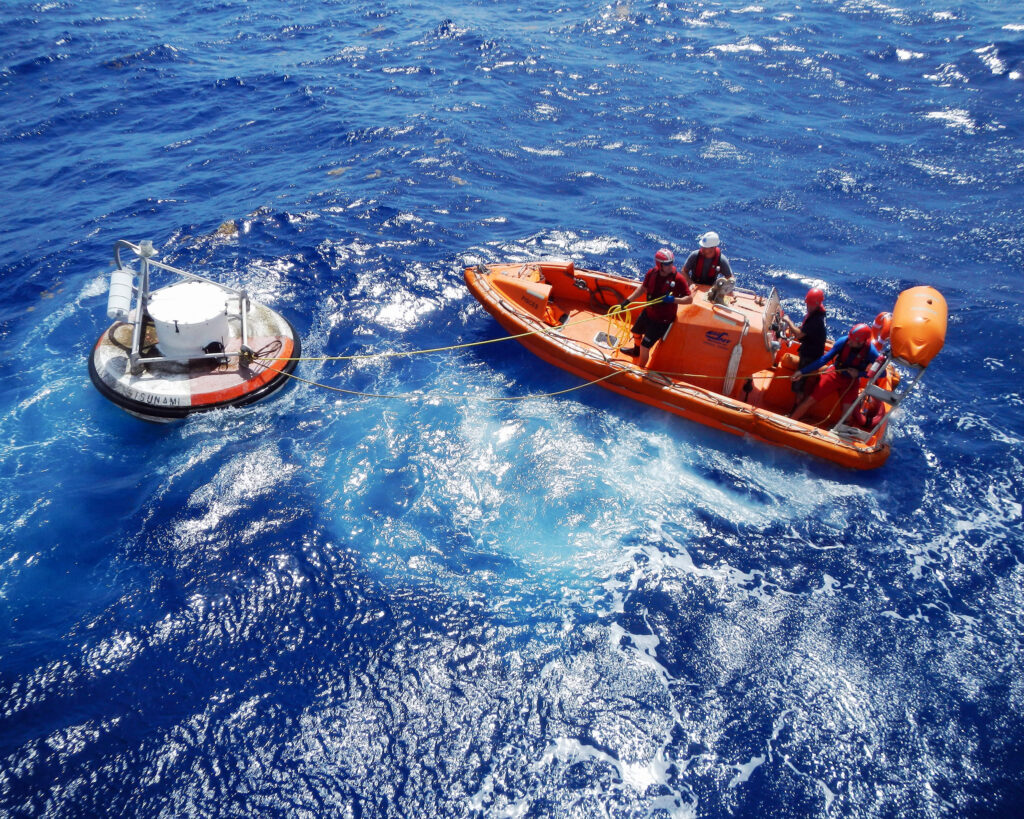
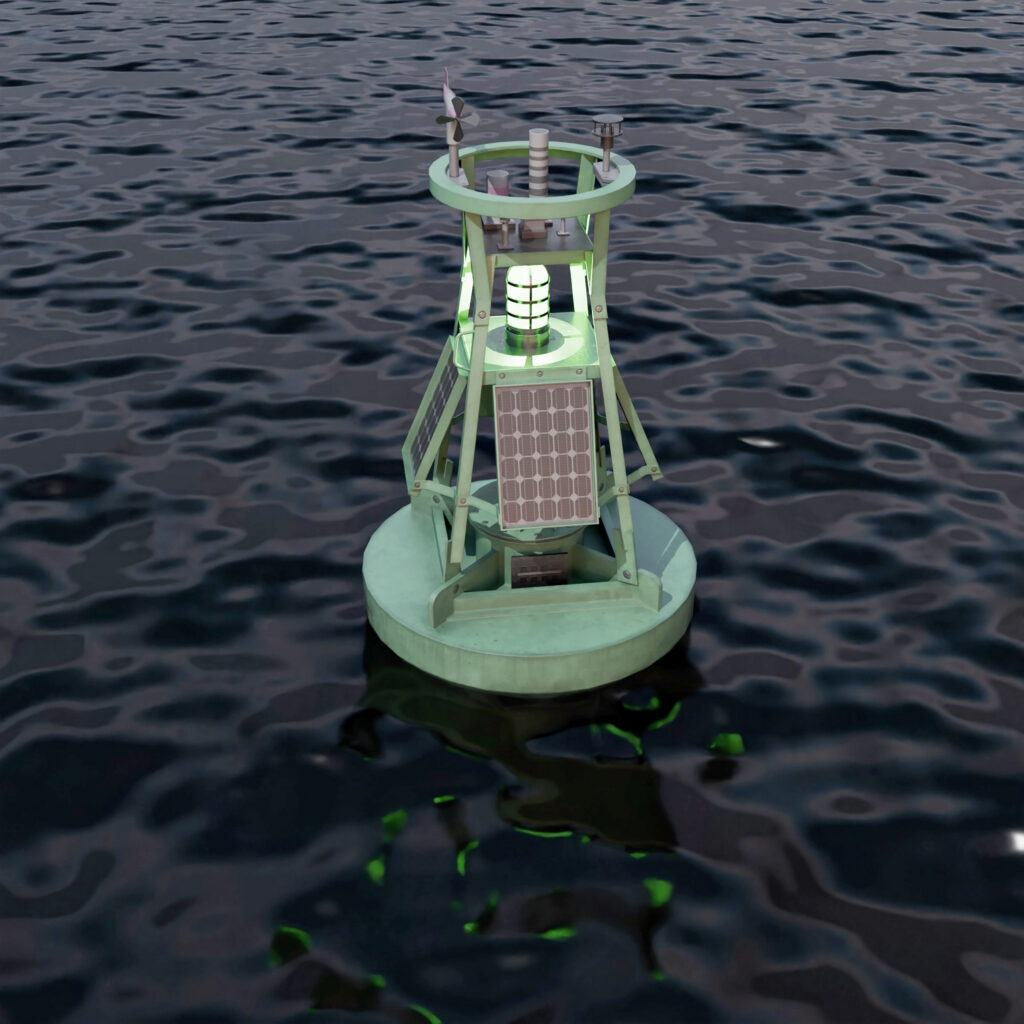
As it turned out, none, or very few, of the twenty-two nearby buoys tethered to the ocean floor and designed to transmit wave height data were operational. Media reports suggested they had not been maintained, or had been damaged by fishers tying their boats to them, or had been stripped by “vandals” and “thieves”—as reporters dubbed those who stole the costly sensors or hauled away entire units to sell for scrap. Prevailing accounts cast InaTEWS as having been rendered useless by this combination of factors. As one commentator remarked, “Not everyone is convinced a tsunami detection system is essential.”3
At the same time, the Indonesian government was criticized on the grounds that they “never allocated enough money” for maintenance; the system was said to be “broken” thanks to a “bureaucratic mess.”4 Failure was thus attributed to familiar human and governmental shortcomings. Meanwhile, the platform itself seemed to be insulated from blame. InaTEWS was lauded as a “well-designed sensor network that could provide critical information.”5 To some, the obvious next step was further automation and safeguarding—placing additional sensors on the sea floor, at greater remove from fallible humans and neglectful institutions.6
Michel Serres’s account of parasitism in social relations offers a different perspective.7 In The Parasite, Serres elevates the parasite from a marginal nuisance to the generative condition of order itself. Serres argues that systems only function through asymmetry and interference—that is, through an irreducible presence that feeds, disrupts, and transforms. What appears as corruption or disorder is thus revealed as the very motor of change.
The fishers who tied their boats to InaTEWS’s smart buoys and the people who stole hardware to sell for scrap were making use of the InaTEWS platform—though not in ways consistent with its design. Their use was parasitic. Like those who looted markets in Palu after the tsunami, they prioritized their own survival over the platform’s promised communal benefits.
Sulawesi was affected at the time by food shortages attributed to drought, as well as economic volatility. Anticipating shortages and distribution problems, wholesalers and intermediaries within Indonesia’s food supply chains engaged in anticipatory stockpiling and sudden selling, generating food price surges that travelled quickly across the archipelago. As some Palu looters told reporters at the time, “There has been no aid, we need to eat.”8
By signaling dependence on others for sustenance, feasting on the system without restraint, and disregarding the state’s investment in securitizing the future, the actors responsible for the damage to the InaTEWS equipment departed from the logic of exchange relations that is premised on forgoing something now in expectation of later return. In Serres’s terms, they did not reject the platform’s logic so much as “cross” it, making the platform into a “diagonal” by enlisting it in a noncompliant form of exchange. “Expelled” as cheats, they nevertheless “invent[ed] something new.” By misconstruing the platform’s value—deliberately or otherwise—they generated what Serres calls “abuse value,” expressing a different configuration of relations, if only for a brief and noisy time. Rather than drawing life from the platform, they injected their own life into it.9
InaTEWS was meant to enroll Indonesians in an internationally sponsored project of futurity in which all would have a role. The Tsunami Early Warning Service Guidebook for InaTEWS, a 2012 public handbook, emphasized that community members, and not just various government agencies, “are responsible for making the necessary preparations to save themselves from earthquake and tsunami risks” and “for passing on accurate information and guidance to others.” The handbook went on to say that “continuous cooperation of all stakeholders” was needed to ensure the platform’s “future development and maintenance” and to move Indonesia toward a future of “better preparedness.” Preparedness, above all, meant sustained engagement with the InaTEWS platform.10
Indonesian coast-dwellers were expected to make themselves valuable to the platform by dedicating their labor to its “future development and maintenance.” Meanwhile, some had other uses for InaTEWS—or at least for its smart buoys, as described above. Ironically, this parasitic usage exemplifies the continuous engagement that many platforms seek to inculcate in their users. However, these actors’ use was of the platform rather than for it; they intercepted the relations on which the platform was predicated, without making themselves useful to it. Consequently, they were devalued and labeled criminals or vandals. Indonesian officials did not regard “ordinary people where the buoys [were] installed as stakeholders”; their actions were not seen as “serious feedback to the system.”11 The abuse of the platform was lamented as “a heartbreak” and “a tragedy for science.”12
For the “vandals” of the InaTEWS buoys, this “tragedy” was productive. It exposed the trade-offs that had been made without their input: investment to secure flows of “accurate information” that might save lives had been set against the immediate “need to eat.” Rather than performing the data-generative, value-generative modes of engagement that the InaTEWS interfaces encouraged, they repurposed the platform to other ends—which may have cost 1,300 lives. Heroes they were not. Yet in acting as they did, they threw open difficult questions: Who or what are “life-saving” platforms such as InaTEWS for? What kinds of lives do they aim to save? What kinds of relations do they make and unmake? And how can these questions be posed to a platform so well-intentioned and so firmly grounded in scientific consensus?
As the story of InaTEWS demonstrates, digital platforms are typically built to secure themselves—physically and normatively. In this sense, perhaps, they are also parasitic, because they persist only insofar as their hosts remain engaged. For data-hungry platforms like InaTEWS, those hosts include sensors, buoys, gauges, and all those stakeholders and communities drafted into “continuous cooperation.” Platforms reproduce within these hosts, optimizing until “the inevitable point when the host dies.”13 They are also predicated on the differential valuation of various users and modes of engagement. These tactics prove highly resilient, reinforced by manuals and guidelines that normalize them. Even so, parasitic interruption can shake the foundations of a platform, burrowing beneath it to lay bare who or what it values—and who or what is expendable within the world that it helps to shape. ✳
- Sven Harig et al., “The Tsunami Scenario Database of the Indonesia Tsunami Early Warning System (InaTEWS): Evolution of the Coverage and the Involved Modeling Approaches,” Pure and Applied Geophysics 177, no. 3 (2020): 1379–1401, https://doi.org/10.1007/s00024-019-02305-1; BMKG, “Indonesia Tsunami Early Warning System,” accessed January 23, 2026, https://inatews.bmkg.go.id/eng. ↩︎
- Jonatan A. Lassa, “Reviewing Indonesia’s Tsunami Early Warning Strategy: Reflections from Sulawesi island,” The Conversation, October 3, 2018, https://theconversation.com/reviewing-indonesias-tsunami-early-warning-strategy-reflections-from-sulawesi-island-104257; Shotaro Tani and Erwida Maulia, “Indonesia’s Tsunami Warning Blamed as Death Toll Reaches 1,200,” Nikkei Asia, October 2, 2018, https://asia.nikkei.com/economy/indonesia-s-tsunami-warning-blamed-as-death-toll-reaches-1-200. ↩︎
- Anjali Singhvi et al., “What Went Wrong With Indonesia’s Tsunami Early Warning System,” New York Times, October 2, 2018, https://www.nytimes.com/interactive/2018/10/02/world/asia/indonesia-tsunami-early-warning-system.html; “‘None of the 22 Buoys Are Functioning’: Tsunami Warning System Might Have Saved Lives in Indonesia,” National Post (Indonesia), October 1, 2018. ↩︎
- Lassa, “Reviewing”. ↩︎
- Tasha Wibawa and Farid M. Ibrahim, “Tsunami Early Detection Buoys Haven’t Worked for Six Years: Disaster Agency,” ABC News (Australia), October 1, 2018, https://www.abc.net.au/news/2018-10-01/indonesia-tsunami-early-detection-buoys-broken-for-six-years/10324200. ↩︎
- Doug Bock Clark, “Why the Tsunami in Indonesia Struck Without Warning,” New Yorker, October 4, 2018, https://www.newyorker.com/news/news-desk/why-the-tsunami-in-indonesia-struck-without-warning. ↩︎
- Michel Serres, The Parasite, trans. Lawrence R. Schehr (Johns Hopkins Press, 1982). ↩︎
- Agence France-Presse, “Indonesians Loot Markets After Tsunami Creates Shortage Of Food, Water,” NDTV World, September 30, 2018, https://www.ndtv.com/world-news/indonesians-loot-supermarkets-after-tsunami-earthquake-create-shortage-of-food-water-1924504. ↩︎
- Serres, The Parasite, 35, 75, 80, 168. ↩︎
- Jaya Murjaya et al., Tsunami Early Warning Service Guidebook for InaTEWS, 2nd ed. (2012), v, 22. ↩︎
- Jonatan Lassa, “When Heaven (Hardly) Meets the Earth: Towards Convergency in Tsunami Early Warning Systems,” Indonesian Students’ Scientific Meeting Conference Proceedings, May 1, 2008, 216. ↩︎
- Wright, “‘None of the 22 Buoys.’” ↩︎
- Serres, The Parasite, 168 ↩︎