The Audacity of Text
The digital idioms of democracy
Americans have long placed their faith in the legal and political Word. The textualist constitutional tradition promised that words could prescribe and enact a social order. Typing away at computer keyboards, some have reiterated that hope with newer media. Perhaps, they have proposed, through the work of code, words can make democratic publics out of dispersed readers. The creation of new reading publics has been the foundational promise of the Intergalactic Computer Network, NSFNET, Bulletin Board Systems, email, the World Wide Web, Web 2.0, the Network Society, and most recently, digital platforms. Critical scholars, in turn, have taught us to read the platforms themselves by decoding their architecture and their codes of conduct, finding traces of hidden labor and dynamic sociality, all in search of new vital politics. But would older forms of politics, the rough-and-tumble of democratic electoralism, remain legible when digitally platformed?
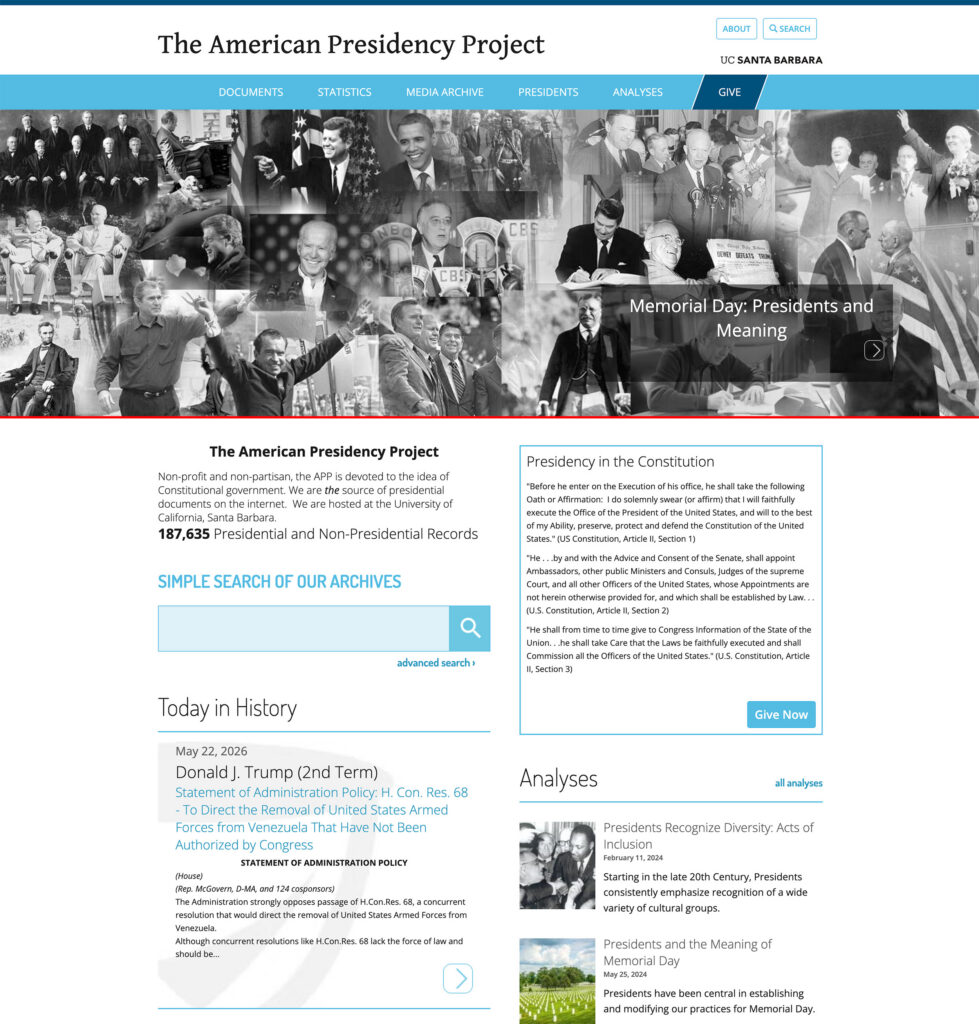
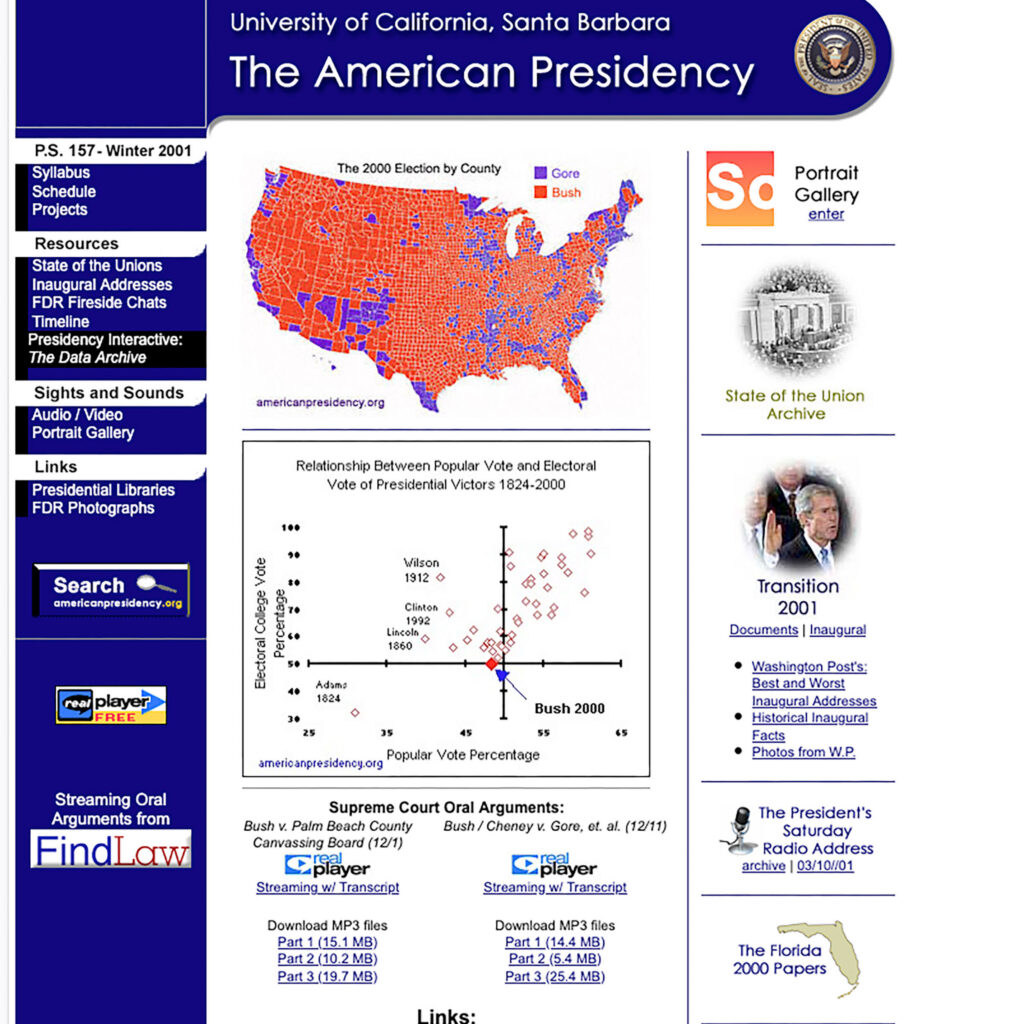
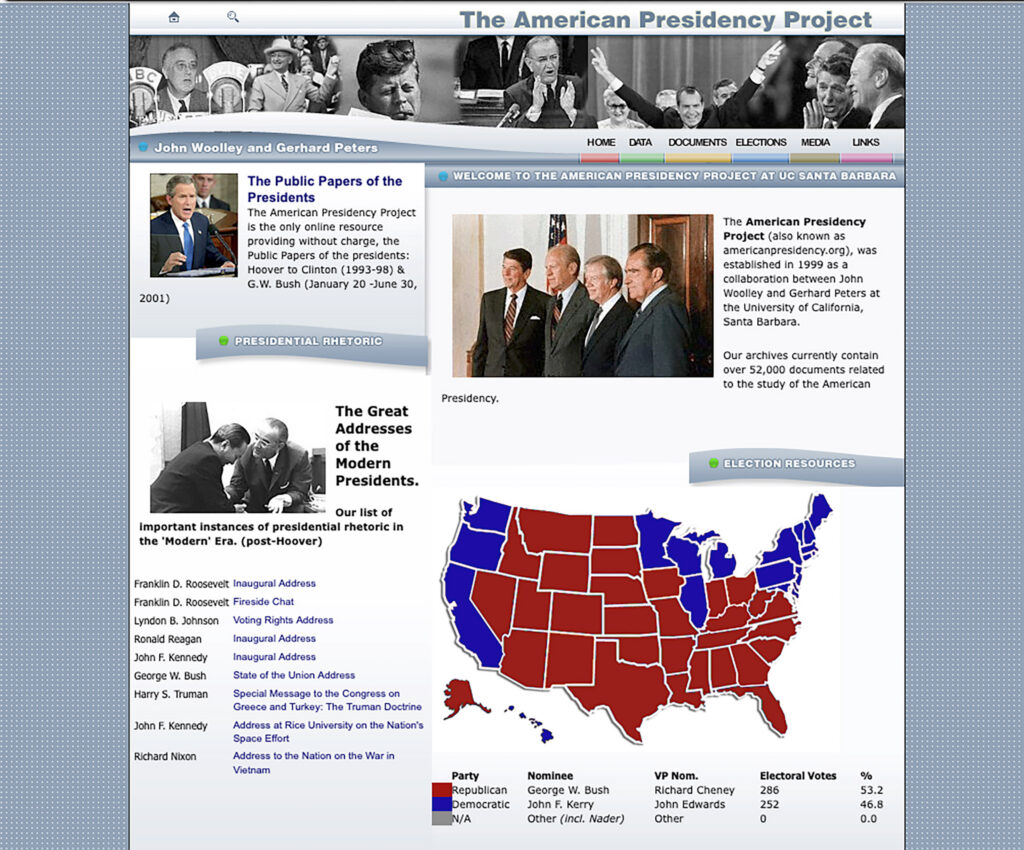
In 1999, political scientists Gerhard Peters and John Woolley believed so. They developed a web platform that aspired to host all of the official words of every American president—speeches, interviews, signing messages, presidential memoranda, executive orders, and press releases. This idea to platform political text was an effort to revive an electoral project, audaciously convening readers around plain text documents in the hope of reinforcing a national democratic public.
The American Presidency Project (APP) that Peters and Woolley built has become an authoritative source for presidential documents, with, according to their count, as many as 200,000 daily users since 2022. The APP’s founders mark its true coming-of-age, however, as the moment when it entered its own archive: in May 2016, after the White House press secretary was asked a question which referenced the APP by name, the transcript of that exchange was duly entered into the database. And although the database contains videos and analysis, plain text is the primary resource. The platform renders tens of thousands of official documents commensurable as HTML markdown text.
Read together, these documents narrate an uncanny political realm of words as deeds. This is an archive of performative politics, in two senses of “performative.” As the philosopher J.L. Austin explained, one can do things with words, performing a reality into being. But, as chronically online commentators insist, many words do nothing and are thus, as the kids say pejoratively, “performative.” There are numerous proclamations on the APP platform, almost none ever actually proclaimed. Some changed the world, others did not. In the digital archive, the Emancipation Proclamation is stored alongside National Character Week and American Heart Month pronouncements. Proclamations that function as law are cataloged alongside those that function as symbol.
The APP also comprehensively collects party platforms, the agreed-upon principles of a political party’s policy convictions. These resolutions, the result of intense backroom negotiations—and sometimes very public ones—are, in theory, the articulation of what an institutionalized political movement believes. Crafted and voted on every four years at each party’s convention to nominate a presidential candidate, they transmute candidates into representatives of larger policy agendas.
The oldest of these entries in the APP, the 1840 Democratic Party platform, reads today as an anti-platform, devoting its nine resolutions to what the federal government should not do: no interfering in the states, no general system of internal improvements, no national bank, and certainly no efforts to curtail slavery. Still, like every platform that followed, its text can be copied directly into Microsoft Word, which is what Peters did. He counted the words and then graphed them to show the sheer explosion in platform length over the years—and the periodic attempts to rein in these articulations of collective values. There is even an invitation to search across time by keyword to find the trends.
For a digital platform, the APP’s participatory asks are minimal, with not much more than a large “report a typo” box on each page, but the sense of a collective and universalizing project is remarkable. The site displays the striking innocence of an earlier digital idiom, in which the commensurability of text on message boards and simple web pages promised a flattened world, and the prospect of equalizing access to written knowledge undergirded many of the hopes for the internet.
There is a similarly innocent optimism to the genre of party platform itself. The dream of a collective governing project, albeit a partisan electoral one, is a noble one. Even though platforms are the sites of so much grubby politicking, they are also proof of a possible accord, of shared and finite prescriptions, bound within language. These words have historically been traded for support. A few sentences could serve as a concession, a mark of respect, or an explicit pander that wins over an interest group or a potentially disruptive faction.
We are more knowing readers now. Party platforms have generally gotten longer, but that wordiness is evidence of a hollowed-out party process that is unable to prioritize.1 From the voters at the convention to the non-voters outside its halls—not to mention the researchers plumbing the APP for insights—everyone knows that platforms are aspirational performances, and everyone acknowledges that parties are likely to come up short in practice. We have also lost our naïveté about digital platforms, which have proven to radicalize and exclude. For all its virtues, Wikipedia did not blunt fascism or redeem liberalism.
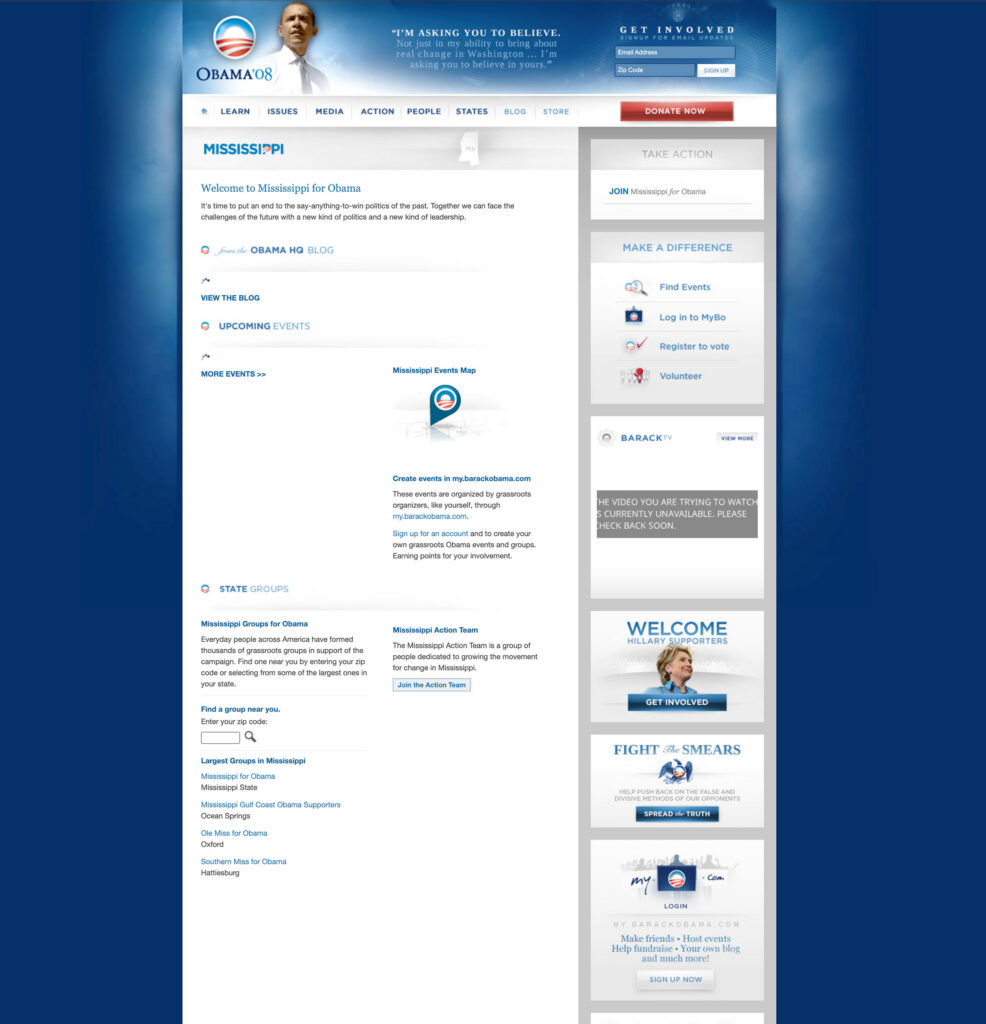
Ironically, the APP faltered most when confronting the platform most committed to reviving the genre: the 2008 Democratic Party platform, the work of Barack Obama’s campaign. Famously, Obama for America used the framework of social media as a core mechanism for creating its party platform. With my.barackobama.com, often referred to as my.bo, anyone could become part of the campaign. This carefully maintained walled garden sustained a new kind of political community, and cultivated a distinct subjectivity for users—teaching them how to be part of the campaign, to develop the sensibility of local organizers, to generate content for the party platform, and to host local meetings. The ensuing Listening to America initiative included 1,645 meetings with 30,000 attendees in just 25 days of 2008. It mirrored the anti-politics of Obama for America as politics.
Scorning the political machine of the twentieth century, Obama for America worked to offer something new.2 In so doing, it presented problems for the American Presidency Project. To capture a democratic authenticity, the 2008 platform document made use of call-out boxes with illustrative quotations from meetings organized through my.bo. These could not be expressed in plain text. Even though the official platform text echoed an older model, the citizen voice broke the flow. In a section on government accountability, one anonymous New Hampshire resident explained, “We the people need to be citizen participants, not consumers of government.” The official language promised to “use new technology to tap into the vast expertise of the American citizenry, for the benefit of government and our democracy.”
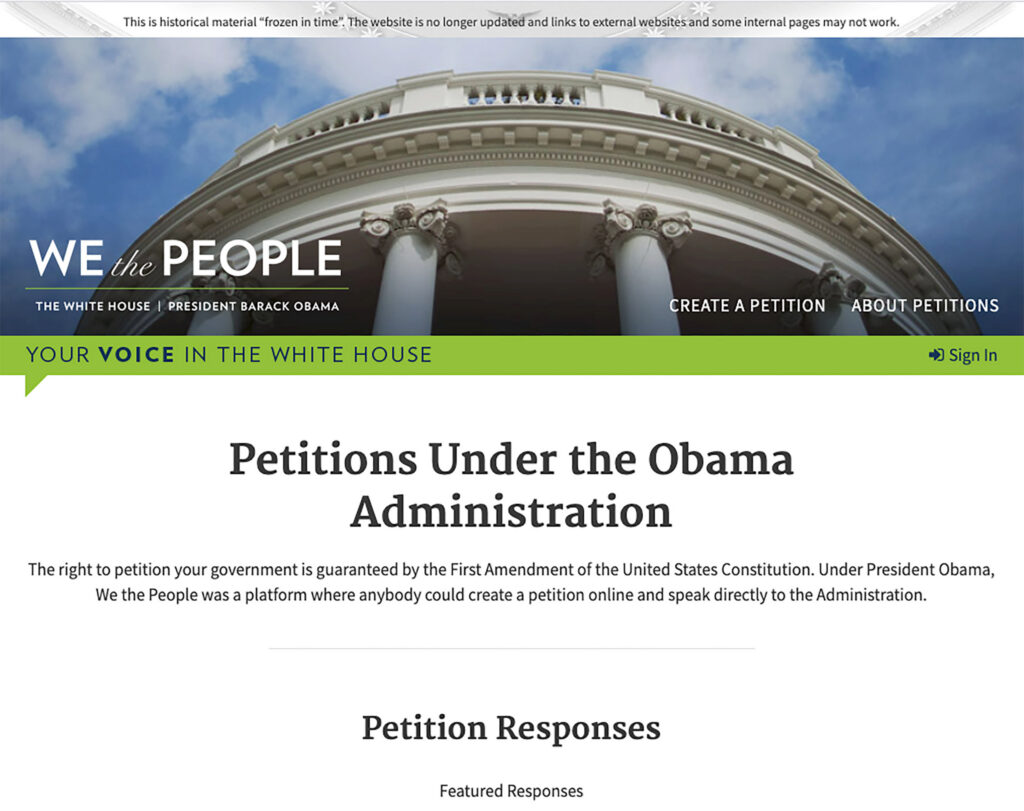
After the election, the Obama administration tried to carry this ethos forward with the crowdsourced Citizen’s Briefing book, in which 44,000 ideas were up-voted by 125,000 users on Change.gov. The administration also maintained a We the People online petitioning platform from 2011 to 2021 with the promise (often delayed or withheld) of “an official response” for the most popular petitions. The National Archives now maintains that website. The remnants of a playful web were there (tongue-in-cheek calls to create a Death Star), alongside the real issues that animated the online community: net neutrality, the Stop Online Piracy Act, and Edward Snowden. Over time, activism and conspiracies that had been incubated on social media platforms migrated to the We the People platform. Calls to investigate Bill and Melinda Gates for crimes against humanity were slowly upvoted ahead of petitions demanding justice for Breonna Taylor.
By 2020, perhaps platforms seemed too dangerous. The Republican Party opted not to go through the work of creating an official platform, while the Democrats produced their longest document to date, with almost twice as many words as in 2008. In 2021, with the techlash in full swing, We the People was quietly deplatformed upon the inauguration of Joe Biden. Platforms were, as the president said and the APP has transcribed, “killing people.”3
As the experiment in merging digital and party platforms is rolled back, we might wonder where else to look for archives of political visions. The temptation is to focus on changing forms and formats. But even as digital platforms continue to mediate our everyday lives, we shouldn’t dismiss content. We should become better readers of partisan politics. The high-stakes work of democratic aspiration is articulated through political documents now stored as deceptively flat text.✳
- Daniel Schlozman and Sam Rosenfeld, The Hollow Parties: The Many Pasts and Disordered Present of American Party Politics (Princeton University Press, 2024). ↩︎
- Daniel Kreiss, Taking Our Country Back: The Crafting of Networked Politics from Howard Dean to Barack Obama (Oxford University Press, 2012), https://doi.org/10.1093/acprof:oso/9780199782536.001.0001; Anna Everett, “Have We Become Postracial Yet?: Race and Media Technologies in the Age of President Obama,” in Race After the Internet (Routledge, 2012), https://doi.org/10.4324/9780203875063. ↩︎
- After growing frustration with Facebook’s decisions on how to moderate information about COVID-19, President Biden blurted out (and then walked back) this pronouncement. The American Presidency Project, “Pool Reports of July 16, 2021,” accessed April 19, 2026, https://www.presidency.ucsb.edu/documents/pool-reports-july-16-2021. ↩︎