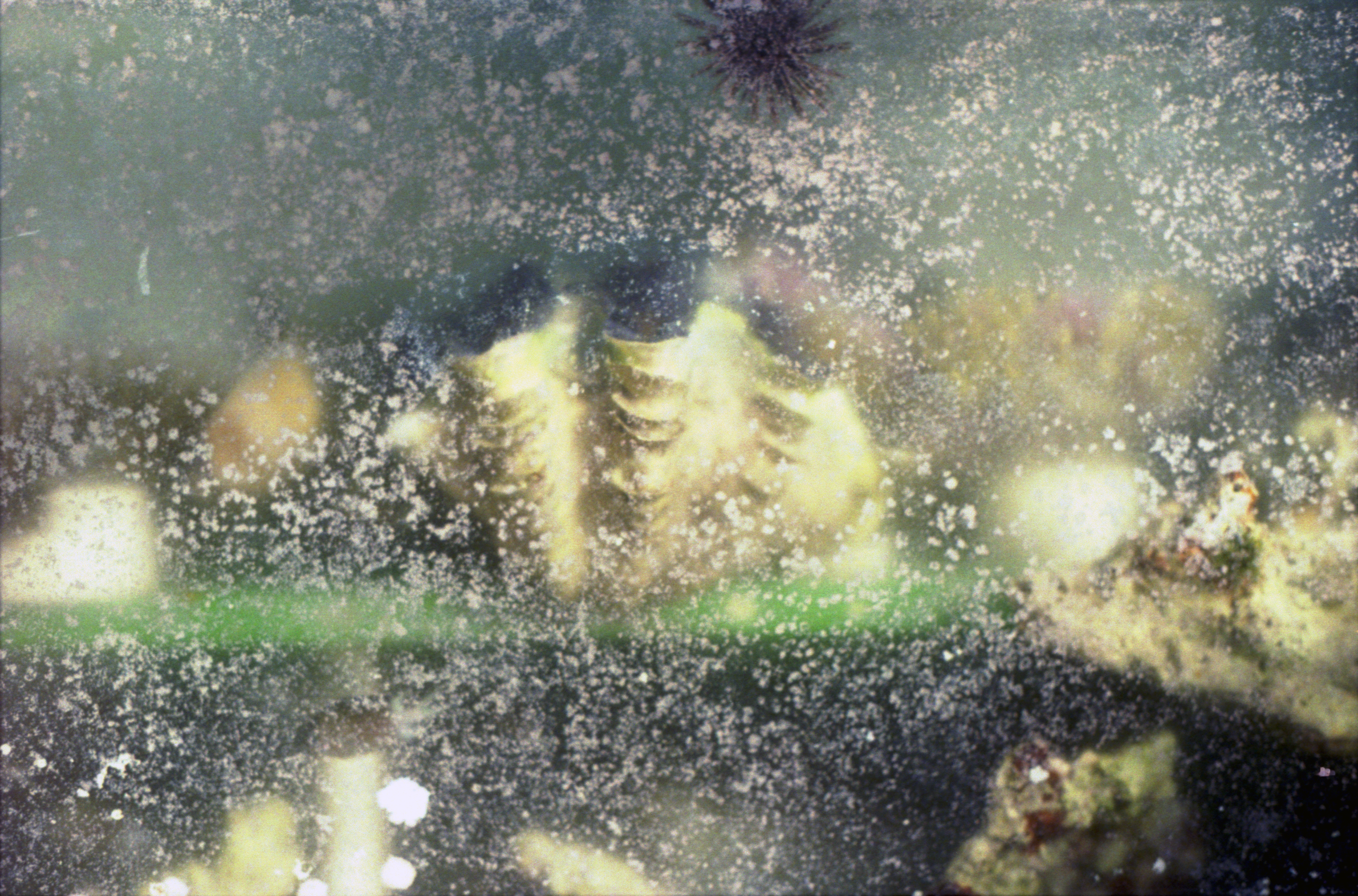
A Reef in a Box
Can we sense ocean acidification in a lab?
How do you respond to a problem you can’t see? As a photographer and fieldworker, this question drew me to a lab on Australia’s northeast coast where, some years ago, I began investigating onshore ramifications of the foretold decline of the world’s coral reefs. I hoped to learn from the researchers, conservationists, activists, residents, creatures, and machines who register this quiet unraveling. You see, the oceans aren’t just warming—they are acidifying, which is fraying the web of earthly life that coral reefs maintain and within which we, also, find ourselves.
Ocean acidification involves a change in pH that is subtle but has seismic consequences. Like an earthquake or a volcanic eruption, ocean acidification is geologically significant and yet, unlike them, it is more of a structure than an event—a process reverberating almost imperceptibly as hypercomplex ocean biogeochemistry slowly mixes molecules of atmospheric carbon dioxide hovering at the sea surface into 352 quintillion gallons of churning seawater.
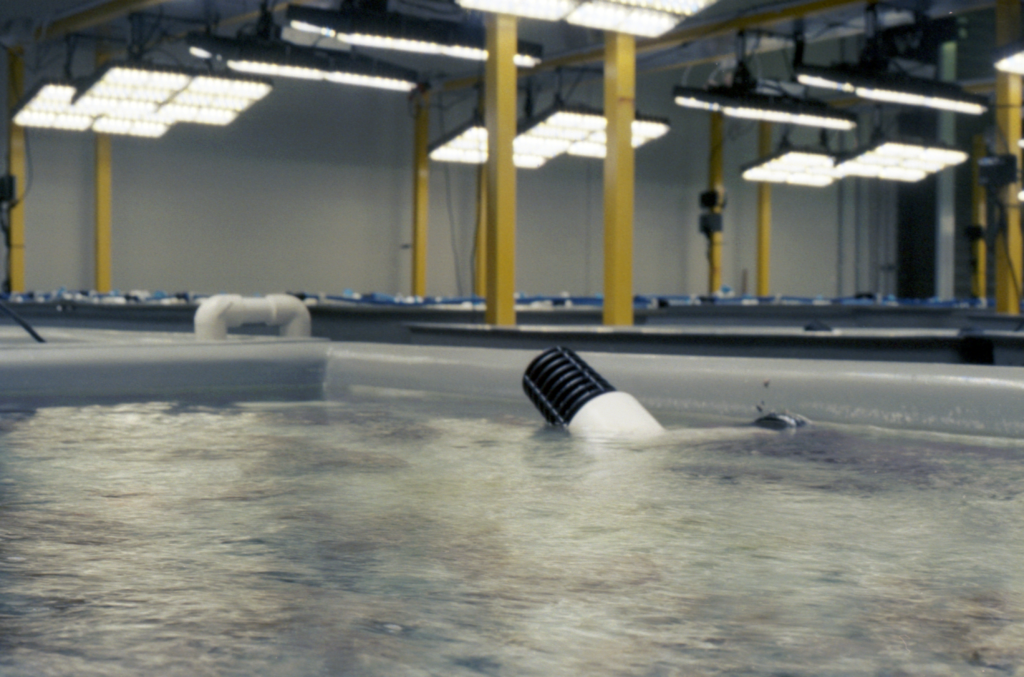
You can’t photograph ocean acidification the way you might a fault line or an eruption, because it defies direct apperception. That may be one reason it’s so daunting once you get a sense for it. It troubles standing assumptions that if only you could see a problem, then you might know what to do about it.
But, like all marine organisms, coral reefs are exquisitely sensitive to their surrounds. And as such, they can show us when the oceans are overheating or overacidifying by getting visibly sick—and, in the long run, by decaying into rubble. We owe a powerful image of the ocean going acid to a noted Australian marine biologist. Imagine, Charlie Veron tells us, that all the world’s coral is a great big antacid tablet. Now drop it in water and watch it dissolve. That’s ocean acidification.
It turns out that if you use coral reefs like a camera, then you can project your senses beyond their existing perceptual range. What was hidden can be seen, and what was unphotographable becomes, precipitously, something you might just think of capturing on film. But if you push things a bit further, if you squint and try bringing the full scale of seismic disturbance into view, the cascade of problems lurking within the problem that is ocean acidification—the degraded food webs, the eroding coastlines, the supply chain disruptions, the mass extinctions, the tattered cultural prestige, the territorial disputes, the climate denialism, the forced displacement—well, then, the neat contours of Veron’s image begin to blur.
* * *
It was easy to lose yourself in the aquaria at the lab facility. It wasn’t so much the sight of creatures behind a thin pane of glass, once entirely unconcerned with the human gaze but whose lot in life was now a permanent spectacle. No, it was the many forms this scenography could take.
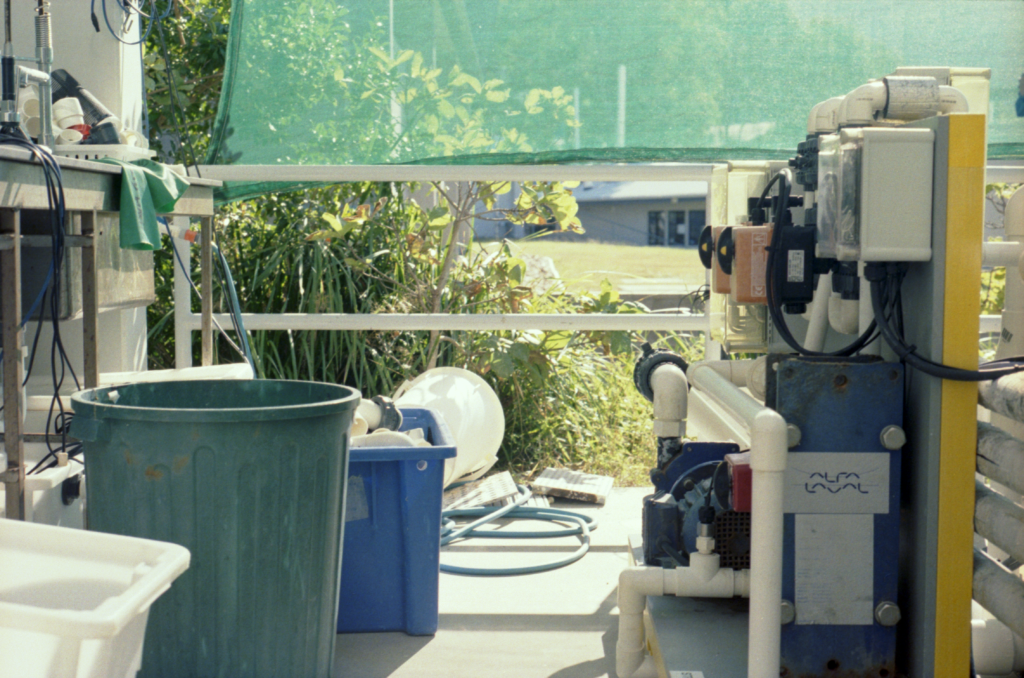
There were isolation tanks for acclimating newly collected organisms or administering veterinary care. Display tanks impressed distinguished visitors and taught school groups about different habitat compositions. Experimental setups came in all shapes and sizes. A predator-prey study was architected with escape routes. A stress test had duplicate tanks all in a line, neighboring one another like the cookie-cutter townhouses in the suburbs an hour away. So many configurations required to maintain the fantasy of a reef-in-a-box. And surrounding all of these different isolated worlds, the same overflow of pipes and nets and bins baking in the sun.
There was often a lot of silence to be had in the lab; not total silence, but the silence that sets in when no one else is about, when there are no voices to be heard, footfalls to catch, doors that clatter, or traffic blaring by. It’s the silence that would set in after the researchers and technicians finished setting up experiments, in the daily intervals between the aquatic husbandry team’s feeding and cleaning rounds, and in the hours when only the security guard circled the building. Such silence prevailed in the years after the constant din of construction had ceased and a one-of-a-kind marine research instrument stood ready for use.
“Sentinel devices not only signal specific troubles in our midst but are, in their proliferation, a signature of our troubled condition.”
Here was a machine designed to produce a limited form of time travel through ocean-fed, industrially-inspired, serially-arrayed, computer-monitored aquaria that calibrated light, temperature, and pH conditions to simulate oceans past, present, or future. And, in the wake of silence came a symphony of hums. Surface water gently swirled. Overhead lights buzzed. Aquarium filters kept cycling. The occasional pocket of air gurgled open and shut. Computer monitors crackled away at the lowest range of hearing. Within this sonic embrace, marine organisms collected from offshore reefs adjusted to their new situation as onshore experimental subjects whose altered life cycles might reveal something about cascading ecological changes.
* * *
Over a decade ago in this publication, Frederik Keck and Andrew Lakoff offered a term for the family of entities that help people see phenomena like ocean acidification: sentinel devices. To explain the way that sentinels mediate the unknown, Keck and Lakoff distinguished them from two other figures who lurk at the edge of the familiar. The prophet foretells a future to come, yet cannot defy its fateful arrival. The prognosticator calculates a path ahead from evidence in the present. By contrast, the sentinel invites a watchful vigil before the possibility of disaster. Whether in the form of ice caps, honeybees, coral reefs, farm animals, lichen, ocean plastics, radionuclides, or airborne pathogens, sentinel devices saturate the world around us and materialize dangers in our midst.
As human beings, we rely on the senses of these early responders precisely because our own perceptual limitations make us a danger to ourselves. The practical conditions of modern life may, in fact, entrench such oversight. Coal miners need canaries to stop singing so they do not dig themselves to suffocation unawares. Scuba divers need gauges to monitor water pressure because, unlike breath-hold divers or whales, they might inadvertently wreck their bodies when surfacing. Agroindustrial supply chains need some animals to show symptoms of viral contagion because otherwise pathogenesis will come for us all.
Sentinel devices do not suture representation to intervention any which way. They work within the narrower genre of what might be called invigilating practices: forms of threat detection, disaster preparedness, controversy management, political debate, and scientific experiment that invite us to simultaneously heighten and question our sensitivity toward our surrounding milieu. Little wonder that such practices can take on an anxious life of their own. Sentinel devices not only signal specific troubles in our midst but are, in their proliferation, a signature of our troubled condition.
* * *
In studying human encounters with the oceans, I have observed how the push to expand the modern condition into the open oceans has gone hand in hand with envisioning and invigilating. A similar tendency might prevail within the offshore more broadly, if we think of it as a domain defined by resistance to permanent human settlement.
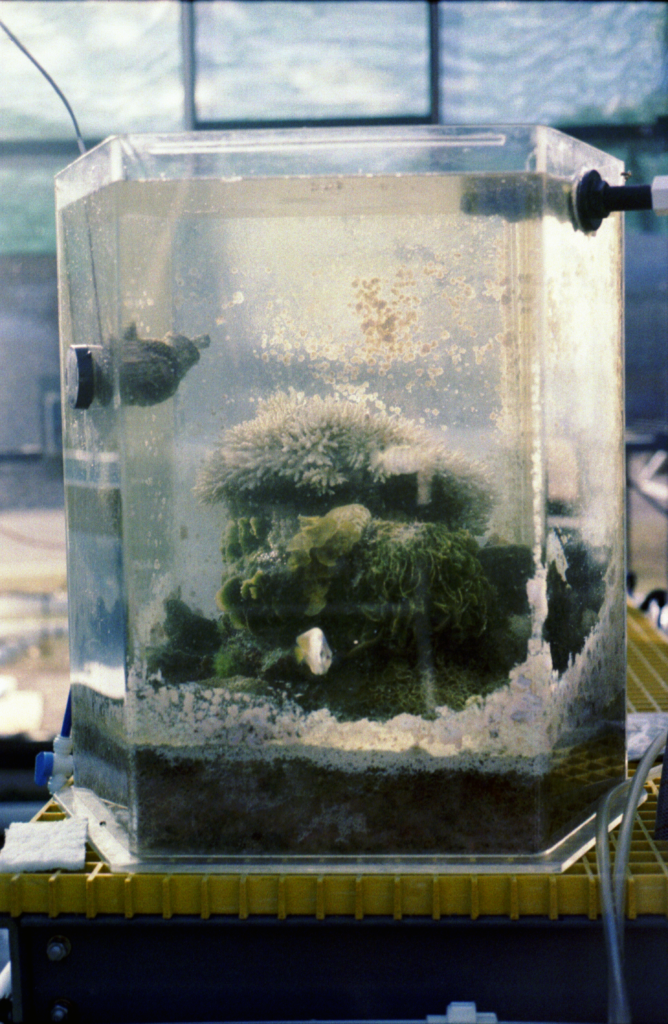
Yet when moving through tropical marine laboratories alongside researchers, technicians, interns, and a regular flow of interested visitors, I often found myself struggling to see signs of overt or imminent catastrophe at the whole-Earth scale, even though this very possibility was so alive to so many of us. It may be that this struggle to see, as a knot of negative affect, echoes the difficult lessons that sentinel devices can teach us. Ethnography and photography court danger when they invite us to strike out beyond our limited perspective; they do so by reminding us of the categorical inadequacy of our senses. Even if we leave the fantasy of “being there” behind, the urge to “get somewhere” still confronts us with the awkward inconvenience of our desire to make sense at all.
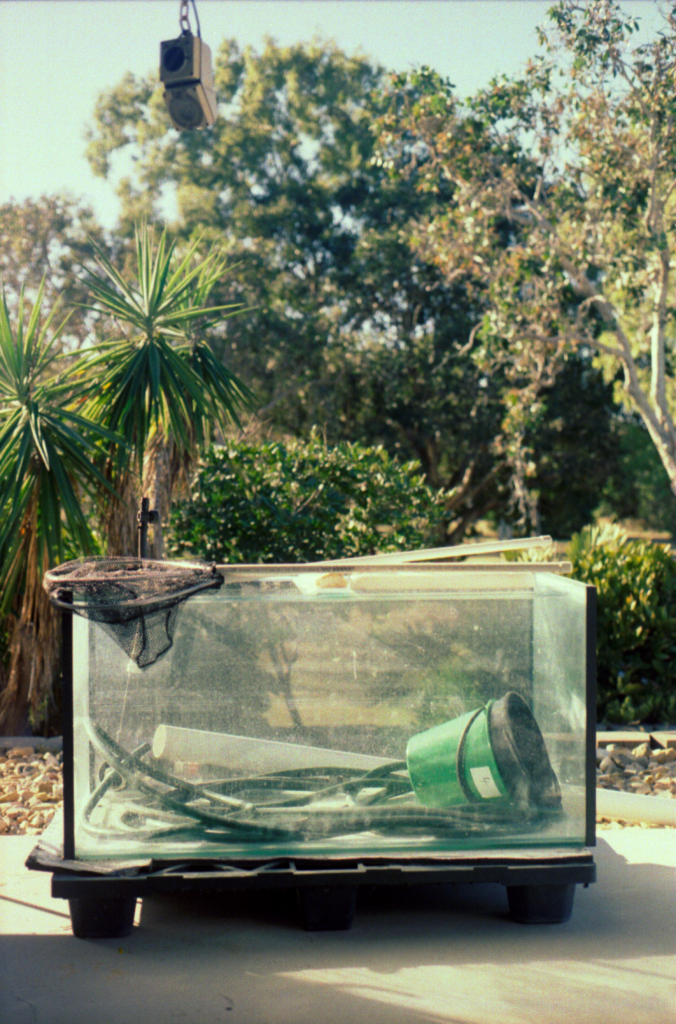
Rather than catastrophe, what often crossed or clouded my field of vision in the lab were fleeting glimpses onto quieter endings, and an atmosphere of ordinary obsolescence. The montage here offers minor views onto the animals, fixtures, lights, pipes, buckets, nets, ropes, containers, benches, tanks, glass, waste, and residues needed to approximate a reef onshore. The unseen people who moved through these spaces were hard at work observing the distressing decline of tropical marine life and debating what else, however drastic or fantastic, they might do about it.
Yet if these images disclose an ethnographic present, then I imagine it as one that draws out a wider temporal gradient. Using film photography as an enabling constraint, I have rendered the marine laboratory roughly in keeping with the conventions of portraiture. In so doing, I hope to refract, in one direction, the tropical haze that envelopes these spaces and organized their coming into being long before the presentist historicity of today, and, in another direction, the impersonal afterglow and associated expenditure that research brings.
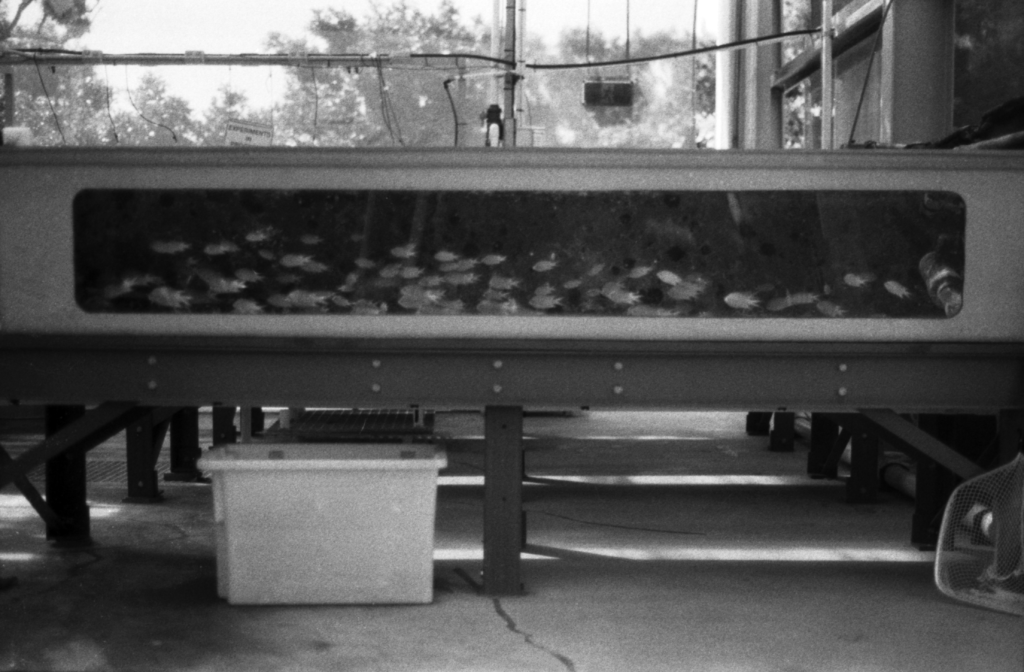
Beyond the image, the water flows. Tanks are cleaned or relocated, experimental animals killed and others collected, pipes removed and others laid, until some or all of these labors come to a rest and the ocean roils on, the algae spreads, and the rust thickens its coat.
* * *
One day a school of parrot fish filled a tank, overfilled by any reasonable standard of care, their numbers swelling against the bare plastic walls. But it was only a temporary measure. Soon enough, after a quick operation, they would be allowed to continue plying their trade offshore—darting in and out of staghorn, plate, and boulder corals, their colors shimmering at daybreak and dulling at dusk. Their beak-like mouths would once again chomp down merrily (you would presume) on a bounty of surface microbiota. Yet they would be changed. Hidden between the folds of their flesh, biometric sensors would ferry messages back onshore, painting a picture of their life’s rhythms that they would never see. ◆