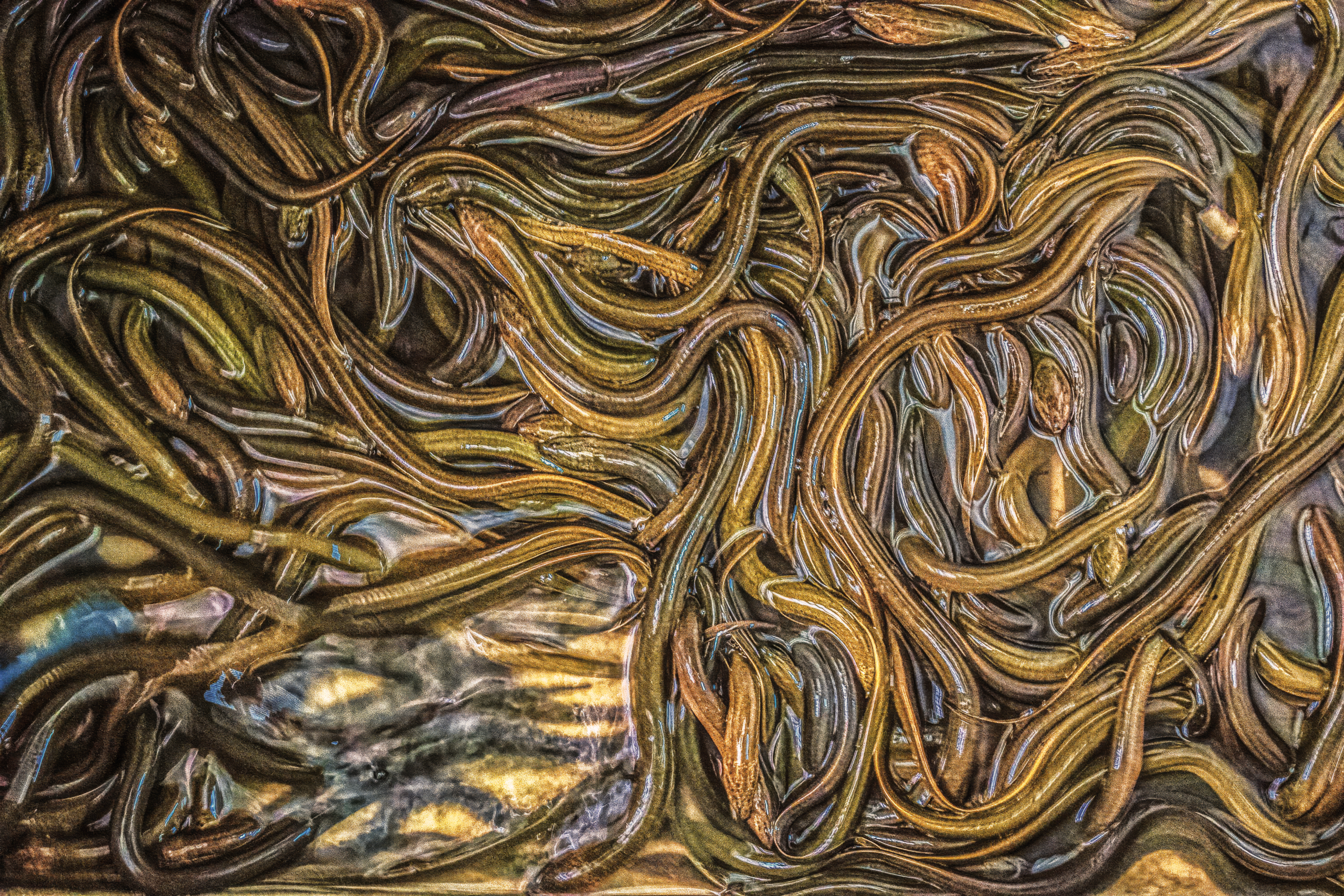
Rachel Carson’s Eel Tank
A journey from formless desire toward formless space
As a PhD student in fall of 1932, future conservationist and ocean writer Rachel Carson kept an aquarium at a basement marine biology lab in Johns Hopkins University’s Gilman Hall, where she tested the salt tolerance of juvenile eels. These days, my English department occupies the same Gilman Hall basement. Sometimes, as I pass one of the murky portraits of the university founders nestled throughout the building, I replace it with a mental painting of Carson emerging from her own chiaroscuro depths to share the fresh rewards of her elver research. To friends who visited her lab, Carson was known to deliver a long and enthusiastic eel “spiel” describing what little was then known of the eel’s life history and mating habits.1 Even as her family managed Depression-era hardships (in a rural house they rented at Stemmers Run, near Baltimore County’s Back River), her work on Anguilla rosastra animated her with excitement.
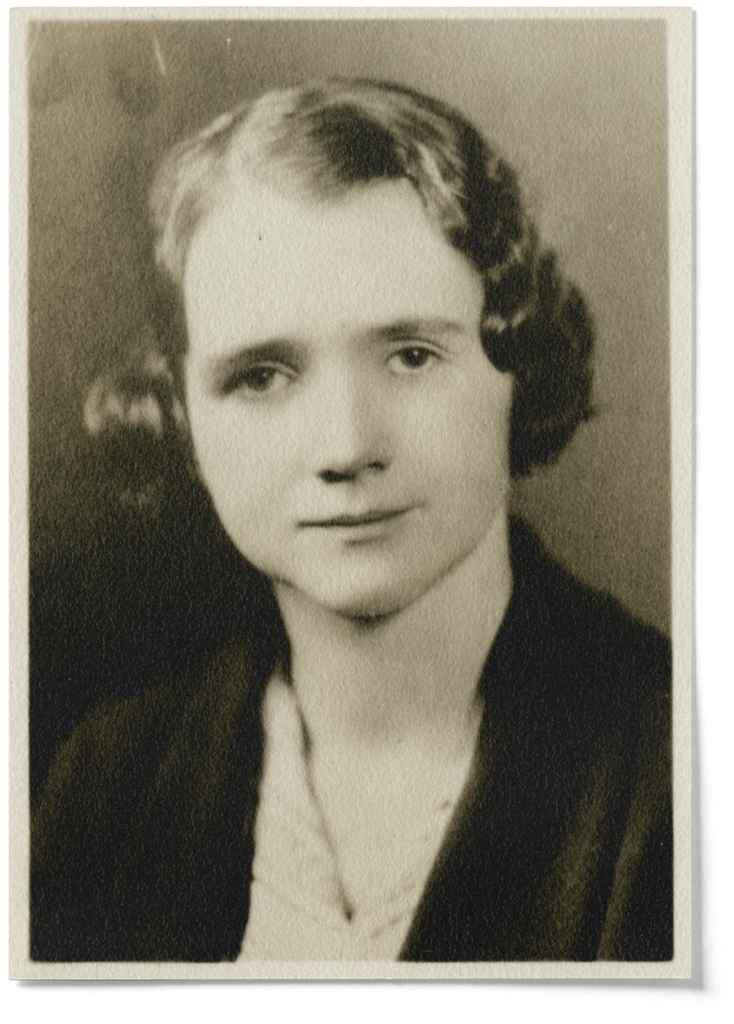
What did she hope to see in the eel’s coming and going from sweet water to salt? How did she plot its passage through the estuarine flux between inland and offshore? How did Rachel Carson’s eel tank shape her poetic understanding of marine conservation?
The scant personal details of Carson’s time at Hopkins derive mostly from her student records and from an unpublished manuscript by her college friend Dorothy Thompson Seif. We can, however, discern her intellectual environment from her 1932 master’s thesis on catfish kidney embryology (accompanied by her painstaking daily photomicrographs), and from the writings of her advisor Rheinart Parker Cowles (whose 1930 report A Biological Study of the Offshore Waters of Chesapeake Bay discussed the effect of salinity on fish migration and distribution).
Financial pressures forced Carson to cut her PhD research short and to find work, but her eel encounters left an imprint on her early writing for The Sun (Baltimore) and Atlantic Monthly, on the popular reports and radio scripts she composed for the US Bureau of Fisheries, and, in 1941, on her first major literary achievement, Under the Sea-Wind, in which Part III narrates the eel’s offshore voyage.
In particular, the eel’s spawning migration from fresh water to salt—a discovery known as catadromous migration—intrigued Carson and became a recurring motif in her literary biographies of the ocean. Eel migration was first described as catadromous (pronounced kuh-TAD-ruh-muss) in the 1870s, and distinguished scientists—from George Brown Goode of the US Fish Commission, to the Belgian oceanographer Gustave Gilson, and the Danish biologist Johannes Schmidt—sought to define catadromous dynamics in the half-century before Carson began her research. Only in 1923 did Schmidt’s breakthrough paper “The Breeding Places of the Eel ” trace the emergence of the smallest larvae to the Sargasso Sea. Carson represented this journey offshore through enigmatic marine habitats as a transgressive drive of sexual maturation, and, as in her article “Chesapeake Eels Seek the Sargasso Sea,” she made the sensory images of the “call of seaward hurrying water” and “descent along darkening sea lanes” central to her experiment in ecological form.2
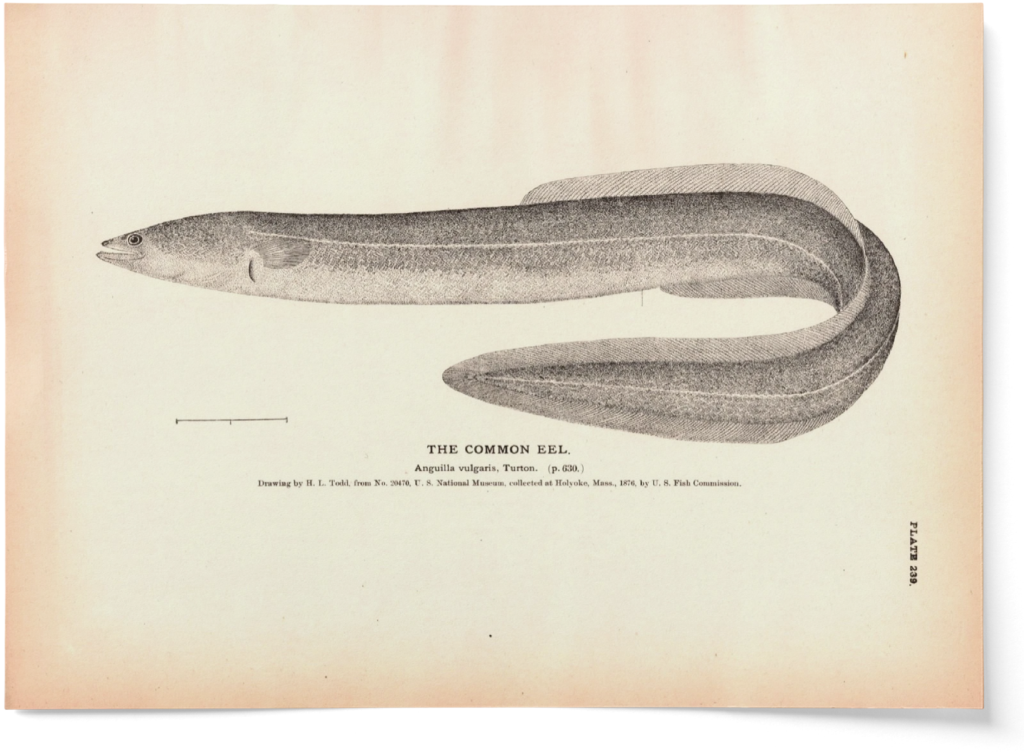
Today, the eel’s metamorphic life cycle is better understood than a century ago, even if many details remain blind spots. Both American eels (Anguilla rosastra) and European eels (Anguilla anguilla) spawn in the deep waters of the Sargasso Sea. American leptocephali (larvae) drift for a year toward the US seaboard, while European larvae take as many as three years to reach their respective shore. Along the continental shelves, both transform into transparent juveniles known as glass eels over a period of weeks. Eventually they pass through bays, estuaries, and rivers as brown-pigmented juvenile elvers. As they then grow into yellow eels, environmental factors shape the eels’ sex differentiation. Females, which are larger and live in lower-density populations, travel farther upstream than males, which cluster in brackish coastal waters. At an average age of ten years in warm climates, or as many as twenty-five years in cold climates, yellow eels transform into sexually mature silver eels, and they complete their harrowing catadromous migration back to the Sargasso to spawn and die.
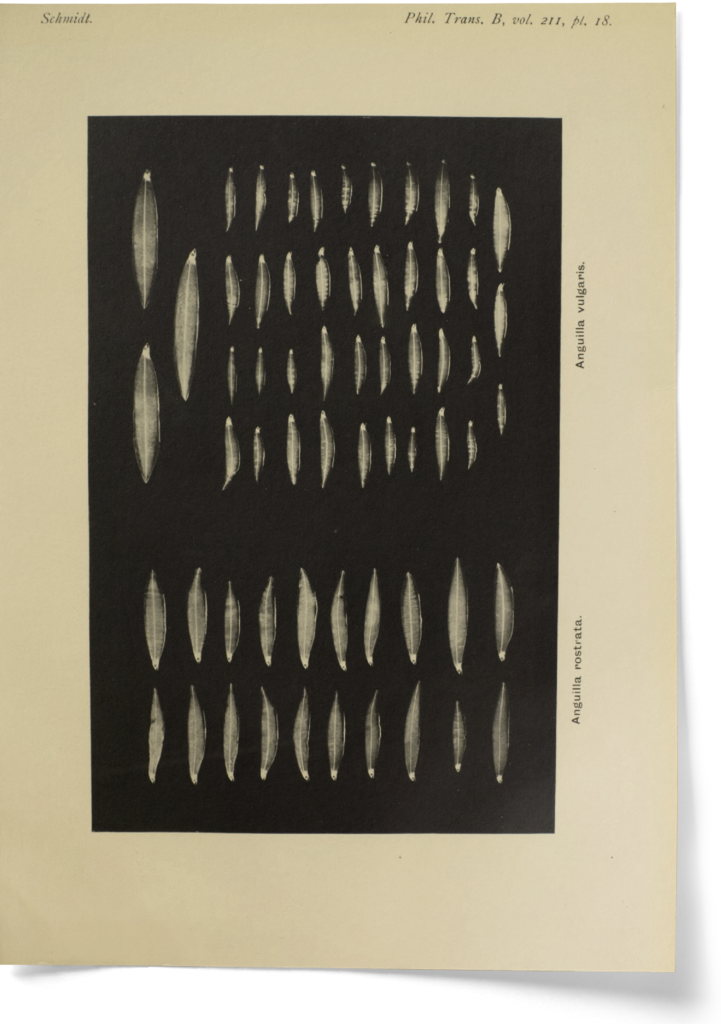
Science must still infer much about this extraordinary plasticity. As the journalist and author Patrik Svensson notes, fish ecologists have never successfully tracked mature eels to their presumptive spawning grounds, never observed them mating in the Atlantic, never found fertilized eggs in the wild before the larvae emerge. They continue to debate the hierarchies of sensory, cosmic, magnetic, and fluid forces that shape the eel larvae’s astonishing endurance trials, and they can only speculate on how this larval drift creates imprints that later help to guide the mature eels back to their birthplace, thus giving form to their catadromous journey.
In Carson’s day, it was therefore hard to derive narrative forms for marine ecology from the drift of the eel, and Carson’s journalism supplemented “observed facts” with her “supply from imagination” as she confronted technical questions of the eel’s life history. She queried how salinity gradients impel or guide the eel’s journey, a question she had tested in the Hopkins eel tank. She hypothesized a link between the eel’s sensation of salt and its sexuality, through which salt’s “bitter tang” excited the eel’s urge to speed offshore. Perhaps the ecologist’s own excitement derived from the eel’s disobedience toward the general law of stratified marine habitats. Carson memorably characterized this stratification in “Undersea,” her breakthrough article on the ocean: “And indeed it is nothing more or less than sea water, in all its varying conditions of temperature, saltiness, and pressure, that forms the invisible barriers that confine each marine type within a special zone of life.”3
Describing the eel’s movement across these zones, Carson questioned human-centric assumptions of sensation by naming chemical and liquid motors of memory and desire such as salt and pressure. Against those who read Carson as simply personifying sea creatures, the literary critic Laurie Shannon encourages us to recognize Carson’s endeavors to denaturalize and even unseat the structure of human perception.4 As Carson put it in “Undersea,” “to sense this world of waters known to the creatures of the sea we must shed our human perceptions of length and breadth and time and place, and enter vicariously into a universe of all-pervading water.”
“… oceanward journeys inevitably call our attention to the geological and infrastructural systems that obstruct them, from tectonics to technics.”
The eel was an adroit submersible with which to map this all-pervading water, and, as Carson described in her “Chesapeake Eels” article, catadromous migration gave form to its journey, “the river ever widening, the channels deepening, the water bringing unfamiliar tastes to her keen senses.” In the final three chapters of Under the Sea-Wind, Carson follows a ten-year-old female eel she tautologically names Anguilla from a fictional Bittern Pond somewhere far upstream in the Atlantic Piedmont to her spawning grounds beneath the Atlantic Sargassum. In her upriver habitat of mudbanks, burrows, and spatterdock, Carson portrays Anguilla as uniquely attuned to the genius of the place she calls home, a nearly Edenic pond-bottom pastoral. But sexual maturation presents itself as an urge to spurn this paradise of plenty.
In perhaps the most beautiful passage of her eel writing, Carson begins to describe the metamorphosis that impels the eel’s catadromous migration:
“A strange restiveness was growing in Anguilla the eel. For the first time in her adult life, the food hunger was forgotten. In its place was a strange, new hunger, formless and ill-defined. Its dimly perceived object was a place of warmth and darkness—darker than the blackest night over Bittern Pond. She had known such a place once—in the dim beginnings of life, before memory began. She could not know that the way to it lay beyond the pond outlet over which she had clambered ten years before. But many times that night … Anguilla was drawn irresistibly toward the outlet over which the water was spilling on its journey to the sea.” 5
In a journey from formless desire toward formless space, Carson points the eel’s metamorphosis toward its endpoint in the open sea. She alludes to its scientific features in this narration when she writes “the food hunger was forgotten,” a nod to an astonishing dimension of the eel’s sexual maturation and metamorphosis: as it augments its eyesight and fin capacity to facilitate its journey to the site in the Atlantic where it was born, the eel dissolves its stomach and lives its remaining days consuming its own fat stores. Though Carson never shies from categories colloquially called “memory” and “desire” in her narration, she translates them into a language of unfamiliar sensation.
Later fish ecologists regard these sensations as switches, cues, and triggers: lunar and electromagnetic forces imprint the larvae, chemical perception shapes their estuarine habits, and rheotaxis (movement with or against flow) develops.6 Carson translated these sensory inputs into literary language, proposing to us as readers that we could stand to resensitize and expand our knowledge of the exchange between language and different modes of planetary sensation. For example, could readers habituate themselves to identifying language’s rheotaxis (flow) as they do its syntax (order)? In her description of Anguilla’s sexual maturation, Carson’s language flows with and against the current (just as the eel might hide by day and drift at night). When describing the unknown causes of the eel’s migration, the vocabulary of the unknown includes words like restiveness, darkness, formless, and irresistible (r-sounds that linguists call “liquid consonants”). Flowing as a countercurrent through Carson’s prose, these verbal forms of rheotaxis formalize catadromous movement as a linguistic sound pattern, as if to emphasize the eel’s mysterious descent into the spillway.
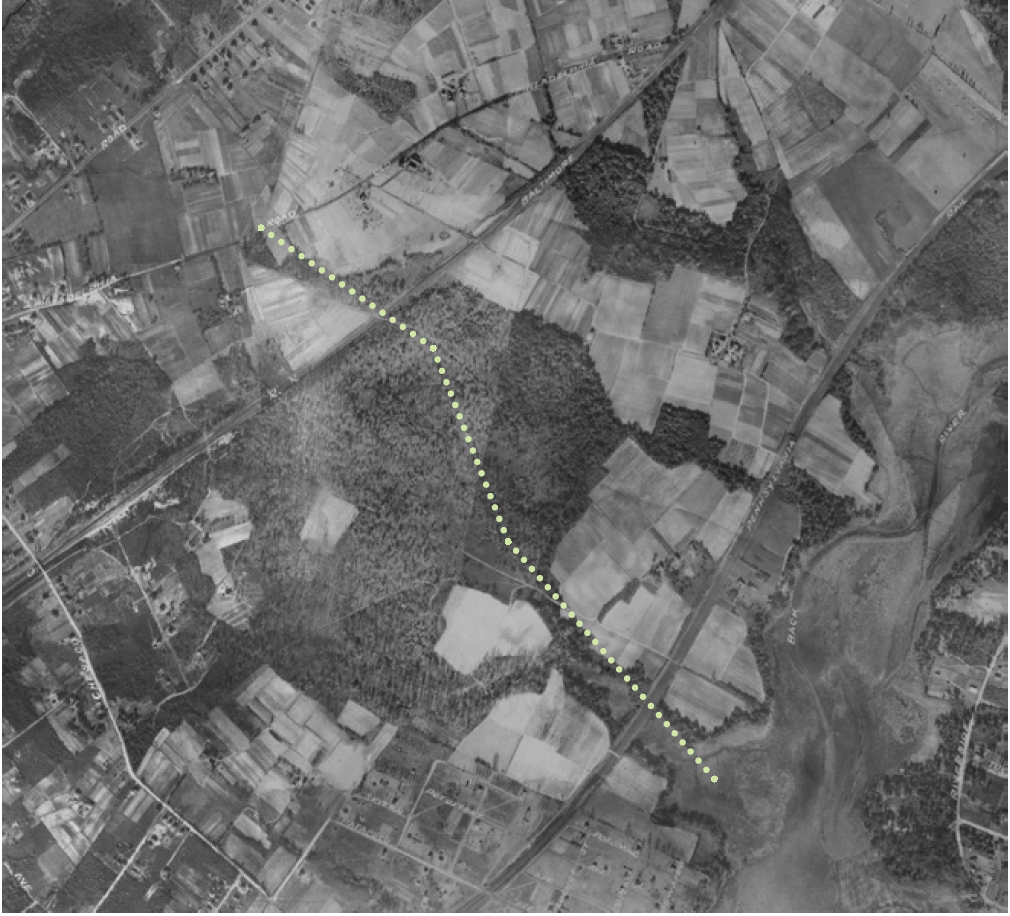
Yet even as language may contain the obscure eel-like desire to flow, we should be careful not to naturalize fluid forms amid the many obstructions we create. Humans badly fragment eel ecology by damming streams and diverting tributaries. On this point, consider Carson’s own propensity for shoreward flow during her marine biology training at Hopkins. From the unnumbered house in Stemmers Run where she lived, she enjoyed a mile-long woodland hike down to the Back River, a tributary of the Chesapeake. 7A 1927 aerial survey shows the patch in question. Today, the woodland’s remnants are streaked and pocked by two highways and an asphalt plant, while the Back River hosts a wastewater treatment facility’s perpetual outflow.
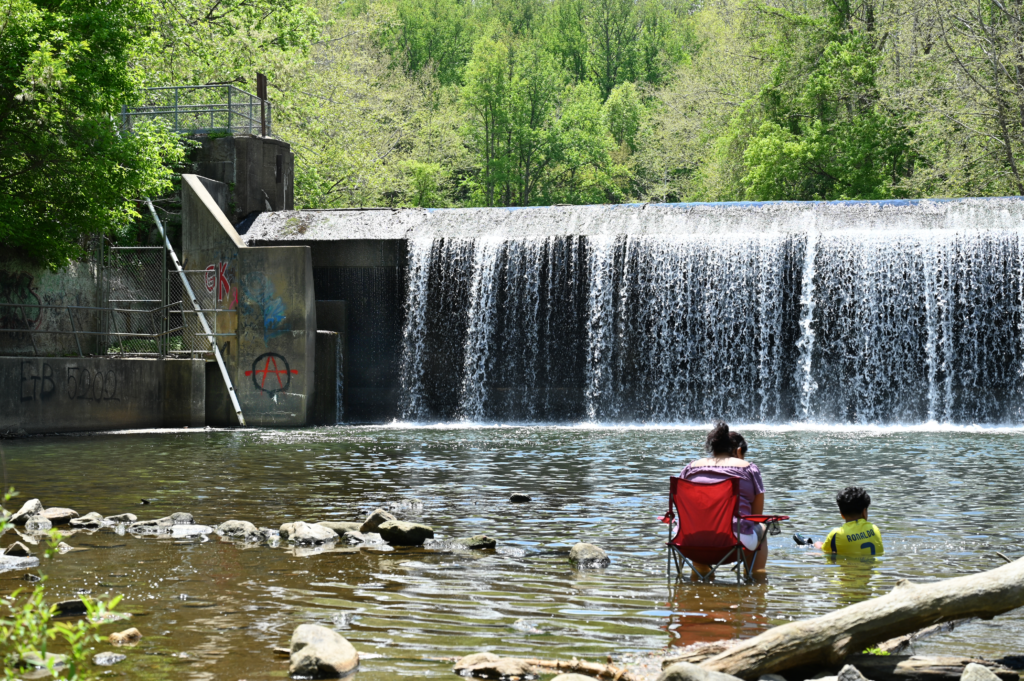
Along other branches of the Upper Chesapeake, at sites such as the Patapsco’s Daniels Dam or the Susquehanna’s massive Conowingo Dam, state-private partnerships manage anguilliform flows by creating clever migratory infrastructures, from primitive PVC eel ladders to expensive fish lifts. At Daniels Dam, an idly drawn anarchy symbol beside the eel ladder cannily critiques the state’s capacity to mitigate the pervasiveness of habitat loss (on a recent visit, I imagined James C. Scott himself holding the can of spray paint). Against these obstacles, rheotactic desires falter.
Catadromous migrations demand our alertness to fluid, cosmic, and chemical sensations (we can observe them like wriggling elvers in the eel tanks of our inquiries). At the same time, these oceanward journeys inevitably call our attention to the geological and infrastructural systems that obstruct them, from tectonics to technics. We can see these contradictions clearly through the developing knowledge of the eel’s life in environmental history: the emerging forms of catadromous migration shaped Carson’s narrative and poetic attention in her calling as the biographer of the sea. An obscure impulsion toward the lightless abyss, transgressing thresholds of salt and pressure, summoned the processes of demystification and enchantment that she brought to her work of translating marine ecology into an enduring cultural form. ◆
- Dorothy Thompson Seif, “Letters from Rachel Carson: A Young Scientist Sets Her Course,” 1987, Linda Lear Collection of Rachel Carson, Box 35, Folder 5, University of Connecticut Special Collections. ↩︎
- Rachel L. Carson, “Chesapeake Eels Seek the Sargasso Sea,” Sun, October 9, 1938, SM1. ↩︎
- Rachel L. Carson, “Undersea,” Atlantic Monthly 160, no. 3 (1937), 322. ↩︎
- Laurie Shannon, “Rachel Carson’s Estrangement of Humanity, from ‘Undersea’ to Hawk Mountain,” paper in progress. ↩︎
- Rachel L. Carson, Under the Sea-Wind (Simon and Schuster, 1941), 215. ↩︎
- Alessandro Cresci, “A Comprehensive Hypothesis on the Migration of European Glass Eels (Anguilla anguilla),” Biological Reviews 95, no. 5 (2020). ↩︎
- Linda Lear, Rachel Carson: Witness for Nature (Henry Holt, 1997), 71. ↩︎