
Big Tech at the Bingo
Eighty-five, there goes our social lives!
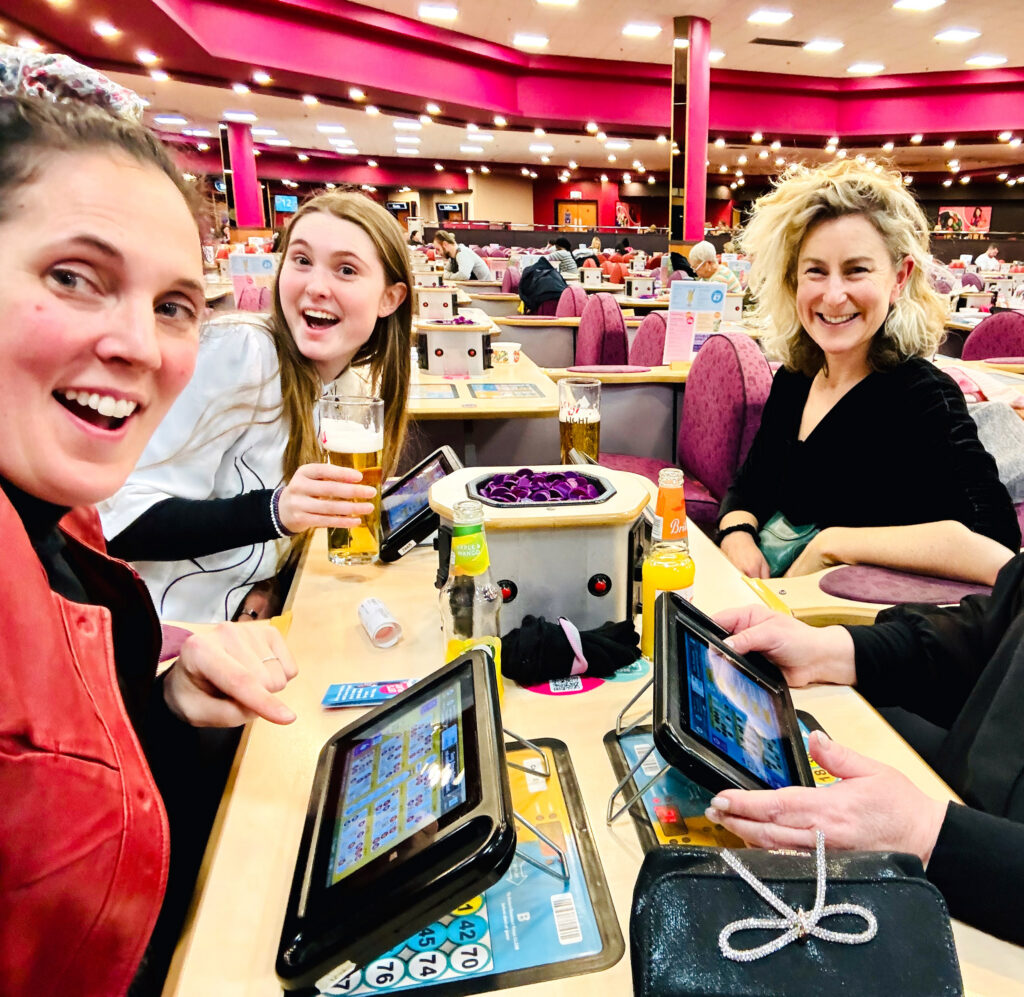
The numbers pour from the bingo caller in a streaming monotone as she leans against the podium in her company-issued, smart-casual uniform. She reads randomly generated numbers from a screen, glancing out at the players’ tables between calls. Close to the microphone, as if she was lulling in a child’s ear, her voice is intimate and calming, bordering on boring. It would indeed be soothing were I not panicking over my screen: an electronic tablet glowing with multiple bingo cards and dozens of numbers, demanding that I jab and dab matches before the caller utters the next number.
Maeve looks at me knowingly. She’s worked her whole adult life with children, and I can tell I’m about to get patiently educated. She leans over and whisper-reminds me of this game’s rules, her 1920s bob swinging forward and her blue-green eyes magnified by her glasses. Maeve’s sparkly nails flit between her tablet and mine as she dabs numbers I missed—all while playing twice as many cards as me, waving and winking at her friends, and sipping her wine.
Maeve seems to know everything and everyone here. At London’s Wood Green Bingo she’s famous—famous for being friendly and famous for being lucky. I’d asked to come along because so many of her stories are about the bingo. What was this place of conviviality, risk, drama, and skill?
Sitting beside her in a pink chair at a laminated table full of inscrutable bingo paraphernalia, I understood. By the time we left, she had introduced me to the charming cashier, swapped updates on the health and children of several friends, and taken me on several emotional roller-coasters of hope and despair. We gossiped. We dined. She won fifty quid.
But I only got to the Wood Green Bingo twice. In my front hall one day, Maeve dropped a bombshell: the place she’d been going for decades was closing soon. It was going to be replaced … by an app! Later she texted: “There goes my social life. ???? ???? x.”
Despite its community feel and community origins, British bingo is a largely commercial enterprise. Escalating costs and declining revenue, sharply exacerbated by the UK’s strict COVID-19 lockdowns, are impelling companies to pivot from what the industry calls land bingo to online bingo apps and websites.
Behind a plethora of branded spaces like Mecca Bingo, Foxy Bingo, and Lucky Cow Bingo are a smaller number of bingo software platforms like Pragmatic Play and Playtech. Many in the business see these technologies as the future. Mecca’s website, for example, states: “Although bingo halls are still around, they have largely been eclipsed by online bingo, with 85% of players choosing to go the online route rather than attending a physical bingo hall.”
Many land bingo players, however, are not letting their bingo halls go gentle into that good night. They want nothing to do with online bingo’s techno-optimistic values of convenience and progress. They are raging against the closure of their halls because of the values their walls protect: the defense of the vulnerable, the sociality of emotion and of luck, the glamour of public entertainment, and the distinct culture that is British bingo.
One fading element of this culture is British bingo lingo: oft-rhyming and sometimes-rude nicknames for each number derived from military language, popular culture, and Cockney slang. The media often blames its disappearance on the “woke brigade,” but I suspect a more prosaic reason: standardization and speed in the pursuit of profits. That, and the fact that bingo slang evokes community, critique, and resistance—concepts that don’t jibe with shareholder returns.
The long history of bingo in Britain hinges on women, who have invented and popularized community numbers games, both as operators and as players.1 These games of chance can be a side hustle that supplements working-class household incomes—or at least provides the dream of doing so.
Widespread informal and charity bingo meant that, as soon as British gambling laws relaxed in 1960, existing communities of players were ripe for profit. Companies that had made their fortunes commercializing working-class British leisure time folded bingo into the mix, often marketed as “affordable glamour.”2
And glamorous it was. Commercial bingo halls often occupied historic buildings—soaring churches and grand cinemas. The stages from which bingo callers entertained, frequently shoulder-to-shoulder with celebrity guests, were dramatically draped and festooned with balloons. The callers also dressed for the occasion, like Ricky in his dicky bow, and they themselves became celebrities: Ricky Denton, North London’s most famous caller, starred in a 1999 BBC documentary about the contest for National Bingo Caller of the Year.
Over a coffee at McDonald’s, Ricky—fast-talking, with charismatic consonants—described leaving the bingo hall at the end of his shift and finding a line of women waiting to chat. Mothers, workers, and pensioners could glam up and strut out for a night that was thrilling yet safe, circumscribed by its low stakes and sustained by its community.
The bingo community was, and still is, about neighbors and regulars, callers and waitstaff, customers and cashiers. It is about care and exchange, noticing and joviality, and the sociality of emotion. As one longtime player explained it, “You enjoy everything more when someone is with you. The competition. The excitement when you want one number, and it’s big money, and your heart—oh my god! … It’s a lovely feeling when you have won or are waiting for just one number. All your friends get excited with you. You win, and they cheer!”
Maeve wins a lot. She once won so much money that she splurged on a family holiday to Florida and put her children through university. She brought an aura of luck when she walked through the bingo hall’s doors. “I was always winning,” she told me. “Everyone said, ‘Oh let me rub you!’ I was like a cat. They were rubbing my shoulders. But it got me to Spain and Turkey, so I didn’t care!” Maeve’s luck was shareable; as much as it belonged to her, it also belonged to the community.
When land bingo players talk about their community, they often mention the pensioner regulars who spend winter afternoons in the bingo hall, warmed by the subsidized heat and inexpensive food. They worry, frowning, about all those they lost track of during the Covid closures.
With the rise of bingo-for-profit, the game became a community practice operating on a commercial platform, though this analog platform was hardly noticeable beneath the laughter and sparkle of a night out. In fact, bingo’s wholesome community aspects were highlighted by profiteers as a way to stave off gambling regulation.3 But regulation has eaten away at bingo’s bottom line all the same.
In 2007, England banned smoking in enclosed workplaces, following closely behind the rest of Britain. Profits tanked as, instead of feeding the slot machines or buying drinks, smokers stepped outside between games for a quick cigarette—or stayed away altogether. In the years between the smoking ban and the Covid lockdowns, the number of bingo halls in the UK halved.
Covid closures took the next bite out of land bingo. When halls reopened, soaring energy prices compounded losses by making heat and light in bingo’s cavernous halls very costly. Between the pandemic and now, bingo halls have declined by a further quarter.
In Mecca’s 2024 annual report, its parent company, the Rank Group, announced a strategy of “estate rationalisation” coupled with the development of a bingo app. Customers have gradually been pushed out of halls and onto apps as the commercial bingo platform model moved online.
Mecca’s messaging portrays this shift in a positive light, coaxing players online with platform promises. We can see the familiar techno-solutionist discourse of convenience on its website: “Many of our members prefer playing online bingo as it offers the same excitement of bingo in a club, but you can do it anytime, anywhere. Games at Mecca Bingo play round the clock, so if you work night shifts or you are an early riser—you’ll always be able to get into a great game of online bingo!”
The move to online bingo is framed as inevitable. After noting that bingo has its roots in the 1500s, Mecca’s website goes on to state: “Technology has come a long way since then, and the way that we play bingo has evolved with it”—lucky for the bingo platforms, unlucky for the bingo landlubbers.
Land bingo players have weathered profit squalls before. They watched lucrative slot machines encircle their halls. Some players gave these a wide berth; a few lost their life savings. They witnessed rationalization hollowing out hallowed traditions. Skill and autonomy in the bingo profession, with the amiable caller at its pinnacle, were flattened into simplified and interchangeable roles, with identically uniformed workers rotating between the bar, the stage, and the bins.
Bingo ball blowers were replaced by electronic random number generators. Paper cards were displaced by tablets that auto-play. The decline in human error that once worried callers and players alike was cold comfort for the decline in human expertise as these machines paved the way for the platformization of bingo.
In the end stages of this transformation, every aspect of bingo is mediated by a platform. This was the future that the Wood Green Bingo players and workers were facing. Maeve told me there was talk of a petition against the closure. There was mulling over meeting members of parliament. Groups were organizing carpools to Cricklewood Bingo—much further away, but with very lucrative prizes. In their organizing and their resistance, these land bingo players kept good company across time and space.
The first (and most famous) instance of bingo resistance dates back almost twenty years, to the threatened closure of Islington’s Essex Road Mecca Bingo following the smoking ban’s profit shock. To raise awareness about the importance of the neighborhood bingo hall to the community and about the lives of pensioners, players formed a rock band.
They declared themselves the oldest rock band in the world, measured by the cumulative age of its members. Named the Zimmers, after the brand of walkers, they eventually made it all the way to the semifinals of Britain’s Got Talent. As they shuffled onstage for their audition in drab overcoats and arranged themselves for a saccharine rendition of “What the World Needs Now is Love,” judge Simon Cowell rolled his eyes. Suddenly, the record scratched. The Zimmers flung off their coats, revealing heaps of gold bling, pulled on baseball caps at jaunty angles, and started boisterously rapping to the Beastie Boys’ “(You Gotta) Fight for Your Right (To Party!).”

VIDEO STILL FROM https://www.youtube.com/watch?v=-m0EZO5O2dM
One night, I’m in Newcastle. It’s darkly autumnal, concrete gray and slippery-shiny with drizzle. I stand at an intersection, waiting for the light. I look at the small group of university students in front of me and smile at their colorful costumes: argyle sweater-vests diamonded in reds and greens, striped saddle shoes, an assortment of wigs, and incongruous pirate gear. They are splitting up at the end of their night. “Anna, message me when you get home,” one says.
A mustachioed man in his late twenties with an umbrella suddenly stops, delighted. He points at the Henry Hoover box one of the preppy-pirates is hoisting. “Have you been at Bongo’s Bingo?” he asks. They nod and grin.
How on earth did he know?
I realize that the whole scene—the costumes, the cheer, the household appliance prize being lugged home in the rain—are instantly recognizable to those in the know as the cultural institution of British bingo.
“I love it!” he laughs, then salutes and walks on by. ✳
- Carolyn Downs, “Two Fat Ladies,” History Today, July 2007, https://www.historytoday.com/archive/two-fat-ladies. ↩︎
- Carolyn Downs, “Mecca and the Birth of Commercial Bingo 1958–70: A Case Study,”
Business History 52, no. 7 (2010), https://doi.org/10.1080/00076791.2010.523460. ↩︎ - Downs, “Mecca”. ↩︎