Metastatic Content
How the porn scene mutates across platforms
As the “Rule 34” internet meme goes, “If it exists, there is porn of it.” One of the most widely consumed forms of digital content, porn now circulates almost exclusively online—via studio websites, video-sharing tubesites like Pornhub, and subscription-based social media platforms like OnlyFans. Since the rise of the internet and the demise of feature-length porn films, the porn industry has been reorganized around the production of “scenes”—sexually explicit videos only twenty to forty-five minutes long.
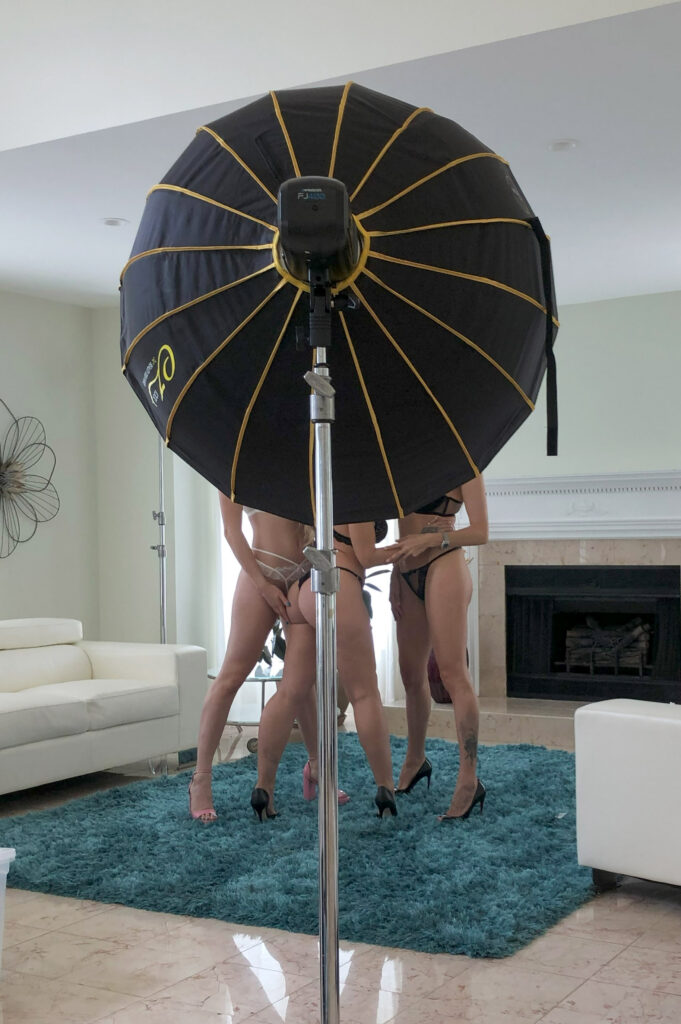
Studios contract directors, crew, and performers to produce these scenes, paying each a flat rate. Scenes are then uploaded to the studio’s website; many are subsequently pirated and circulated across tubesites by third parties. Performers also work independently as content creators, collaborating with one another to produce their own scenes—called “content trades” or “collabs”—for subscription-based platforms where users subscribe to individual performers’ accounts.
As scenes travel from the hands of directors and content creators, through websites and social media platforms, and onto the screens of users, they give rise to other cultural objects that travel in different ways. Drawing upon ethnographic fieldwork on the porn and adult content creation industry, I explore how platforms shape and are shaped by the movement of three objects that would not exist without the porn scene, but are irreducible to it. By showing how these objects replicate and transform across platforms, I argue that content doesn’t merely go viral—it metastasizes.
The Promo Post
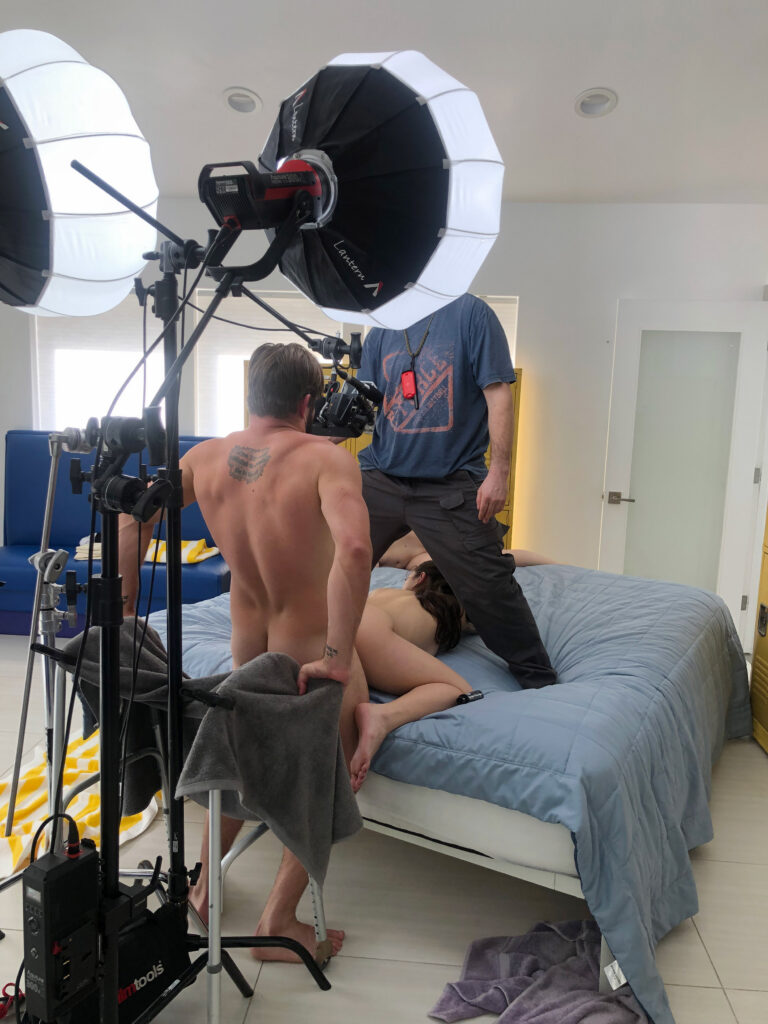
Studios and performers use X (formerly Twitter) and other social media platforms to post promotional content—promo—an image or a video accompanied by text telling viewers where to watch a scene and linking the studio’s and performers’ accounts. Promo is deliberately generated during the production process. Before shooting a scene, directors take stills—photographs of the performers in each sexual position they plan to enact. During content trades for OnlyFans, where users expect less technical polish, stills are usually taken during filming for efficiency—often by one of the performers themselves, while holding the camera for point-of-view (POV) footage.
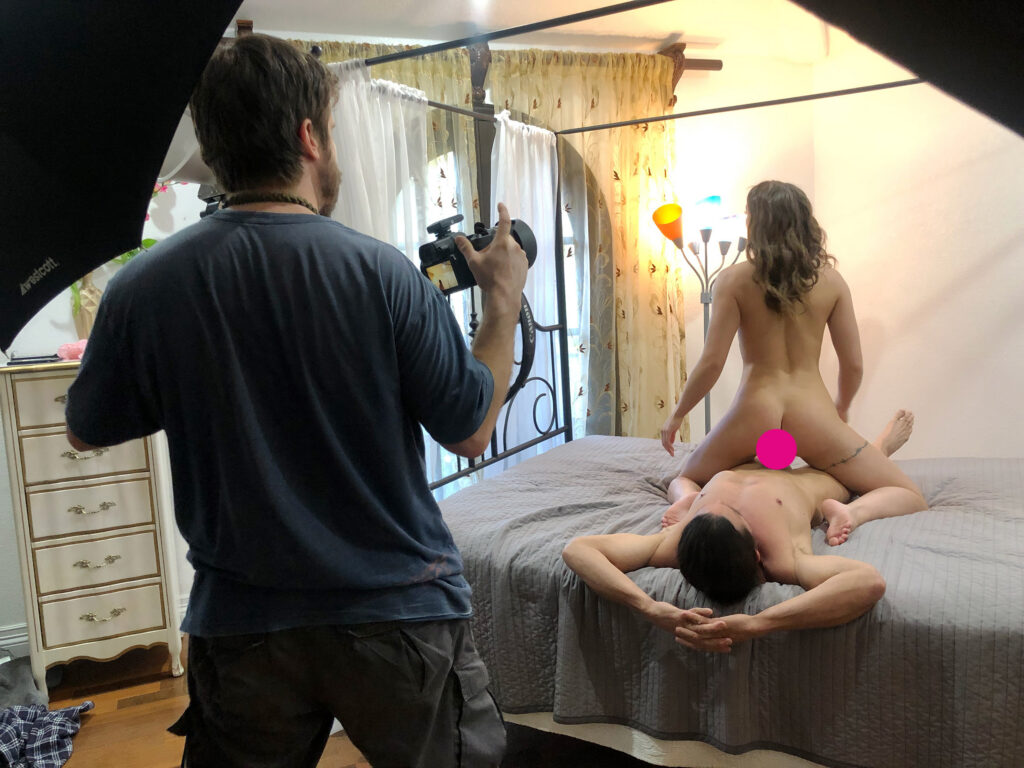
Studios and performers also produce behind-the-scenes (BTS) videos—short recordings, usually only a couple of minutes long, in which the performers address the camera to discuss the scene they are about to shoot or have just shot. Directors instruct performers on what to say, such as making sure to name the studio, but performers may also film their own BTS on their phones.
Because performers, especially women, often have far more social media followers than studios, studios want performers to post promo on their own social media accounts and are more likely to rehire them if they do. However, this is not contractually obligated, and performers will not post promo that they deem to be damaging to their individual brand. One female performer told me:
There’s some things where it’s like they’re done really amateur, and whatever sets they’ve used, or whatever thing is posted, it’s horribly unflattering—which is fine. I’ve accepted that. I have no control over the content that’s out there. You can just use my image and do whatever with it. But some of those I’ll just like instead of retweet.
As independent content creators, performers also use promo to cross-pollinate followers across one another’s accounts, and to draw users to their own various accounts on multiple platforms, especially OnlyFans. The same performer went on to explain how this approach differs from promo for studio projects:
My collabs, of course, I’m the one making the money off of that. So I will definitely promote those. I’ll do a Twitter post, an OnlyFans mass message to everybody who subscribed, plus everyone who has subscribed in the past and their subscription has expired. … Even if they don’t want to resubscribe, maybe they’ll go buy this one video. And that’s why you follow everybody that follows you. And then that way you have access to all the people that subscribed.
Promo is a derivative of the scene, included in the flat rate for producing the scene, and consumed only in reference to the scene. It travels where the scene cannot and brings back users. As it does so, it enables the scene to spread across networks of accounts embedded within networks of platforms.
To drive traffic effectively, creators must understand how users navigate different platforms. For example, OnlyFans has limited search functionality, so creators must rely on other social media platforms to bring users to their OnlyFans accounts. Creators must also navigate the regulatory thickets of multiple platforms. TikTok and X prohibit direct links to OnlyFans, so a creator instead has to post an aggregator link page on their bio that includes their OnlyFans page, conforming to the “two clicks away” rule. TikTok bans nudity and most sexual suggestion; Instagram permits risqué imagery but no nudity; X is the only major platform where explicit content is allowed as long as it’s tagged and consensual. In this way, promo moves the user from one creator’s account to another within the same platform, and from one platform to another as the user follows a single creator across multiple platforms.
The Softcore Scene
Softcore porn depicts sex without visible genitalia. Studios produce and distribute softcore scenes so that their content can travel even more widely across platforms. They sell these scenes to hotels and cruises, where they are aired on pay-per-view television platforms, and to websites in countries with more restrictive obscenity laws. As this suggests, platforms are subject to institutional and state regulations governing what kinds of content they can host and where that content can travel.
As with stills and BTS, a softcore scene is bundled into the flat rate that performers receive for shooting a hardcore scene. Typically, performers shoot the softcore scene directly after filming the hardcore scene. Performers reenact the same positions but only simulate penetrative sex, posing so that their genitalia are not visible on camera.
The edited softcore scene contains the same non-pornographic introductory dialogue filmed for the hardcore scene, combined with the softcore version of the sexual interaction. Yet this introductory scene would not exist without the softcore version. As one director explained to me:
Some of those movies also get repackaged. They get sold to Showtime and places like that. So there’s a certain level of actual scripted dialogue. The story needs to have a beginning, middle, and end, whereas a lot of the other stuff we do is more vignette-oriented, where one scene doesn’t have anything to do with the scene following it. They’re self-contained, which is essentially what happened when porn moved away from DVD into just individual content sites. It was like, “Well, maybe people don’t want to watch [the scripted dialogue].” I mean, I’ve been doing this for a hundred thousand years. I’ve never met a person that ever told me, “Yes, I watched a pornographic film from beginning to end.”
… But when you’re making softcore porn for a different market, then you need those story elements, because you’re taking all the hardcore sex out. So now it’s a different demographic or a different viewership watching that product. Even though it’s the same product, it’s just repurposed.
The softcore scene is a composite of the hardcore version and its softcore reenactment. The scene, in effect, mutates to conform to regulations—allowing it to travel further, across more platforms and wider geographic space.
The (Counterfeit) Clip
The clip is a short segment of a scene, or several segments spliced together, usually containing part of the sexual interaction, uploaded as a stand-alone video. One form of clip is what’s known as an ad scene. Ad scenes are produced by studios, and they are publicized on studio websites as standard scenes. But the primary function of ad scenes is to serve as banner ads—digital advertisements embedded in webpages. A studio produces a banner ad by editing an ad scene into a GIF: multiple moments of the scene spliced together into a short clip. The studio then pays tubesites to post the banner ad in order to drive traffic to the studio’s website.
Unlike other scenes, where performers are typically allowed to stray from the script, studios script ad scenes tightly to produce the series of moments that they plan to splice. The ad scene is often deliberately staged as an outrageous scenario to serve as clickbait. On a panel at XBIZ, the porn industry’s main trade convention, a director explained the logic to the audience:
Somebody’s trapped in the washing machine. They’re stuck in a window. There’s some certain thing going on. And of course, the rationale behind that is these twelve seconds are going to be so outrageous, you’re going to go, “Oh my God, I need to see how that turns out,” and then click on it, right?
Studios and performers also truncate regular scenes into clips to upload to social media and tubesites. As with promo and ad scenes, these clips function as advertisements for full scenes, meant to entice the user to purchase access. But unlike promo, users often watch these clips in lieu of the original scenes.
Users can also become creators, not by making scenes, but by making new clips that they post to tubesites. Done without the authorization of the scene’s legal owners, this is piracy. Counterfeit clips threaten the value of the original scenes because users may deem the clips sufficient to watch instead of the originals. To protect the value of their work, studios and performers contract companies to monitor platforms and to request platform moderators to remove counterfeits.
But this work is never done, and the threat is never fully vanquished. A clip can be endlessly reproduced, re-uploaded, and copied onto other platforms. Authorized and unauthorized creators alike struggle to control how these objects move across platforms. The clip is a fragment that is strategically severed from the original and further metastasizes it.
Coda
When a porn scene is posted online, it quickly replicates across platforms. But it does not remain whole and unchanged. Its derivatives, composites, and fragments move through alternative channels across digital and geographic space. These transformations accumulate over time, such that the scene is no longer a singular object, but one that replicates and mutates indefinitely.
No single actor controls this spread. Instead, it unfolds through distributed agency across a network of human and technological actors: performers and studio employees who post promo, fans who screen-record and share, algorithms that surface certain fragments over others.
In this way, the scene metastasizes, breaking away from the original body and seeding itself across new sites—where it continues to reproduce, mutate, and circulate. Its life is no longer anchored to a single upload. Instead, it is sustained by the platforms that keep its fragments in motion. ✳