
Platform Obscurantism
The hidden substrates of machine learning
ChatGPT is a platform. The chatbot is infrastructure. Thousands of applications now build on OpenAI’s application programming interface, creating a dependent ecosystem of developers, startups, and enterprises.
When OpenAI positions ChatGPT primarily as a conversational interface, it obscures this platform identity, one that extracts value not only from user data and app store partnerships, but from the planet itself.1 Like earlier platform companies—Uber, Facebook, Amazon Web Services—AI platforms systematically render invisible the infrastructures that make them possible. These hidden foundations include workers in the Global South who rate AI outputs for a few dollars per day, uncompensated creators whose work trains AI models, public water systems that supply data center cooling, and communities that bear the environmental costs of mineral processing and electronic waste.
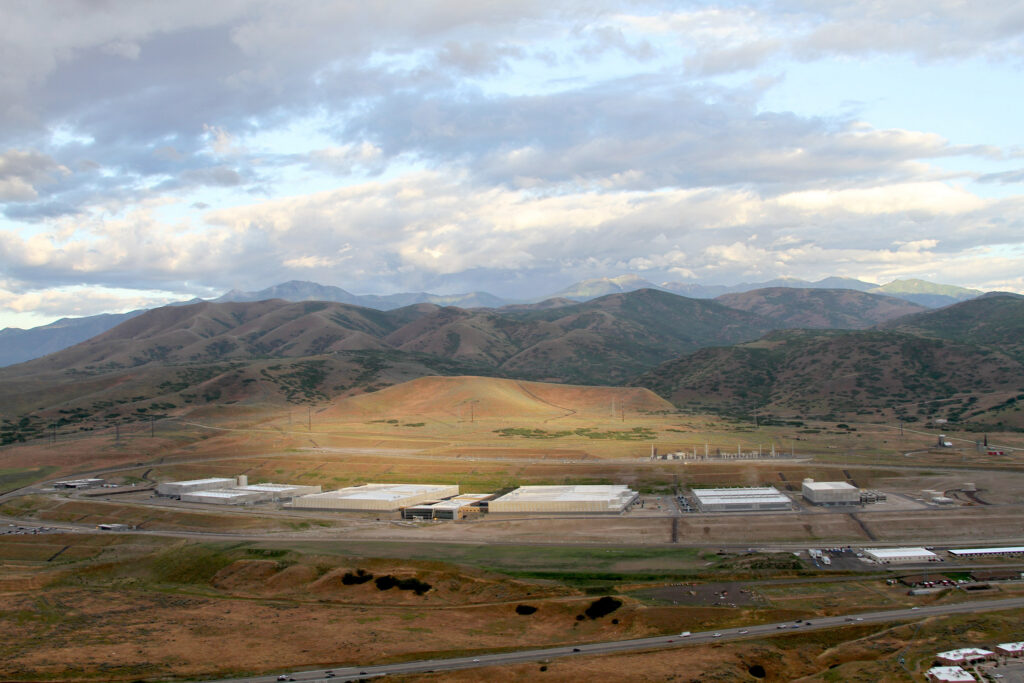
PHOTO BY PARKER HIGGINS ON WIKIMEDIA COMMONS, CC0 1.0
Advanced artificial intelligence is often described as an ethereal technology—an immaterial power floating in “the cloud.” But clouds have weight. Behind every chatbot prompt lies a material reality that extends deep into the earth.
The rhetoric of immateriality distracts us from what is apparent in markets and geopolitics. Seven United States-based technology companies now account for nearly a third of the S&P 500’s value, their AI ambitions inflating market capitalizations into trillions of dollars. Without these firms, US economic output would have contracted in recent quarters. The entire economy is now tethered to cloud promises that analysts increasingly describe as a bubble waiting to burst.
Platform obscurantism operates through misdirection.2 It trains our attention upward, to the cloud, to imagined utopian futures, while extraction happens all around us. What if we got our heads out of the clouds? What if we looked down instead? Understanding the political and ethical stakes of AI requires excavating what platforms work so hard to bury.
Substrates are foundational materials, like the silicon wafers upon which circuits are etched—the physical base of computation. The AI political economy is composed of multiple, layered substrates, including geological, temporal, imaginary, and epistemic ones. AI platforms rest on these and other substrates. Tracing these hidden foundations reveals where power concentrates and where it might be contested.
Geological Substrate
Consider the mine. From the vantage of deep time, deep learning is a geological phenomenon. Cobalt, lithium, nickel, and rare earth elements are extracted from strata that condense millions of years of planetary history. These minerals are reanimated through circuits, chips, and data infrastructures, transforming geological time into computational capacity.
This geological substrate tracks the longue durée of extractivism documented by scholars of empire and resource economies. Howard French has traced extraction across African, Caribbean, and American colonies. Modernity, he argues, was built on the plunder of the earth—a process that reordered human societies as much as it rearranged geology.3
Thea Riofrancos extends this framework to the present by examining lithium extraction in Argentina, Chile, and Bolivia. Her research in the Andean region reveals a pattern: northern nations secure minerals needed for “clean” technology while southern communities bear the environmental costs. The promise of sustainable futures, she demonstrates, often rests on intensified extraction in the Global South.4
AI development extends this lineage. Critical minerals are to the algorithmic economy what gold was to empire and what oil is to industrial modernity. All are resources that become essential global interdependencies.
The so-called “critical minerals supercycle” has entangled national industrial policies, private capital, and planetary ecosystems.5 Argentina’s lithium fields: water depletion in arid lands. The Democratic Republic of the Congo’s cobalt mines: exploitative labor, environmental devastation. Chile’s Atacama salt flats: brine extraction conflicting with Indigenous water rights.
These sites have become hinge geographies in a reconfigured global economy. Not peripheral zones of AI development. Constitutive ones.
The benign language of “training models” and “machine learning” conceals what this actually requires: finite reserves of water and minerals, energy-intensive processing, and human labor at every stage. The platform ideal perfects this erasure, treating extraction sites as mere supply chains rather than the material foundation of computational power.
Temporal Substrate
Resource extraction has worked through conquest and enclosure, the seizing of space. AI platform extraction works additionally through the manipulation of time, the seizing of futures. Industry narratives of urgency, competition, and existential risk compress the horizon of deliberation. Policymakers are told that regulation must not slow innovation, that data must flow without friction, that the benefits of the AI future are too abundant to pause.
This temporal logic demands sacrifice zones, communities whose past and future are deemed expendable in the name of an accelerated present.
In Southaven, Mississippi, xAI built its Colossus 2 data center to train Grok. Twenty-seven gas turbines were installed without air permits. The largely African American community had already endured decades of industrial pollution, their lungs carrying the residue of past extractions. Now they breathe emissions from turbines burning methane to power machine learning. The future collapses into a toxic present.
An NAACP lawsuit identifies what this negative externality represents: environmental injustice compounded by purported algorithmic urgency. In the age of AI, the civil rights struggle extends into the fight to breathe.6
AI platforms accelerate this logic while obscuring what they accelerate. By abstracting computational processes into frictionless and often dialogic interfaces, platforms compress the distance between desire and fulfillment. The temporality of the click, the keystroke, the prompt.
Yet beneath this immediacy lie vastly different timescales: the geological time required to form minerals, the generational time of communities disrupted by mining, the long horizons of environmental recovery, and real-time energy consumption of computation.
All are collapsed into a perpetual present of instant response.
Slowing down may be the most radical act against platform obscurantism. To pause amid the rush for critical minerals and computational dominance is to reclaim the possibility of collective choice. To insist on time for excavation and examination.
In that pause, power relations become visible. Dependencies become negotiable. Sacrifice zones become refusable.
Urgency is itself a technique of extraction, a way to exhaust the present for the future, while foreclosing deliberation about what we build, how we build it, and who pays the price.
Imaginary Substrate
Every mineral rush depends on speculation—not only in markets but in imagination. The AI economy is propelled as much by sociotechnical imaginaries as by hardware. Much of the infrastructure expansion today rests on hypothetical futures: visions of artificial general intelligence, sentient systems, and boundless productivity that have little empirical grounding yet immense narrative force.
These imaginaries constitute their own kind of substrate, a foundation of belief that supports material extraction. They do not merely describe technological futures—they produce them, shaping investment flows, labor relations, and international policy. They also deflect attention from the material and political present: the waste streams, energy consumption, and environmental externalities that make AI possible.
Platform companies have always trafficked in futures. Uber promised autonomous vehicles, Facebook pivoted to the metaverse. AI platforms amplify these speculative dynamics by linking technological development to existential narratives about intelligence, consciousness, and human obsolescence.
Just as early modern alchemists dreamed of transmuting base metals into gold, today’s AI evangelists promise to turn data into value. Both rely on the enchantment of transformation. Both conceal the bodies, both human and mineral, on which that transformation depends.
The more dazzling the promised future, the less visible the extractive mechanisms. And so communities sacrifice water rights for promises of progress, nations race to secure minerals for intelligences not yet built, and workers breathe methane emissions to train systems whose benefits remain speculative.
Epistemic Substrate
At stake is not only what is being extracted, but who knows what is being extracted. As Riofrancos observes, the sites of resource extraction are also sites of epistemic contestation, places where definitions of “critical” minerals, “clean” energy, and “responsible” AI are negotiated. This constitutes another substrate: the infrastructure of knowledge production itself.
Governance frameworks, whether the EU’s due-diligence acts or US legislation like the Critical Minerals Security Act, often lack effective enforcement. Voluntary standards dominate, and local communities are tasked with monitoring compliance without meaningful authority. This mirrors AI governance itself: a proliferation of principles with few mechanisms of redress.
Epistemic asymmetry is built into the AI stack. Corporations invoke trade secrecy to withhold model data and energy metrics, even as they extract publicly available knowledge and natural resources. Researchers attempting to audit the environmental impacts of Microsoft’s data centers or OpenAI’s model training are denied access. Communities near cobalt mines cannot trace which AI companies purchase their minerals.

Mineral opacity and algorithmic obscurity reinforce each other. Both insulate powerful actors from scrutiny, transforming public goods into private assets. Where earlier platforms obscured labor relations and data flows, AI platforms add layers of geological and epistemological concealment, making it nearly impossible to trace the full supply chain from lithium brine to language model.
This is obscurantism as knowledge regime: a systematic organization of knowing and not knowing that protects extraction while mystifying its operations. It exemplifies what I term “algorithmic agnotology”: the strategic production of ignorance through technical inscrutability, selective transparency, and the deliberate framing of the AI stack as too complex to interrogate or govern.7
The Work of Exposure
The challenge is not only to imagine alternatives but to build countervailing power against platform obscurantism. This requires us to recognize where leverage actually exists.
Resource-producing countries in the Global South control substrates that AI companies cannot do without. This dependency creates negotiating power if wielded collectively.
Strategic coordination around mineral pricing, processing requirements, and environmental standards could shift value capture in supply chains that currently extract wealth while externalizing costs.
Making substrates visible is not merely an analytical exercise but a political one. What platforms conceal, policy and collective action can reveal. Reconceiving extraction as relation rather than resource requires institutional capacity: technical expertise to trace supply chains, legal infrastructure to pursue accountability, and financial mechanisms to make noncompliance consequential.
Transparency and audit mechanisms in mining and oil extraction have often fallen short, weakened by voluntary compliance and inadequate enforcement. What distinguishes AI obscurantism is the speed at which dependencies form, and the layers of technical, geological, and informational complexity that conceal them.
Yet accountability can emerge through strategic litigation, as the NAACP’s lawsuit against xAI demonstrates, and through whistleblowing by workers who refuse to be complicit in concealment. Such interventions bring hidden infrastructures into public view.
Still, these struggles for exposure never fully resolve. They are as enduring as extraction itself, requiring sustained contestation at every layer of the AI stack.
Exposure itself must become infrastructure: transparency mandates with enforcement power, independent audits with legal standing, and public access to data currently held as trade secrets. What lies beneath the surface can become the ground for a different politics of intelligence. The weight of the cloud can be measured, can be accounted for, and can be made to matter. ✳
- Kate Crawford, Atlas of AI: Power, Politics, and the Planetary Costs of Artificial Intelligence (Yale University Press, 2021). ↩︎
- Marc Aidinoff et al., “Five Theses on the Gravity of Platforms,” Institute for Advanced Study, 2024, https://doi.org/10.48706/0KXB-N725. ↩︎
- Howard W. French, Born in Blackness: Africa, Africans, and the Making of the Modern World, 1471 to the Second World War (Liveright, 2021). ↩︎
- Thea Riofrancos, Extraction: The Frontiers of Green Capitalism (W. W. Norton, 2025). ↩︎
- Tatiana Carayannis, Naima Kane, Marie-Therese Png, and Alondra Nelson, “Summary Report: Workshop on the Geopolitics of Critical Minerals and the AI Supply Chain,” Science, Technology, and Social Values Lab, Institute for Advanced Study, 2025, https://www.ias.edu/sites/default/files/Critical-Minerals-Workshop_Summary-Report.pdf. ↩︎
- “NAACP, SELC, Earthjustice Threaten Lawsuit over xAI’s Unpermitted Gas Turbines in Mississippi,” press statement, NAACP, February 13, 2026, https://naacp.org/articles/naacp-selc-earthjustice-threaten-lawsuit-over-xais-unpermitted-gas-turbines-mississippi. ↩︎
- Alondra Nelson, “Algorithmic Agnotology: On AI, Ignorance and Power,” paper presented at IASEAI Conference, February 2026, https://library.iaseai.org/videos/algorithmic-agnotology-on-ai-ignorance-and-power/. ↩︎