
Big Wellness and goopy Governance
Aspirational health is not cheap
Lifestyle brand goop commands a lucrative corner of the $4 trillion global wellness industry, packaging high-end holistic services and celebrity-curated shopping with off-the-beaten-path doctrines about beauty, nutrition, and “glow.” Movie star Gwyneth Paltrow parlayed a newsletter—once filled with recipes, health tips, and travel recommendations—into this $250 million empire. Today, goop spans a website, a print magazine, beauty and supplement lines, pop-up boutiques, and health summits costing upward of $5,000 per ticket—all offering visions of personal optimization amid a crowded field of influencer platforms devoted to fitness, spirituality, and slimness.
Thriving in the largely deregulated market of supplements and personal care, goop has featured everything from jade eggs for vaginal detox to its own Science and Regulatory Wellness Portal. The brand promises an enhanced, recombinant life through eclectic philosophical appropriations, “clean” food, and e-commerce, irrespective of government guidelines or scientific verification. As its twentieth anniversary approaches, goop has become a bellwether of influencer-led health governance. And in a landscape of unstable health care provision and absent social safety nets, even the US federal government has become a platform for Big Wellness.

Boosted by influencer culture, “wellness” typically denotes the proactive optimization of physical, mental, emotional, and spiritual life—a holistic alternative to curative medical strategies. It gestures toward a plural, globally inflected understanding of health, while demonstrating a malleability that helps drive its market power. As a nebulous ideal, wellness is able to fuel a vast industry of commercialized self-care that converts insecurity and desperation into a demand for premium remedies. With energy healing, boutique fitness memberships, meditation apps, at-home DNA tests, and vitamin IV drips, the idea of wellness reframes health as an endless task of self-improvement.
Through deep-cleanse fasting and detox dusts, goop even commodifies depletion itself, selling self-imposed elimination as a lifestyle. Goop’s content dramatizes the difficulty of fasting and purification, aligning spiritual abnegation with the exclusivity of its curated goods. What religious studies scholar Dana Logan terms “ascetic accumulation” becomes a marketing strategy: disciplined self-denial framed as the path to optimized human potential.1 The virtuous individual accomplishes health through devotional purchases and transactional well-being.
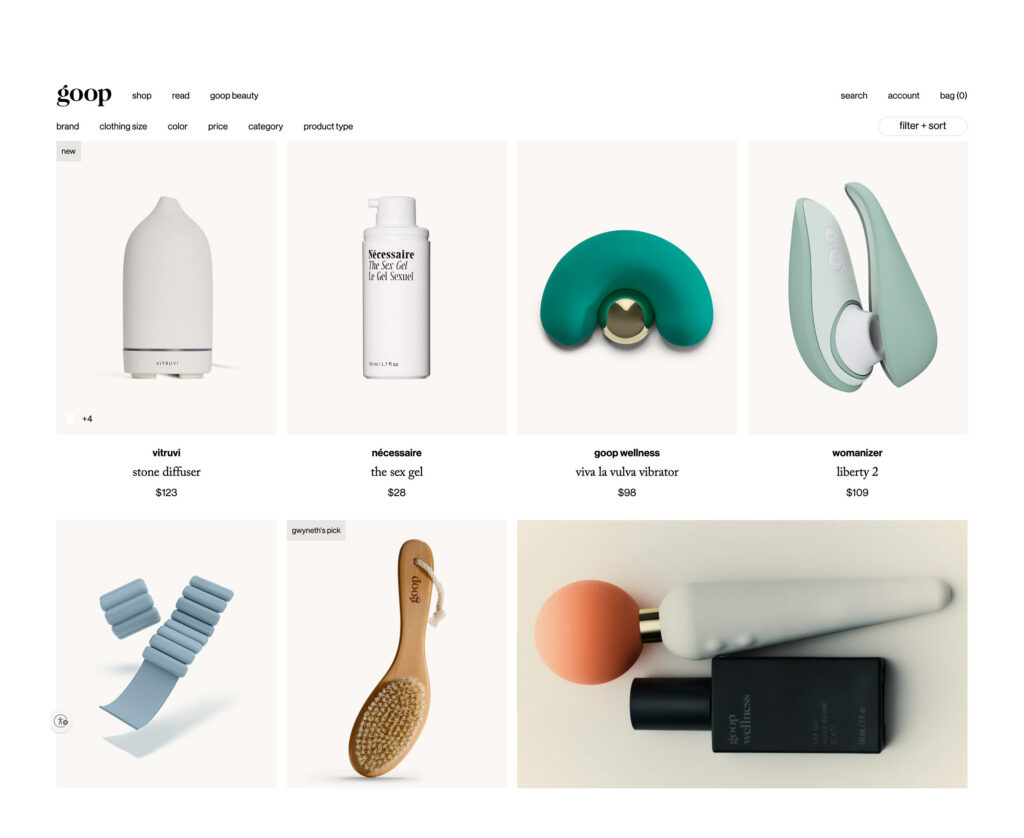
WHAT WAS NEW IN SEPTEMBER 2025 ON GOOP’S WEBSITE, © 2008-2026 GOOP, INC.
This rhetoric of personal responsibility grants businesses like goop free rein to shape health markets, generating enormous profits from the moral equation of physical attractiveness with righteousness. And wellness gadgets and diagnostic tools—from menopause magnets to at-home genetic tests—can dodge regulations when they market themselves as non-medical or low-risk and do not claim laboratory-level accuracy. Loopholes in the federal oversight of herbal supplements also enable companies like goop to evade the scrutiny applied to drugs and medical devices. In an era defined by deregulation and mistrust, the wellness industry relies instead on personal testimonials, anecdotal evidence, intuition, and celebrity endorsements to supply affective credibility, often displacing professional expertise or clinical evidence.
Paltrow personalizes and legitimizes this process through content centered on her own experiences. In goop’s “Food Stamp Challenge,” Paltrow attempted to subsist on $29 of groceries per week. The brief exercise converted food scarcity into a stage for moral uprightness, sympathy, and upgraded recipes for boxed staples—and translated political struggles into aesthetics. Paltrow ultimately gave herself a C, a grade that revealed less about poverty in the United States than the fact that aspirational wellness is not cheap.
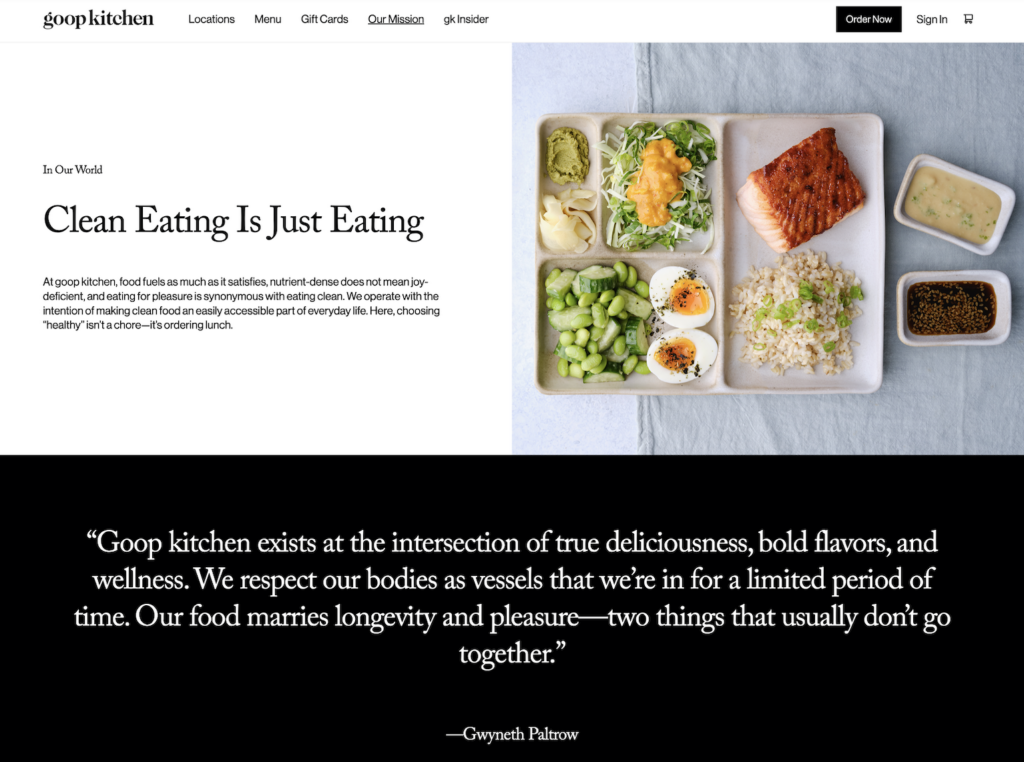
By cosplaying the burden placed on women to manage limited resources while sustaining family health, Paltrow sidestepped the more urgent question of why food insecurity persists in the United States in the first place. As grocery prices climb, the response from Washington follows the same logic. US Secretary of Agriculture Brooke Rollins recently urged Americans to eat healthier on $3 per meal, with a meal consisting of “a piece of chicken, a piece of broccoli, a corn tortilla, and one additional item” from the White House’s updated food pyramid—recasting systemic deprivation as a matter of discipline and choice.2
To be fair, goop’s techno-gadgetry and lifestyle spirituality attempt to address genuine and well-documented gaps in conventional medicine—failures that have disproportionally harmed Black, Indigenous, and other women of color. Yet the brand’s marketing works by exploiting the vastly unequal health and education systems, fears surrounding sexual health and fertility, and misogynistic beliefs that women’s bodies are unclean and must be socially surveilled. Leveraging ambivalence toward scientific authority, goop claims to be “providing information without judgment” and “just asking questions” (a practice so common in the influencer-scape that is has earned the rude sobriquet of “JAQing off”). The company ventriloquizes patient-centered health care’s language of consumer choice, presenting a supposedly innocent à-la-carte menu that lets users select what’s right for them within a free-market paradigm.
Consumer sovereignty is reinforced through goop product labels that signal agency and discernment: “for your enjoyment” (no solid science backing), or “ancient modality” (an old concept not yet proven), or “rigorously tested” (PhDs and doctors agree). When criticized for promoting pseudoscience—from vaginal steaming to bee sting therapy—Paltrow reframes the critique as an affront to female empowerment and body positivity, casting aspiration and self-care as feminist virtues, and converting public disdain into a self-appreciation exercise.
Goop’s blended business and media platform complements an ascendant “manosphere” of podcasts and dubious product trials that equate pain with bravery and “body hacking” with being superhuman. Current trends in men’s wellness culture include “hardness culture” and “jelqing” (penis stretching). The one-stop-shop digital dispensary HIMS hawks erectile dysfunction drugs, hair-loss remedies, and other direct-to-consumer personal care products. And the multi-platform podcaster, Spotify content partner, and JAQ-off enthusiast Joe Rogan endorses “alpha brain” pills, protein “maxxing,” and hormone-optimizing cold plunges, marshaling a never-ending and wallet-draining quest for masculinity and peak performance.

Meanwhile, under a recently reined-in focus on beauty, nutrition, and fashion—accompanied by mass layoffs and severed budget retail partnerships—goop has quietly retired its overt sexual wellness branding. Customers once courted with “This Smells Like My Vagina” candles and gold-plated vibrators were deemed insufficiently loyal;3 a $145,000 settlement over unsubstantiated health claims hastened the pivot.
As the company’s brand refresh flushes away the residue of New Age sex-goddess-hood, goop peddles limitless detox opportunities for the entire pre-pregnant to pregnant body spectrum, tapping into resurgent white pronatalism—a target market that spans Silicon Valley’s transhumanists to the Heritage Foundation’s tradwives. Even as the goop blog advocates progressive policies like paid maternity leave and calls attention to oft-ignored conditions such as antepartum and postpartum depression, its brand content converges with the fertility anxiety and womb surveillance of the “Make America Healthy Again” agenda (MAHA) led by the influencer-socialite and US Health and Human Services Secretary Robert F. Kennedy Jr.

Once peripheral, the Big Wellness industry now overlaps with the vaccine denial lobby that currently occupies federal health offices—promising efficiency, access, vitality, and quality of life, while leaving intact the structural deficits of inadequate health insurance, food insecurity, and other inequities. Its deregulation mantra operates as paranoia and promise, invoking institutional mistrust in order to refute evidence, logic, and accountability. Health is reframed not as a public good but a provocation: a theater of incendiary claims that erode social protections while disclaiming responsibility.
When President Trump falsely attributed autism to Tylenol, anti-vax influencers-turned-advisors were furious that vaccines were not targeted as the culprit. This is entrepreneurial contrarianism as governance: regulatory debate reduced to JAQing off, long-standing research consensus rejected as dogma, and critical thinking displaced by performative skepticism. What should be a public process of civic engagement and collective care becomes another platform to be monetized.
As Paltrow and RFK Jr. promote goat milk cleanses and raw milk shooters, rejecting over a century of accrued scientific knowledge about pasteurization, the MAHA Commission advances food industry deregulation and dismantles federal barriers to unpasteurized milk sales. Under the leadership of RFK Jr., MAHA touted “gold-standard science” in a 2025 report.4 That report was found to contain AI-generated citations of non-existent studies.5 “Make our children healthy again” strategies include relaxing infant formula regulations (“Operation Stork Speed”), directing federal nutrition programs to focus on national breastfeeding rates, and treating the resurgence of measles and other preventable diseases as matters of personal freedom. Television host and Centers for Medicare and Medicaid Services official Dr. Oz heralds robot-performed ultrasounds on pregnant moms as the solution to rural America’s lack of OB-GYNs. RFK Jr. maintains that wi-fi causes cancer and “leaky brains.”
Paltrow’s own words illustrate the incoherent ambivalence of influencer governance best, “What is actually meant to be incendiary and what is actually meant to be policy?”6 ✳
- Dana Logan, “The Lean Closet: Asceticism in Postindustrial Consumer Culture,” Journal of the American Academy of Religion 85, no. 3 (2017): 600–628, https://doi.org/10.1093/jaarel/lfw091. ↩︎
- James E. Causey, “I Doubt Trump’s Ag Secretary Would Eat Her Own Meal Plan,” USA Today, January 25, 2026. ↩︎
- Michelle Ruiz, “Gwyneth Paltrow on Motherhood, MAHA, Meghan Markle, Making Out with Timothée Chalamet—and Much More,” Vanity Fair, March 18, 2025, https://www.vanityfair.com/hollywood/story/gwyneth-paltrow-2025-interview. ↩︎
- MAHA Commission, The MAHA Report, May 2025, https://www.whitehouse.gov/wp-content/uploads/2025/05/MAHA-Report-The-White-House.pdf. ↩︎
- Caitlin Gilbert, Emily Wright, Fenit Nirappil, and Lauren Webber, “The MAHA Report’s AI Fingerprints, Annotated,” Washington Post, May 30, 2025, https://www.washingtonpost.com/health/2025/05/30/maha-report-ai-white-house/. ↩︎
- Ruiz, “Gwyneth Paltrow.” ↩︎