Bounding Box Architecture
Seeing the relationships that leak from the frame
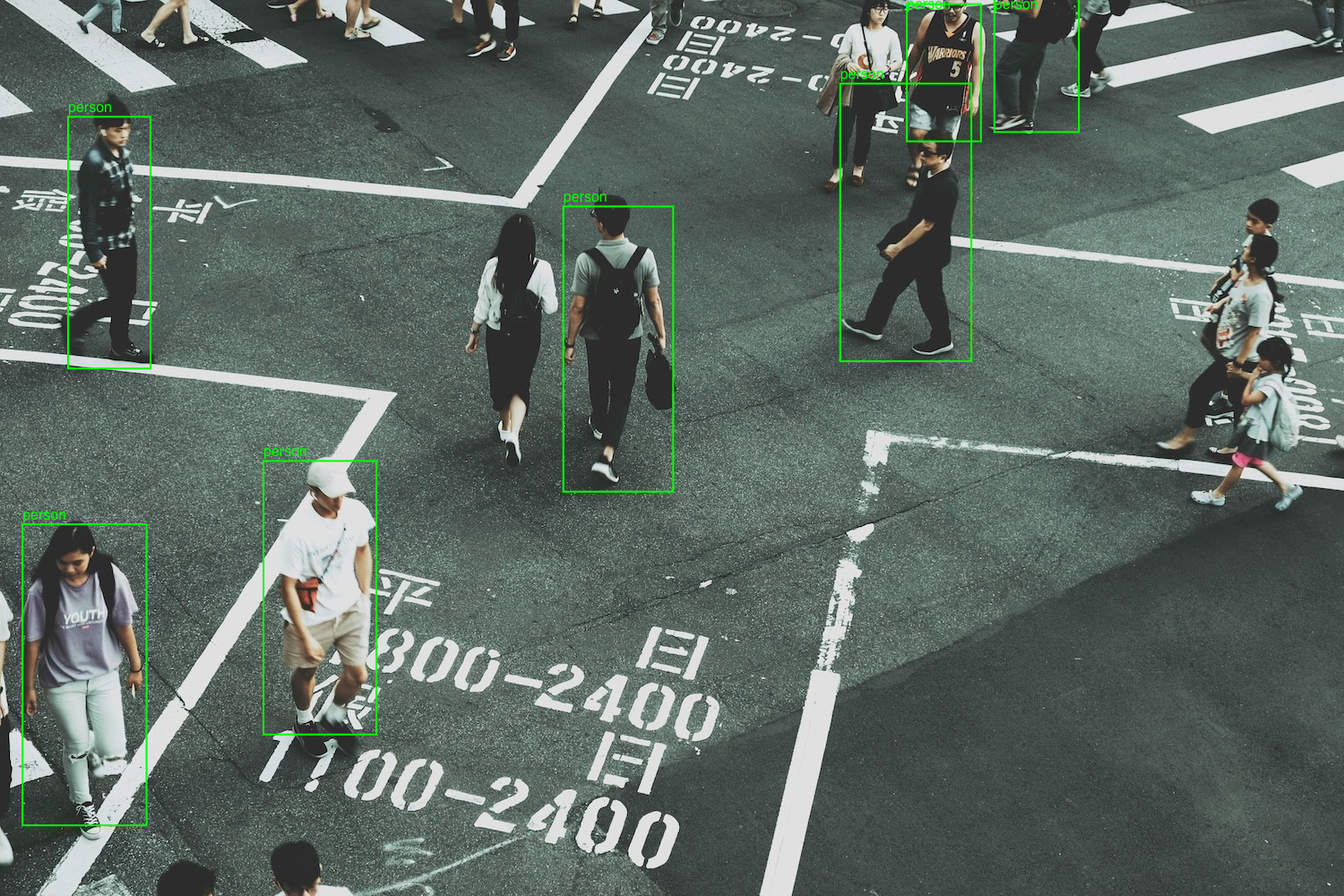
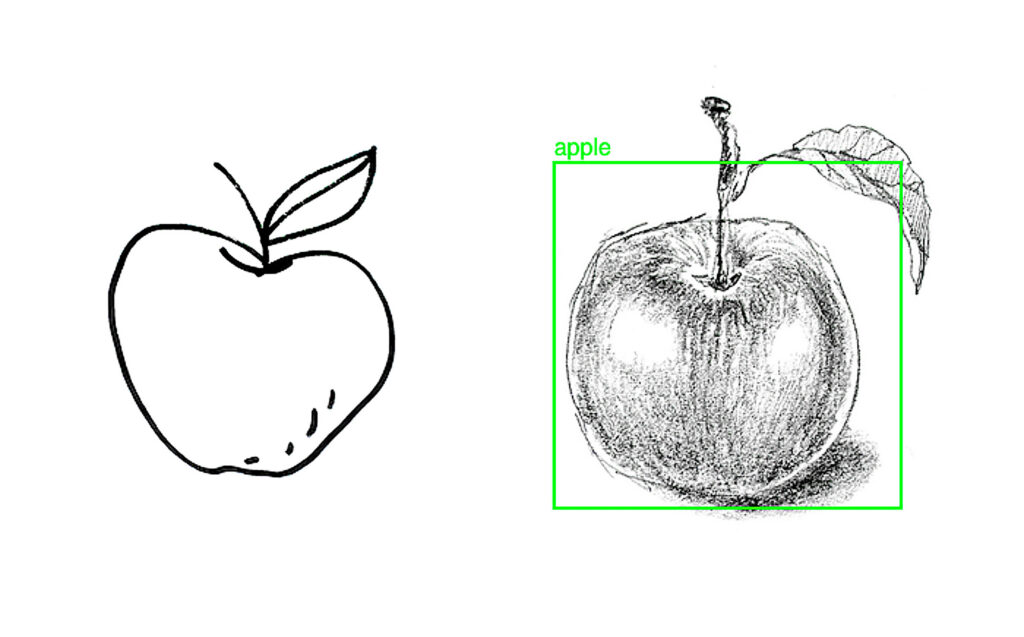
Along the path to developing computer vision, the built environment is surveilled, framed, and tagged through bounding boxes. The bounding box is an annotative device used in AI training—a rectangular frame temporarily drawn over an image in order to isolate an object or “region of interest.” By labeling each box with a classification—car, tree, desk, bed, laptop, person—bounding boxes form a basic vocabulary for identifying things in images. In the race to train deep learning models to identify and discern ever larger aggregates of objects in the real world, rectangular frames now relentlessly pepper surveillance footage of rush-hour traffic, factory assembly lines, crowds of pedestrians, and domestic settings, breaking visual information down into localized, machine-readable parts. As computer vision develops, these frames wrap ever tighter around the edges of their subjects in the form of polygons and automatic segmentation masks.1
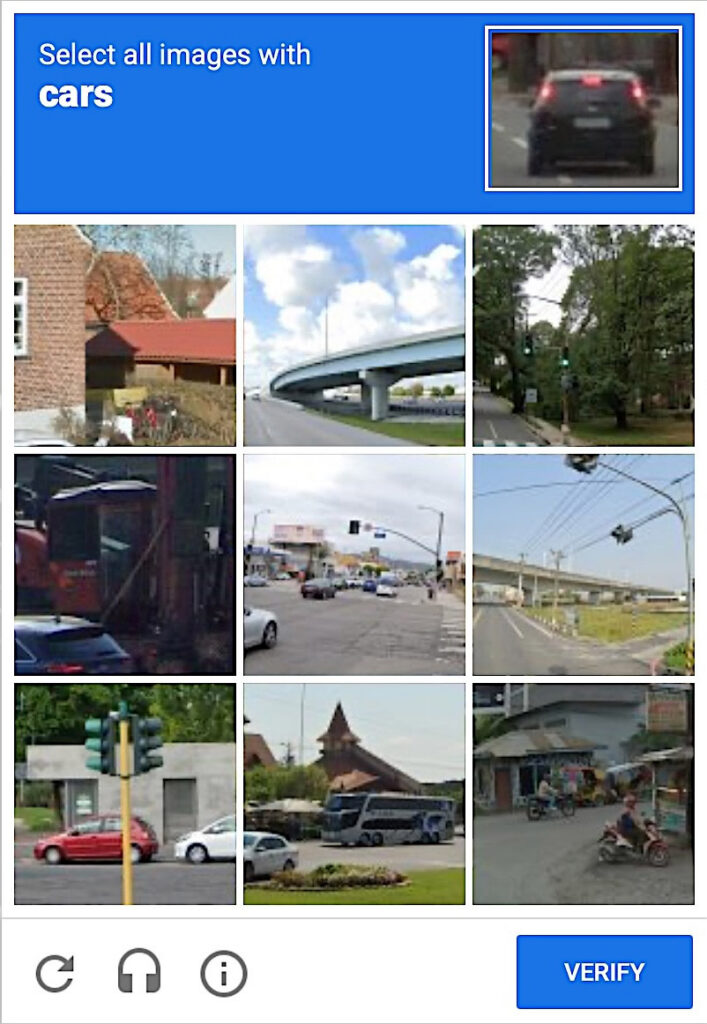
This kind of image classification is not new. Over the last decade, most internet users have unwittingly trained Google’s AI models through the dreaded pop-up dialog known as reCAPTCHA (Revised Completely Automated Public Turing test to tell Computers and Humans Apart). Presenting a grid of banal street scenes that demand to be identified—select all images with traffic lights!—the wearisome web security test doubles as a free training platform for machine learning and AI benchmarking.2
Often invisible to the end user (or hidden in plain sight), bounding box architecture structures a kind of “platform seeing,” in which images in massive datasets are “not simply quantified, but labelled, formatted and made ‘platform-ready.’”3 To see by platform is to apply its classifying logics to everything, everywhere—and to guess based on probabilities and built-in assumptions. The innocuous bounding box is, in fact, a black box of training decisions that proliferates profiling and surveillance systems, and attempts to best-fit the world through algorithmic verification. But even as AI models are invoked as totalizing systems of classification, “no universal standard is possible.”4 In its attempts to distinguish signal from noise and order from disorder, these definitive borders enforce a poverty of relations between ultimately “leaky subjects.”5
Boxes are not even limited to detecting visible objects. They can form zones of prediction based on past records, such as reported crime data, which can then grossly exaggerate crime alerts while appearing authoritative. Take the now-defunct PredPol, a notoriously racist predictive policing platform that covered neighborhood maps with 500-foot by 500-foot boxes, drawing “temporary crime zones” around areas where crime was expected to occur. When “merely passing through one of the red boxes” can “constitute probable cause,” it matters who and what the box enframes.6
The bounding box is also a sign that a vast amount of work has taken place. The chore of data annotation—repetitively outlining, tagging, and describing objects in millions of training images—has a human cost that remains largely invisible.
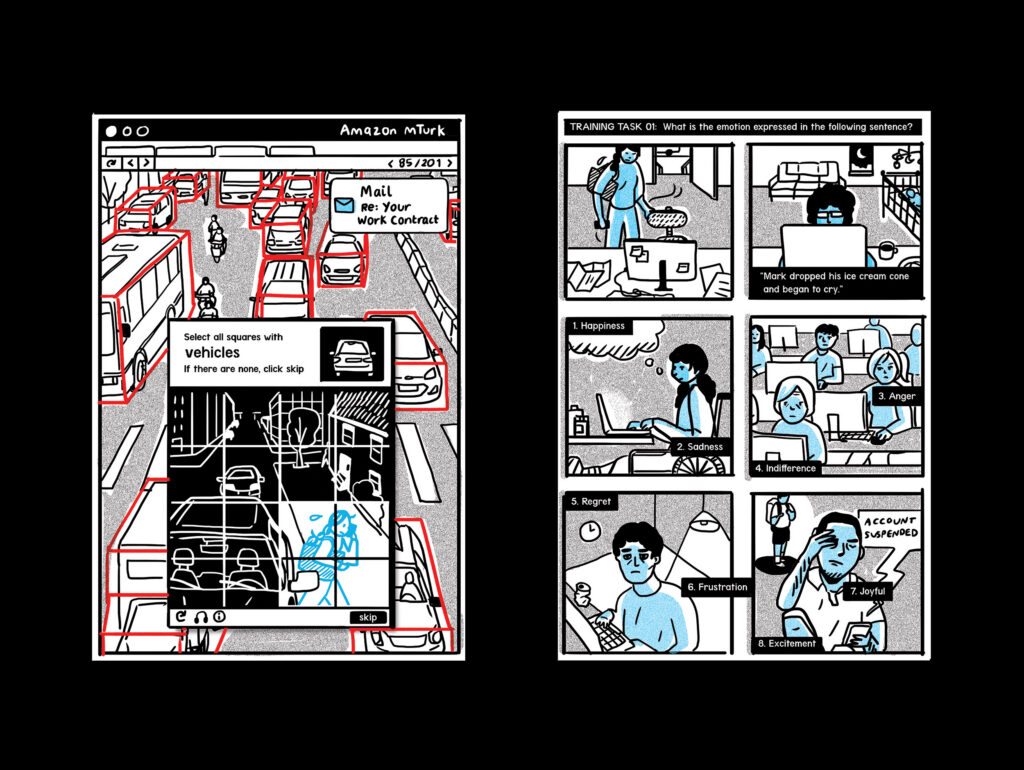
Consider the (problematically named) Amazon Mechanical Turk platform, a digital sweatshop for AI data classification and content moderation. It crowdsources gig workers around the world to perform menial and extremely underpaid annotation tasks without access to employer protections or a minimum wage. This class of hidden figures—what the Communications Workers of America union (CWA) has called “ghost workers in the AI machine”—is conveniently left out of the frame of computational recognition.7 Worker-led activist groups such as Turkopticon have emerged to fill the gap and to advocate for online data workers who face unfair treatment, rejected tasks, and suspended accounts.
I wish to recast the bounding box as a device that irrevocably binds the graphical with the spatial and the social—that is, as a relational rather than classificatory technique of visualization. In architectural drawing, the edges of plans and sections are cropped by an invisible rectangle, or views are condensed with break-lines so that they fit on a single sheet. Such “shortcuts” imply continuity between drawings without representing every inch of a building.8
Along similar lines, the comic panel might be understood as a bounding box in the realm of sequential narrative. Panels accumulate on a page as a deliberate composition of spaces over time, inviting the eye to read not only what is contained by a single panel, but across a spatial sequence. Graphic artists such as Richard McGuire and Chris Ware use panels within panels to collapse different temporalities of lived experience into depictions of architectural space. Winsor McCay’s comic innovations, dated over a century ago, shatter the bounding box altogether.
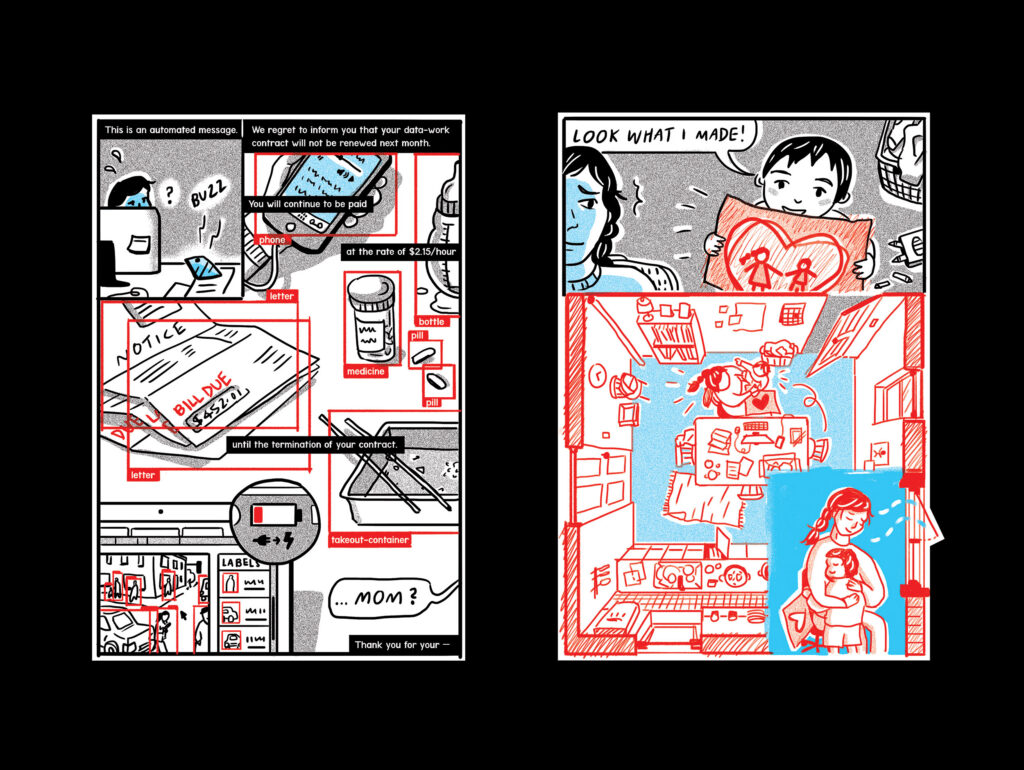
The following graphic essay offers a series of windows into the everyday life of an annotator working from home. Drawn from reports conducted by Turkopticon and CWA’s interviews with US-based data workers, it plays on the relentlessly classifying gaze of the bounding box, as well as the many computer windows that mediate remote work.9 The comic points out a fundamental mismatch between the contents of data work and its precarious social contexts: the unpaid bill, the unrefilled medication, the child in the next room, the exhausted mother, and the atomization of gig work.
The comic format ultimately calls the bounding box into question, and rejects “platform seeing” in favor of a partial, specific perspective into human relationships. In my own tests, cartoons and comics seem to prove particularly difficult for general-purpose AI training platforms to detect.10 May the comic genre sow more seeds of playful, willful platform resistance. ✳
- “Image Annotation Guide: Types, Techniques & Best Practices for Machine Learning,” Sama, https://www.sama.com/blog/image-annotation-guide. ↩︎
- “By Typing Captcha, You Are Actually Helping AI’s Training,” Associated Press, November 27, 2020, https://www.accesswire.com/618585/By-Typing-Captcha-you-are-Actually-Helping-AIs-Training. ↩︎
- Adrian MacKenzie and Anna Munster, “Platform Seeing: Image Ensembles and Their Invisualities,” Theory, Culture, & Society 36, no. 5 (2019), 5–7, https://doi.org/10.1177/0263276419847508. ↩︎
- Geoffrey C. Bowker and Susan Leigh Star, “Classification, Coding, and Coordination,” in Sorting Things Out: Classification and Its Consequences (MIT Press, 1999), 158, https://doi.org/10.7551/mitpress/6352.003.0007. ↩︎
- Elisa Giardina Papa, Leaking Subjects and Bounding Boxes: On Training AI (Sorry Press, 2022), 6. ↩︎
- Jackie Wang, Carceral Capitalism (MIT Press, 2018), 242–243. ↩︎
- “Ghost Workers in the AI Machine,” Communications Workers of America, accessed October 26, 2025, https://cwa-union.org/ghost-workers-ai-machine. ↩︎
- Samuel Stewart-Halevy, “Shortcuts,” e-flux Architecture, January 26, 2018, https://www.e-flux.com/architecture/representation/159205/shortcuts. ↩︎
- The “Training Task 01” cited in the comic is a real training question from the Amazon Mechanical Turk platform. See “We Are the Foundation of AI Models!,” Turkopticon, June 2, 2023, https://blog.turkopticon.net/?p=3048. ↩︎
- See Amelyn Ng, “Bounding Box Architecture.” ↩︎