
Climate Change Chatter Inside the Box
UN Live’s promise of social repair through teleconferencing
In summer 2022, I published an article about Shared_Studios, an organization that created “portals”—retrofitted shipping containers equipped with Zoom—to host curated conversations and music jams that would “connect people across the world.” I concluded by admitting that I was curious how these steel boxes for transnational teleconferences would hold up, now that we have grown accustomed to—perhaps even tired of—virtual boxes as our default mode of communication.1
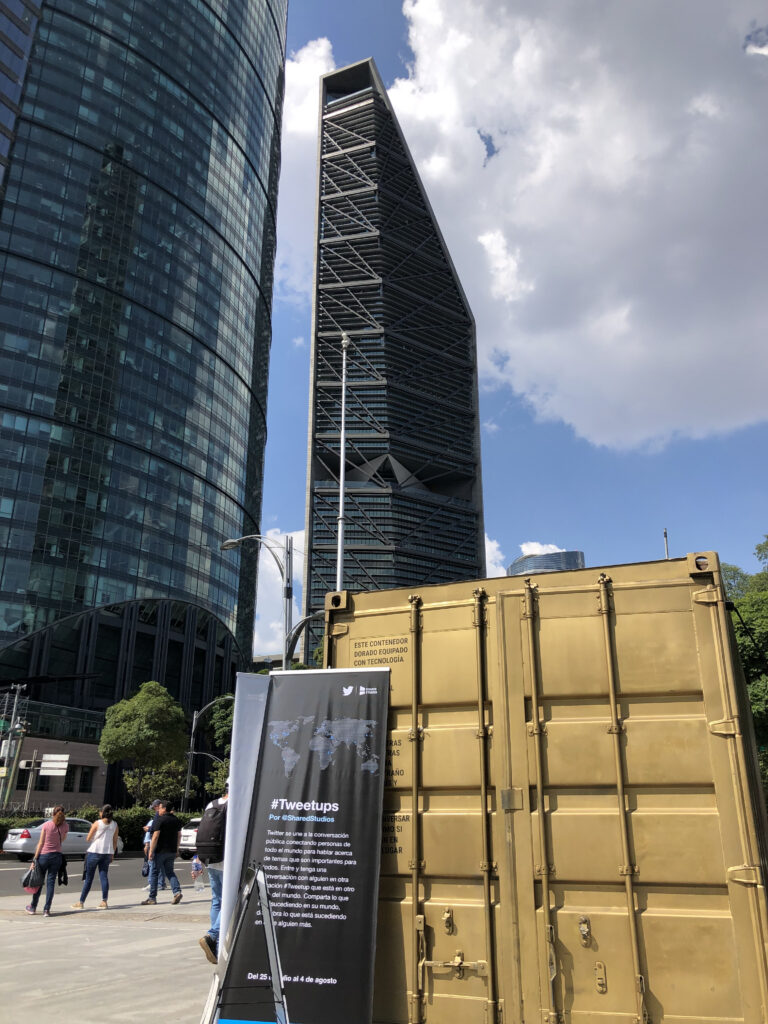
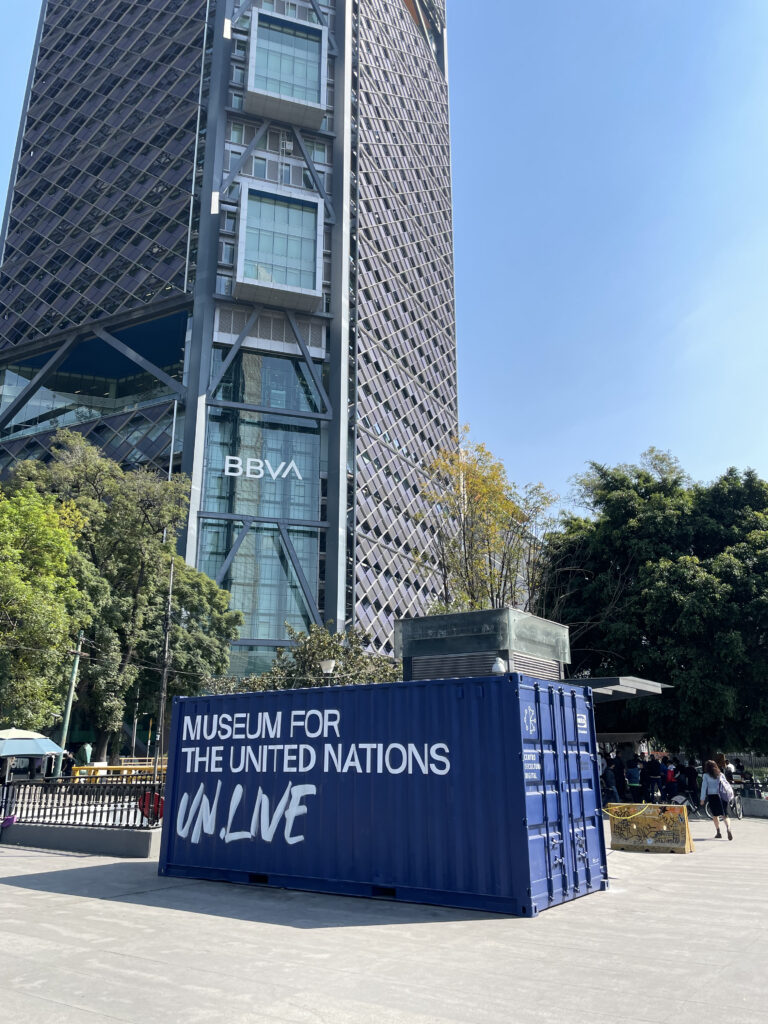
Later that year, I had the chance to address that curiosity during my first visit to Mexico City after the COVID-19 lockdowns were lifted. I had previously visited the installation known as “Mexico City_Portal” when it was run exclusively by Shared_Studios, but this time I noticed that it had been painted a new shade of blue, with “Museum for the United Nations,” “UN Live,” and the IKEA Foundation logo stenciled in white.
After walking by the portal every day for a week, I saw the door slightly ajar on a Thursday afternoon. I met the curator in charge—let’s call her Lluvia—who had been working with the portal since 2018. She said they had shut down for the first year and a half of the pandemic, and that, after this rebrand, they were part of a network operated by UN Live (an independent institution based in Denmark that is not affiliated with the United Nations). Though the portal still hosted conversations and music sessions, their focus had shifted to climate change.2
She invited me to join a conversation happening inside the portal at that very moment. The person sitting inside—let’s call her Veronica—was a climate activist in Mexico City and one of the new curators hired for the rebranded project. On the screen was a curator in Denmark and another person. Veronica explained that they were in the middle of considering two questions: Who is missing from the discussions around climate change? Who needs to be invited into the conversation?
“Migrants,” I said, “especially those who have been displaced by capitalism’s deleterious effects on their homelands.” Everyone nodded. There was no follow-up, just a general consensus about the need to include “diverse voices.” The conversation struck me as very casual. No one seemed to be taking notes or keeping any record of what was being discussed. My preliminary conclusion was that having the conversation seemed to be the goal in itself.
I excused myself and, on my way out, asked Lluvia when the portal would be open again. She told me that they had three sessions scheduled the next day: Palestine at 9:00 a.m., South Africa at 10:00 a.m. and the Netherlands at 11:00 a.m.. I told her that I would be back the next morning.
✳ ✳ ✳
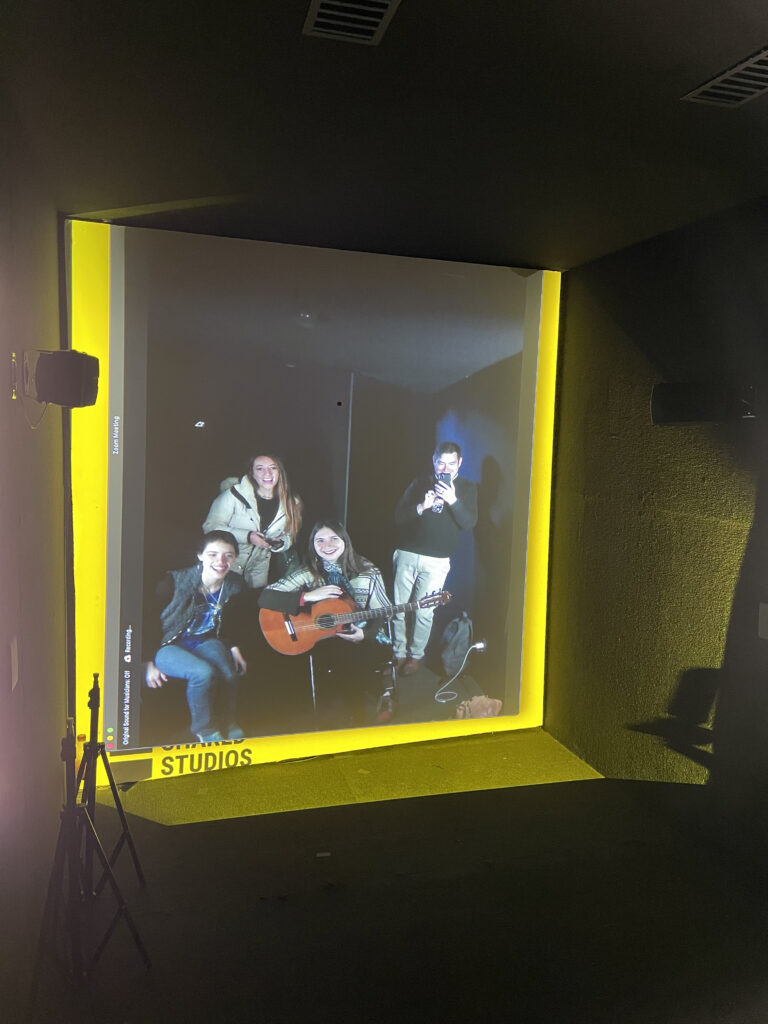
I arrived shortly after 9:00 a.m. on Friday. Inside the portal I found Lluvia and two other women waiting for the other side to connect. I asked if we were waiting for the Palestine portal and, to my chagrin, Lluvia said, “No, they can’t make it. We’re connecting with Iraq.” I noticed that, apart from the portrait mode screen, the interface was almost identical to the Zoom interface on my computer. “Ugh, they are not using the link,” Lluvia said, but she answered the call nonetheless.
On the screen was a young woman whom I’ll call Nadia. Maybe twenty years old, she was the curator for the Iraq portal. Five young men, also in their twenties, came in and said hello. After some small talk it became evident that none of the men spoke English, so Nadia had to translate—or summarize—everything they said into English, and everything we said into Arabic.
Lluvia suggested we start the music jam. It was clear this would not be a talking session. One of the women in the Mexico City portal, Dulce, a professional musician, played a famous Mexican folk song on her guitar. When she was done, everyone clapped. Dulce began playing a second song when, suddenly, the Iraq feed cut out. Lluvia struggled to get them back online for a minute, then gave up. “Their internet must be down,” she said matter-of-factly.
While waiting for the Iraq portal to come back online, I asked Lluvia questions about the project and how the UN Live rebrand was going. When I brought up the issue of language, she told me that most sessions rely on participants speaking some English or curators translating haphazardly, as Nadia had done. Curators had been asked to keep the sessions “light,” focusing primarily on music until more specific programming was put in place. I asked Lluvia what she thought of this rebrand and she admitted that she preferred the older model. The UN Live leaders had asked that all conversations be solely focused on climate change—to the extent that, if participants go off on a tangent, curators must redirect the conversation to the topic at hand.
I wondered how the network leaders would even know if conversations went off track. Lluvia explained that each session has a dedicated Zoom meeting link, which both sides use to log on instead of calling each other directly through their personal meeting rooms. The dedicated meeting link is set up to record automatically—without the usual Zoom alert—and to upload the final recording to UN Live’s cloud storage.
Suddenly, Nadia and the young men reappeared, and Dulce began another song on the guitar.
✳ ✳ ✳
“Communication sometimes masquerades as the great solution to human ills,” wrote John Durham Peters in 1999, yet we often mistake communication for a “semantic or psychological” problem rather than a “more basically political and ethical” one.3 In the conversations facilitated by UN Live, there is no semantic problem to address: plenty has been said about the stakes of climate change. Channeling a call for action into a strictly structured, platform-mediated conversation struck me as a turn toward inaction.
The platform itself plays a role in this. After the isolation of the pandemic lockdowns, video teleconferencing platforms were “no longer simply concerned with bringing the distant near,” according to Gary Kafer. Rather, they have “entered into our historical present armed with a promise of social repair.”4 That promise is ever-present in UN Live’s foundational claim that what is most missing from climate change action is talk. The implication seems to be that, now that the video teleconferencing platform is there to facilitate that talk, something might happen.
UN Live’s first major event, just a month before my visit to the rebranded portal, was COP27, the United Nations Climate Change Conference. They had set up a Shared_Studios portal outside the event’s main venue in Sharm El Sheikh, Egypt. This launched the company’s “Global We” program, which sought to enable “young people and communities most affected by climate change to have two-way conversations with world leaders, who have the power and means to accelerate the decisions we need to protect our planet.”5
This framing assumes that what prevents world leaders from caring is the fact that they have not heard from young people or underrepresented voices. Meanwhile, the call to join the collective “Global We” enacts a flattening of responsibility. Stating that “we” should all care about climate change because it affects “us all” ignores the uneven distribution of harm that already existing climate disasters wreak on disenfranchised communities in the Global South.
After learning that the meetups are recorded, without the participants’ explicit consent, I better understood UN Live’s former CEO, Molly Voss Fannon, when she stated that their goal was “building a collection” of “actions.”6 In its recorded form, the once live conversation event becomes an object stored for future use.
In its first year, UN Live released promotional videos showing understandably upset people in places like Indonesia, Ethiopia, Brazil, and Barbados voicing their concerns to a screen in a shipping container. By that point, they were not speaking directly to “world leaders” as originally proposed, but to other civilians like themselves.7 Their concerns were collected by UN Live and edited into two-minute videos, centered on keywords like “caring” and “worry.”
The conclusion of these videos seems to be: Join them. Add your own story of frustration.
✳ ✳ ✳
In November 2023, UN Live released a report stating that, based on three thousand of its recorded conversations across twenty-five locations worldwide, processed “through AI tools and deep human listening,” they have concluded that the global climate crisis should be “guided by empathy, social justice, and human well-being.”8 This suggests that the recordings are intended not only to “build a collection” for the figurative museum but also to mine data about what transpires in these conversations for the organization’s own market research.
UN Live’s promise of social repair through teleconferencing depends on a platform in the most basic economic sense: the initiative acts as an intermediary that brings together concerned parties (such as climate activists in two different cities), extracts their emotional and intellectual labor through conversation, and turns it into value.
So here was the ultimate purpose of all that talk: to channel everyday feelings of care, concern, and worry about climate change into hours of recordings—and then to submit them to an AI platform which consumes enormous amounts of energy and water—only to reach the conclusion that hundreds of people around the world believe that someone, somewhere, should do something. ✳
- Juan Llamas-Rodriguez, “Portals, Platforms, and Other Standards of Global Communication,” Media Fields Journal, no. 17 (2022), https://mediafieldsjournal.org/portals-platforms-and-other/. ↩︎
- Shared_Studios portals have been rebranded before. For instance, the Portals Policing Project at Yale Law School used them from 2016 to 2018 to connect highly policed communities. ↩︎
- John Durham Peters, Speaking into the Air: A History of the Idea of Communication (University of Chicago Press, 1999). ↩︎
- Gary Kafer, “Zoom in the Past Conditional,” Jump Cut: A Review of Contemporary Media, no. 60 (2021), https://www.ejumpcut.org/archive/jc60.2021/Kafer-Zoom/text.html. ↩︎
- Museum for the United Nations—UN Live, “Join the Global We,” accessed November 7, 2023, https://www.museumfortheunitednations.com/. ↩︎
- Lameez Omarjee, “This ‘museum’ is connecting people across borders to tackle the climate crisis,” News 24, November 20, 2022, https://www.news24.com/business/climate-future/solutions/cop27-this-museum-is-connecting-people-across-borders-to-tackle-the-climate-crisis-20221120. ↩︎
- Museum for the United Nations—UN Live, “CelebratingInternationalDayofDemocracy today,” X, September 15, 2023; Museum for the United Nations—UN Live, “Imagine a life where we could feel at ease when contemplating the planet’s health and our future on it,” X, June 15, 2023. ↩︎
- Museum for the United Nations—UN Live, “Press Release: Global We Conversations: Empathy, Connectedness, and Cultural Influence Can Drive Urgent Climate Action,” November 29, 2023, https://www.museumfortheunitednations.com/. ↩︎