The First City on Mars
The desert as an otherworldly substitute
The United Arab Emirates’ plan to establish a city on Mars by the year 2117 was to begin with Mars Science City, a simulation of the Martian atmosphere enclosed in a geodesic dome in the Dubai desert. The proposed simulation was launched with yet another simulation:
On behalf of the United Government of Mars, I would like to welcome you to your second home. … It’s our pleasure to be your host of the seventieth anniversary of humanity’s first colony on Mars.
This announcement comes from Saeed, an avatar modeled after an official at the UAE’s Mohammed Bin Rashid Space Centre. Saeed then inducts the viewer into a virtual reality rendering of the Martian built environment, and draws our attention to the continuities between Dubai and Mars:
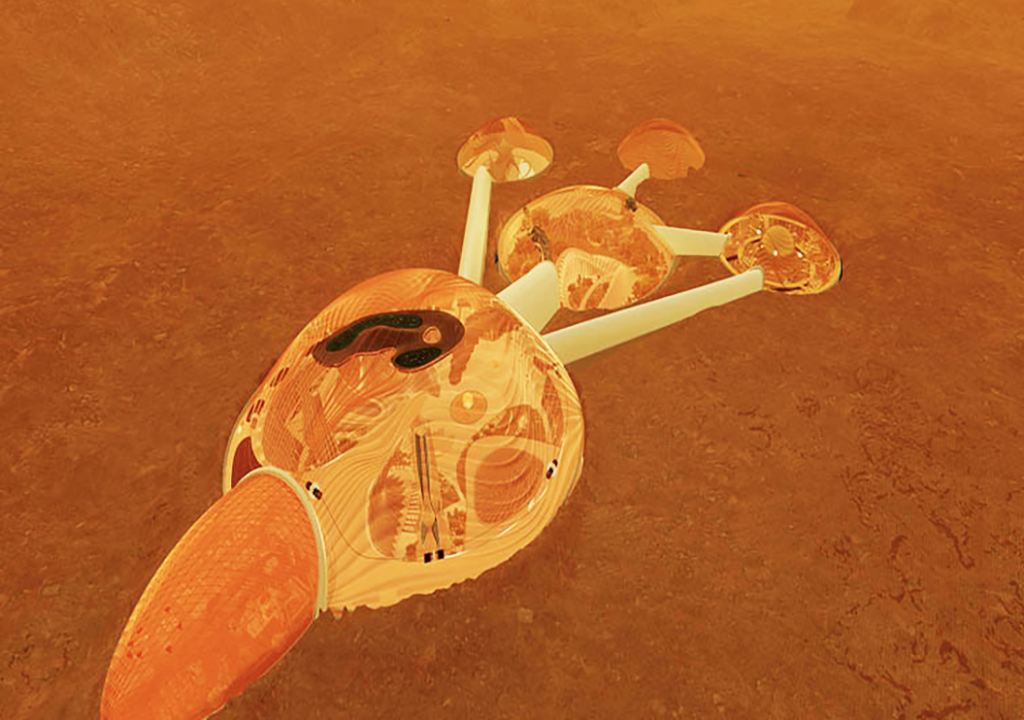
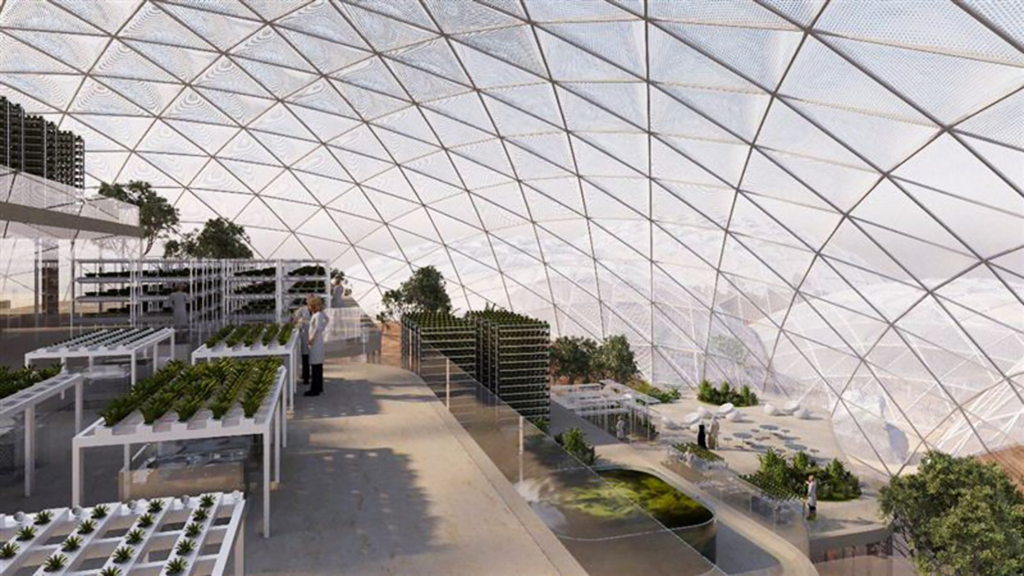
This is the first city on Mars: the City of Wisdom. Its historic outpost represents the growth of the first city and how the first settlers on Mars had to innovate and utilize what they had [of] resources to make Mars a permanent home for humanity, much like the desert Bedouins did back on Earth. In the first settlement, there are units dedicated to geology and water exploration, gravity and atmosphere, soil composition and mining, radiation, and energy harvesting.
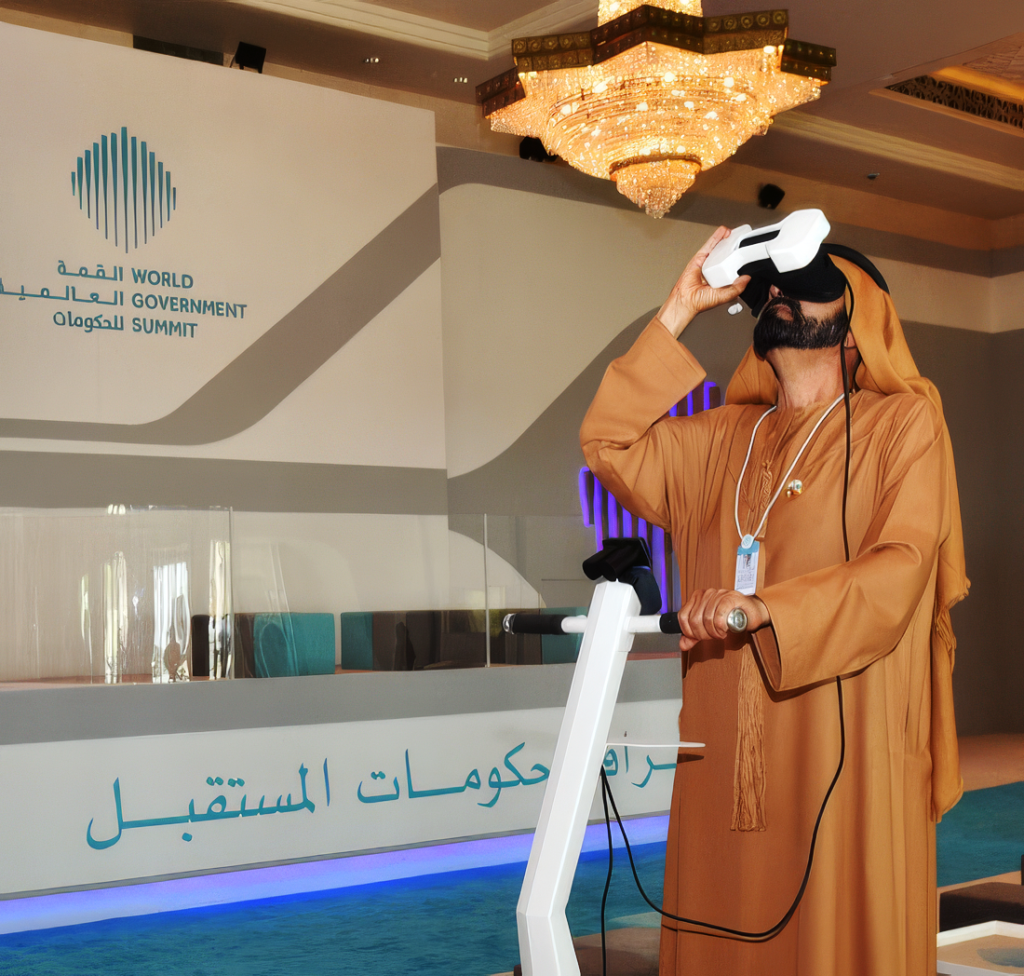
The Mars 2117 virtual reality experience debuted in 2017 at the World Governments Summit, an annual event held in Dubai to shape the future of global governance. The summit draws thousands of participants, including heads of state, and functions as a key diplomatic and agenda-setting platform for the UAE.
For Emirati officials, the Mars 2117 project and the space program more broadly aim to inspire future generations of Arab youth, carry the mantle of Arab knowledge production, cultivate a post-oil identity, and position the UAE as an innovation hub.
Throughout the UAE’s space and environmental projects, from Mars 2117 to the sustainability-branded Expo 2020 to its cloud seeding, geoengineering, and land reclamation, there is a recurring logic: to register an environmental limit and, rather than alter the march toward it, extend that limit outward. Consider water: as the freshwater table dwindles, officials seed clouds and desalinate the gulf. In 2015, they commissioned a half-million-dollar climate model in order to design an artificial mountain that would redirect rain.
Ubiquitous water spectacles and high water usage continue unabated in the meantime. Scarcity can be made and then evaporated. The shore can always be extended. An offshoring logic imagines another shore, an iteration of something that already exists, an elsewhere constituted by reference to a here.
Here, in the UAE, where I lived from 2016 to 2017, we are in an arid landscape surrounded by a shallow, salty gulf. Artificial canals cut through the sand and reclaimed islands stud the coastal waters, some in the shape of other landmasses. Rain is scarce, though the air is humid.
Historically, the UAE’s Arab tribes were desert dwellers and seafarers. But while Bedouins lived carefully within the desert’s limited resources, the contemporary state treats those limits as opportunities for innovation. The petrochemical powerhouse has among the highest carbon footprints and per-capita water use in the world. Innovation is the idiom that solves this problem and enables growth to extend. Now, when it rains, Emiratis often wonder whether the rainfall is natural or the result of cloud seeding. This question registers the limit even as it marvels at the capacity to exceed it.
Generations of Arab poets have written of the desert’s sublime beauty and brutality. For Imru’ al-Qays and Nabati poets like al-Majidi ibn Dhaher, the desert was a site of intimate observation and moral formation, a school of character, an ecology one had to learn in order to live. Their verses marked specific locations still used by ecologists today.
Many Emirati leaders of the young state have also been poets in this tradition, but their poetry increasingly figures the desert as a landscape for grand state-building visions. Likewise, Emiratis and other Arabs in the arid region celebrate their environment by camping in the desert, often along the edges of highways. Still, they no longer inhabit the desert in the same way.
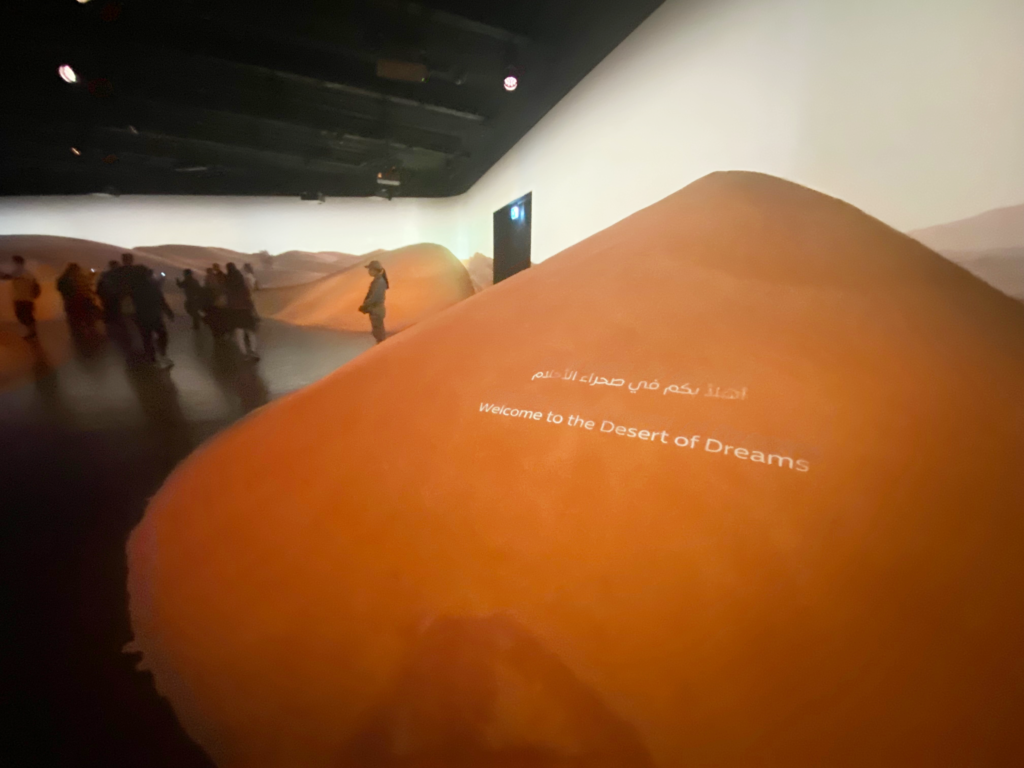
The dangerous intimacy of living in the desert has been displaced by a kind of distant wonder at a zone of inhabitability. Increasingly, the desert is encountered as an engineering problem or a conservation effort. In environmental media and in casual conversation alike, I observed Emiratis describing the desert in an otherworldly register, as though it were already another planet.
Planetary science has long treated deserts as analogous environments to that of Mars. These analogies have forged a conceptual link between terrestrial deserts and the Martian surface that builds on Enlightenment aesthetics framing deserts as hostile, barren wildernesses. The continuity between the Emirati desert and the Red Planet creates a convergence between environmental and space exploration projects in the UAE.
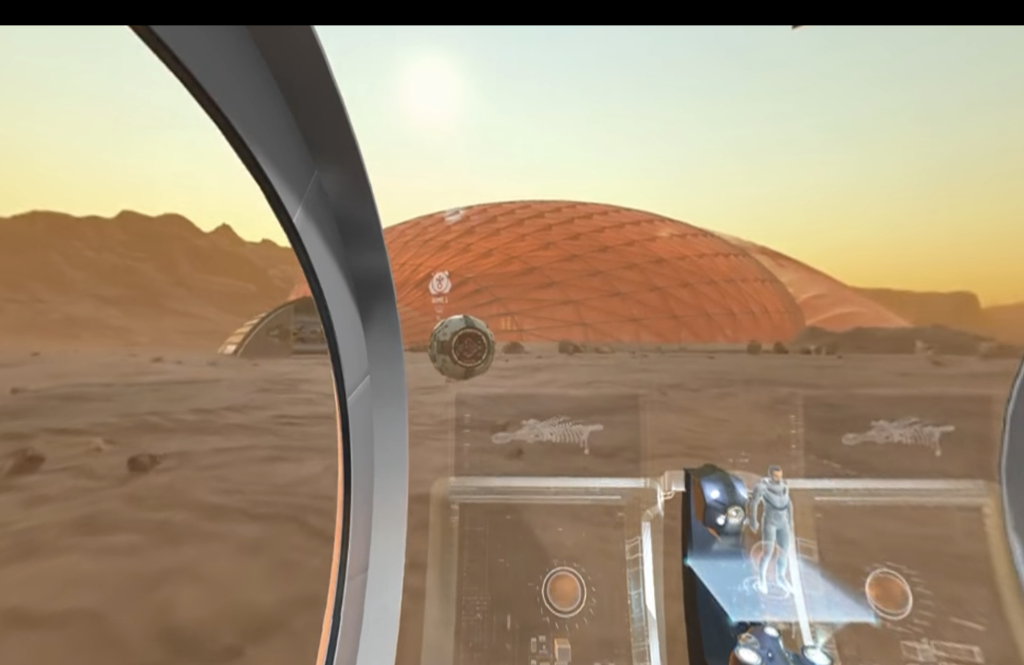
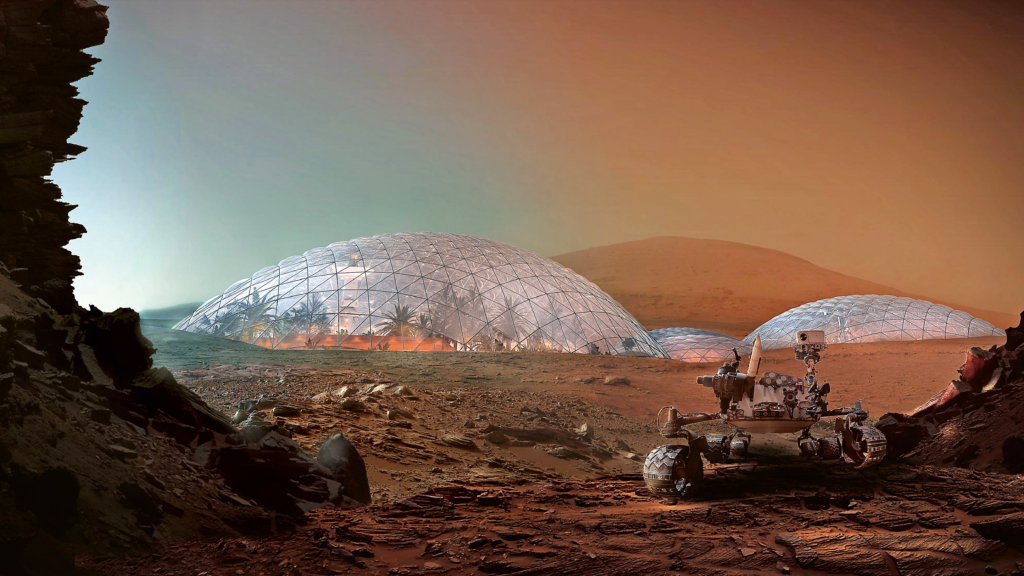
Mars Science City occupies this convergence, though the project has yet to break ground and remains in the design phase, living only through renderings and simulations.1 It is planned as a living laboratory enclosed in a geodesic dome—a simulation of the Martian atmosphere and terrain, optimized not to attenuate the harshness of the Emirati desert but to intensify it. Mars Science City simulates Mars, but it does so partly by mimicking the desert which surrounds it. In a rendering produced by the Danish architectural firm Bjarke Ingels Group, the project appears as if it were set in a Martian environment, not in Dubai at all, as a rover in the foreground peers toward the illuminated dome in the distance. These renderings of Mars Science City in Dubai and the renderings of the City of Wisdom on Mars look identical, inside and out.
“But offshoring is asymmetrical: it leaves some behind, landlocked in a zone of neglect.”
By 2021, when I returned to the UAE, Mars expeditions had become a prominent theme of state branding, traveling well beyond the World Governments Summit where the Mars 2117 VR had debuted. Neon signs along major highways declared that “Space is Our Ambition.” Children’s bookstores were filled with picture books about intrepid Emirati astronauts. Space conquest and environmental sustainability sat side by side as the twin pillars of Expo 2020 (postponed, despite its name, to 2021–2022).
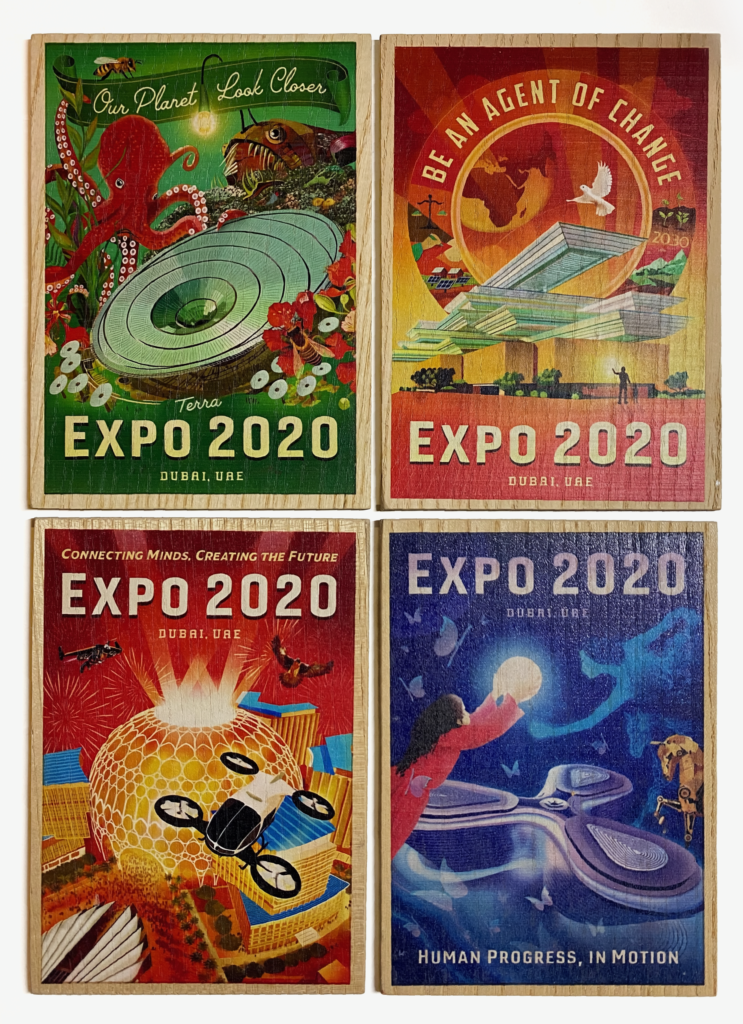
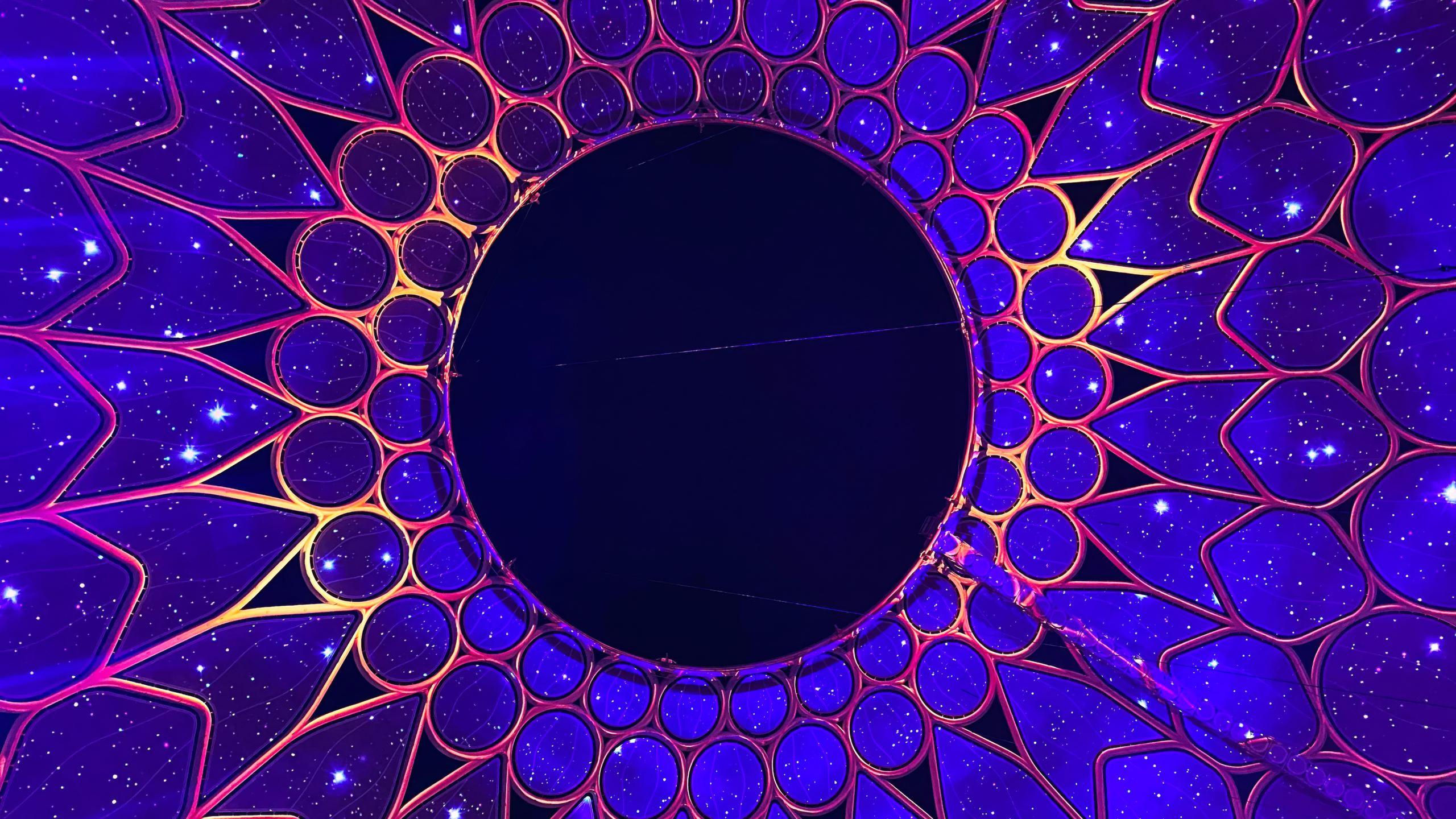
Having pored over the prototypes of Mars Science City and the videos from the Mars 2117 VR, walking through Expo 2020 induced a strong sense of déjà vu. The open-air central dome at Al Wasl Plaza shares the form of these speculative designs, if not their function.
The lineage of the geodesic dome runs from Buckminster Fuller’s Biosphere at the 1967 Montreal Expo all the way through Biosphere 2 (the 1980s “Spaceship Earth” miniature in the Arizona desert that was financed by a petro-billionaire heir). Beneath domes like these—whether at the City of Wisdom, at Mars Science City, or at Al Wasl Plaza—the technical and the symbolic intermingle. The domes contain environments that require complete design and control; they are engineered bubbles of habitability. The architects of Mars Science City have described it as a prototype for “Martian vernacular architecture.”
During one of my visits to the Expo, taking refuge from the harsh midday sun, I stepped into an air-conditioned gift shop. I leafed through a 200-euro volume about one of the Emirati pavilions. The volume was produced by Assouline, the Paris luxury publisher, and Foster + Partners, the London starchitect firm. I read it under the close watch of the guest worker who had been assigned to guard it; in hushed tones, she described the strains of working the massive event as she allowed me to read and take notes. The book described Mars Science City: “The experimental city’s mission is to find out what it takes for people to spend long periods, or even live permanently, on Mars.… Pioneers live in a simulated Martian colony, not only doing their research, but also being research subjects.”
The pioneer image evokes the colonial frontier. Just as the American frontier myth casts the astronaut as cowboy, conqueror of hostile terrain, Mars 2117 recasts the astronaut, but as an inverse Bedouin: not one who adapts to environmental limits, but one who treats environmental resources as fungible and pliable, as material to be experimentally transformed.
What Mars 2117 borrows from the frontier myth is not only territorial expansion but a vision of the desert as alien, awaiting transformation. If the freshwater table dwindles, seed the clouds. If the desert can no longer sustain life, build a habitable enclosure—whether terraformed in the Arabian desert or the red sands of Mars. In Dubai, one may simply build an island. But on Mars, offshoring enables one to find an island beyond earthly limits.
Expo 2020 featured three themed Emirati pavilions: Opportunity, Mobility, and Sustainability. Together, they demonstrate a strategy: extend opportunities for growth infinitely, enable mobility to seize opportunities wherever they may be, and design sustainability to imagine infinitely extensible plastic resources. The 2023 United Nations Climate Change Conference—which was hosted by the UAE, with the head of ADNOC, the national oil company, at the helm—exemplifies this logic. Sustainability and innovation can suture together incommensurate goals, enclosing them in a bubble of techno-optimism.
But offshoring is asymmetrical: it leaves some behind, landlocked in a zone of neglect. I often think of Vincent, a guest worker I met in the UAE when I first moved there. He told me how hard it was to adjust to the desert after growing up in the Philippines. He dreamed of being a sailor but spent his days as a lifeguard at a hotel pool in the desert, watching the water evaporate.
As Saeed continues his tour of the City of Wisdom, he informs visitors that “policies are focused on … the further deep-space population programs and the Earth energy preservation and support protocols designed for supercharging the de-pollution of our earth.” The Martian City of Wisdom circa 2117 thus suffers from the same uneven imagination as the present day, for one can imagine erecting an entire civilization on Mars designed to de-pollute Earth, but one can scarcely imagine not polluting it in the first place. ◆
- Neither the plan to establish a city on Mars nor Mars Science City has been officially canceled, but Mars Science City appears to have stalled. The most recent publicly announced groundbreaking target was 2022, with operations promised by 2024. There has been no construction to date. ↩︎